
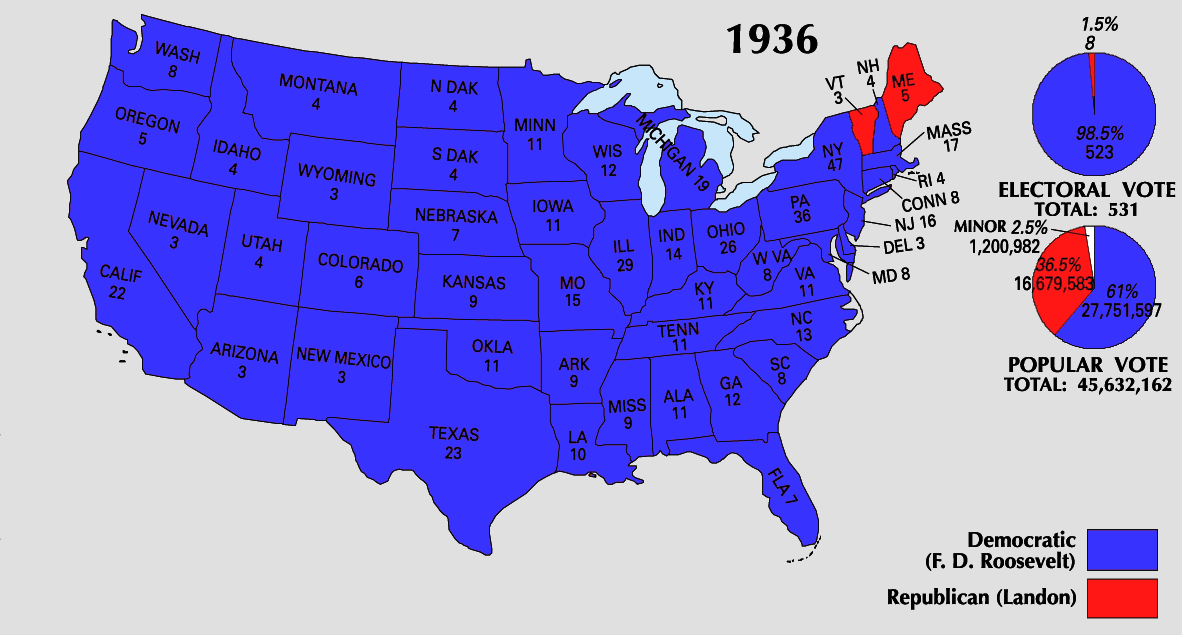
The map above shows the result of the 1936 US presidential election between Franklin D. Roosevelt and Alf Landon. Turnout for the election was 61.00%.
Here are the key details:
| Winner: | Runner-Up: | |
|---|---|---|
| Name: | Franklin D. Roosevelt | Alf Landon |
| Political Party: | Democratic | Republican |
| Home state: | New York | Kansas |
| VP Name: | John Nance Garner | Frank Knox |
| States: Won (Out of 48): | 46 | 2 |
| Electoral College Votes (out of 531): | 523 | 8 |
| Percentage of Popular Vote | 60.80% | 36.50% |
| Total Votes | 27,752,648 | 16,681,862 |
| Margin % | 24.26% | – |
| Margin (votes) | 11,070,786 | – |
| 3rd Place | 4th Place: | |
|---|---|---|
| Name: | William Lemke | Norman Thomas |
| Political Party | Union | Socialist |
| Electoral College Votes | 0 | 0 |
| Number of Votes: | 892,378 | 187,910 |
| Percentage of Popular Vote: | 1.95% | 0.41% |
Key Issues In the 1936 Election
The election centered around President Franklin D. Roosevelt’s New Deal policies, which aimed to alleviate the economic hardships faced by millions of Americans.
The key issues revolved around economic recovery, government intervention in the economy, social welfare programs, and the role of federal authority.
Candidates’ Positions:
- Franklin D. Roosevelt (Democratic Party):
- Advocate for the New Deal: Roosevelt stood firmly behind his New Deal policies, advocating for their continuation and expansion to further aid economic recovery.
- Economic Philosophy: Believed in active government intervention to provide relief, recovery, and reform, addressing both immediate needs and long-term structural issues.
- Social Welfare Commitment: Emphasized the importance of social safety nets to protect the most vulnerable populations.
- Labor Support: Supported labor unions and workers’ rights as essential components of a fair economy.
- Response to Criticism: Argued that government action was necessary to combat the unprecedented economic crisis and that his policies were restoring hope and confidence.
- Alf Landon (Republican Party):
- Critical of New Deal Implementation: While not entirely opposing the New Deal, Landon criticized it as inefficient and overly bureaucratic. He agreed with some goals but disagreed with the methods.
- Fiscal Conservatism: Emphasized the need for balanced budgets and reduced government spending to prevent excessive national debt.
- Limited Government Role: Advocated for less federal intervention in the economy, promoting private enterprise and free-market solutions as the path to recovery.
- States’ Rights Advocate: Supported greater autonomy for states, arguing that local governments were better suited to address certain issues.
- Social Welfare Skepticism: Questioned the feasibility and administration of social welfare programs like Social Security, expressing concerns over their impact on businesses and taxpayers.
Why did Roosevelt win?
Franklin D. Roosevelt’s triumph in the 1936 presidential election was one of the most decisive victories in American political history.
He secured 523 out of 531 electoral votes and garnered approximately 60.8% of the popular vote.
Several interrelated factors contributed to this overwhelming success:
1. Widespread Support for the New Deal
- Economic Relief and Recovery: The New Deal programs, implemented during Roosevelt’s first term, aimed to address the severe economic hardships of the Great Depression. Initiatives like the Civilian Conservation Corps (CCC), the Works Progress Administration (WPA), and the Agricultural Adjustment Act (AAA) provided jobs, financial assistance, and support to farmers and the unemployed.
- Restoration of Public Confidence: Roosevelt’s policies restored hope and confidence among the American populace. His “Fireside Chats” communicated directly with citizens, explaining his policies in understandable terms and fostering a sense of inclusion and reassurance.
- Visible Improvements: By 1936, there were tangible signs of economic improvement. While the Depression was not over, unemployment had decreased from its peak, and many Americans credited the New Deal for these positive changes.
2. Effective Political Coalition Building
- The New Deal Coalition: Roosevelt successfully built a diverse coalition that included urban workers, ethnic minorities, African Americans, farmers, and intellectuals.
- Urban Workers and Labor Unions: The Wagner Act (National Labor Relations Act) empowered labor unions, leading to strong support from organized labor.
- African American Voters: Historically Republican since the Civil War, many African Americans shifted to the Democratic Party due to New Deal policies that, despite some shortcomings, offered more assistance than previous administrations.
- Farmers: Programs aimed at stabilizing agricultural prices and providing relief won the support of rural communities.
3. Weaknesses of the Republican Opposition
- Alf Landon’s Ineffective Campaign:
- Lack of Clear Alternative: Landon struggled to present a compelling alternative to the New Deal. While he criticized its inefficiencies, he did not advocate for its complete dismantlement, causing confusion about his stance.
- Limited Campaigning: Landon campaigned less vigorously than Roosevelt, failing to connect with voters on a national scale.
- Fragmentation Within the Republican Party: The Republicans were divided between conservatives who wanted to repeal the New Deal and moderates who supported some form of government intervention. This disunity weakened their overall message.
4. Roosevelt’s Charismatic Leadership and Communication Skills
- Personal Appeal: Roosevelt’s optimism and confidence resonated with many Americans seeking strong leadership during difficult times.
- “Fireside Chats”: His use of radio broadcasts to communicate policy and progress directly to the public was innovative and effective in building trust.
5. Economic Context and Voter Sentiment
- Desire for Continuity: Many voters believed that changing leadership could disrupt the progress made. Roosevelt’s first term had not fully resolved the economic crisis, but there was a general sentiment that the New Deal was moving the country in the right direction.
- Fear of Regression: The memory of the economic collapse under previous Republican administrations made voters wary of returning to conservative policies that they associated with the onset of the Depression.
6. Political Strategy and Campaigning
- Strong Democratic Organization: The Democratic Party, under Roosevelt, was well-organized and mobilized voters effectively.
- Targeted Messaging: The campaign tailored messages to different demographic groups, emphasizing how the New Deal benefited various segments of society.
- Counteracting Criticism: Roosevelt addressed critiques of the New Deal head-on, defending his policies and discrediting opposition arguments about government overreach and fiscal irresponsibility.
7. Limited Media and Opposition Influence
- Media Landscape: While some newspapers and business leaders opposed Roosevelt, their influence was insufficient to sway the majority opinion.
- Supreme Court Challenges: Attempts to undermine the New Deal through legal challenges were perceived by some as obstructionist, rallying more support for Roosevelt.
1936 Election Results Map By County

1936 Map From The National Atlas of the United States (now sadly permanently offline)
Other US Presidential Election Maps: