
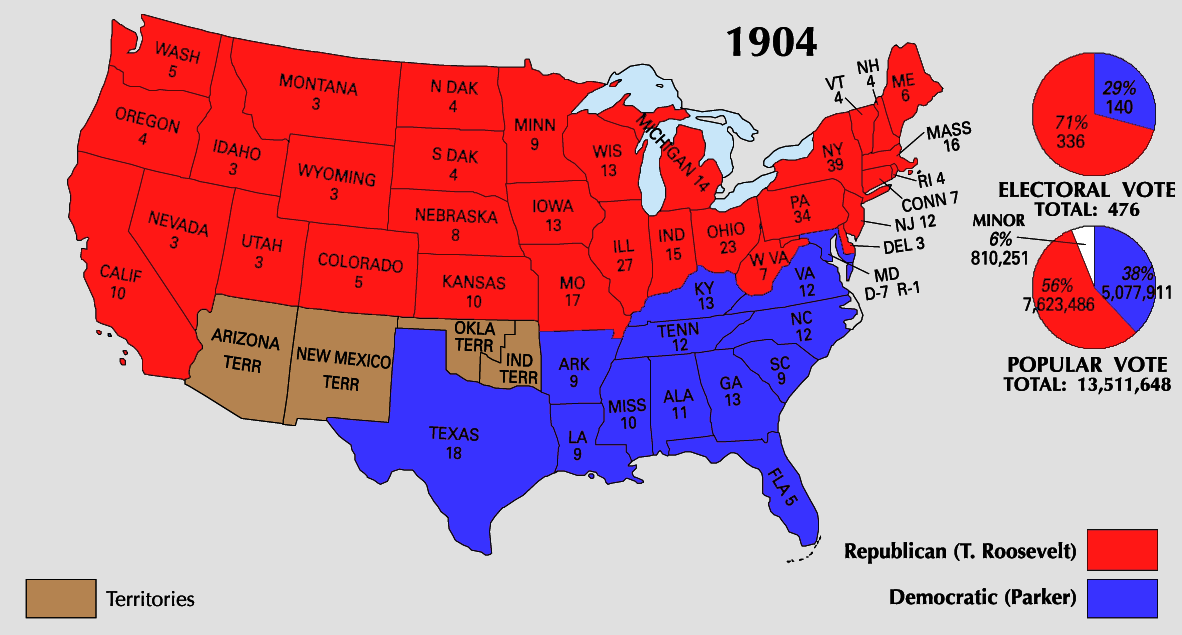
The map above shows the result of the 1904 US presidential election between Theodore Roosevelt and Alton Brooks Parker. Turnout for the election was 65.50%.
Here are the key details:
| Winner: | Runner-Up: | |
|---|---|---|
| Name: | Theodore Roosevelt | Alton Brooks Parker |
| Political Party: | Republican | Democratic |
| Home state: | New York | New York |
| VP Name: | Charles W. Fairbanks | Henry G. Davis |
| States: Won (Out of 45): | 32 | 13 |
| Electoral College Votes (out of 476): | 336 | 140 |
| Percentage of Popular Vote | 56.42% | 37.60% |
| Total Votes | 7,630,557 | 5,083,880 |
| Margin % | 18.83% | – |
| Margin (votes) | 2,546,677 | – |
| 3rd Place | 4th Place | |
|---|---|---|
| Name: | Eugene V. Debs | Silas C. Swallow |
| Political Party | Socialist | Prohibition |
| Electoral College Votes | 0 | 0 |
| Number of Votes: | 402,810 | 259,102 |
| Percentage of Popular Vote: | 2.98% | 1.92% |
What Were The Key Issues In The 1904 Election?
Here’s a summary of the key issues and each candidate’s stance:
1. Trust-Busting and Big Business Regulation
- Theodore Roosevelt: Roosevelt had made a name for himself as a “trust-buster.” He believed that the federal government should regulate big businesses to protect public interest but not necessarily dismantle them. He aimed to curb the power of large corporations while allowing “good trusts” to operate under reasonable regulation.
- Alton B. Parker: Parker took a more conservative approach to big business. Although he did not openly advocate for monopolies, he was less aggressive about trust-busting than Roosevelt. He argued for maintaining a balanced approach that would protect businesses from excessive government intervention.
2. Labor Rights and Working Conditions
- Theodore Roosevelt: Roosevelt was seen as more sympathetic to labor rights. He advocated for fair treatment of workers, promoted an eight-hour workday, and supported labor unions in their efforts to secure better working conditions. His intervention in the 1902 coal strike, where he sided with the workers to an extent, had won him support among laborers.
- Alton B. Parker: Parker did not directly oppose labor rights but was less vocal in his support. The Democratic platform did not prioritize labor reforms as much as the Republican platform did under Roosevelt.
3. Progressive Reforms
- Theodore Roosevelt: Roosevelt embraced progressive policies, including consumer protection and conservation of natural resources. He believed in using government power to address social and economic issues, aiming to benefit the public good. Roosevelt’s progressive stance appealed to many reform-minded voters.
- Alton B. Parker: Parker was generally more conservative and did not advocate for sweeping progressive reforms. His approach appealed more to traditionalists and business interests who felt Roosevelt was overstepping the bounds of presidential authority with his progressive initiatives.
4. Foreign Policy and Imperialism
- Theodore Roosevelt: Roosevelt promoted a more assertive foreign policy, famously summed up by his phrase, “Speak softly and carry a big stick.” He believed in expanding U.S. influence abroad, particularly in Latin America and the Pacific. His support for the Panama Canal project exemplified his commitment to establishing the U.S. as a global power.
- Alton B. Parker: Parker opposed imperialism and was critical of some of Roosevelt’s foreign policies, though he did not actively campaign against them. He represented a more isolationist stance, favoring a focus on domestic affairs over foreign expansion.
5. Tariffs and Trade
- Theodore Roosevelt: Roosevelt favored moderate tariffs, primarily to protect American industries. He was not as protectionist as some within his party but believed tariffs were essential to support U.S. businesses.
- Alton B. Parker: Parker’s stance on tariffs was more ambiguous, though he generally supported lower tariffs than the Republicans. However, he did not make it a central issue in his campaign.
6. Panama Canal
- Theodore Roosevelt: The Panama Canal was a central part of Roosevelt’s vision for American global influence. He championed the canal’s construction and took decisive actions to secure its development, including supporting Panama’s independence from Colombia.
- Alton B. Parker: Parker criticized Roosevelt’s handling of the Panama Canal, suggesting that it was an example of Roosevelt’s overreach. However, he did not oppose the canal itself, only the means by which Roosevelt pursued it.
Why did Roosevelt win?
Here’s a closer look at the factors that contributed to his landslide win:
1. Roosevelt’s Personal Popularity and Charisma
- Roosevelt was a dynamic and charismatic leader with a reputation as a reformer and a champion of the common man. His bold personality, energetic style, and “man of the people” image resonated with many Americans.
- He was known for his courage and resilience, which he demonstrated through his actions as a soldier in the Spanish-American War and his adventurous persona. This gave him a heroic status in the eyes of the public.
2. Trust-Busting and Regulation of Big Business
- Roosevelt was seen as a defender of the public interest against powerful business monopolies, or “trusts.” His administration had filed lawsuits against several major corporations, showcasing his commitment to reining in the abuses of large corporations.
- His approach of regulating, rather than dismantling, all trusts appealed to those who feared the power of monopolies but still valued economic growth and stability. This stance allowed him to gain support from both reform-minded voters and moderate business interests.
3. Support for Labor Rights
- Roosevelt’s actions in support of workers, such as mediating in the 1902 coal strike, won him support from laborers and their advocates. His policies and statements showed a commitment to fair treatment of workers, which appealed to many Americans concerned about labor conditions and economic inequality.
- This position helped Roosevelt win votes from working-class citizens who felt they had an ally in the White House.
4. Progressive Reforms and the “Square Deal”
- Roosevelt’s promise of a “Square Deal” symbolized his commitment to fairness for all Americans, encompassing consumer protection, labor rights, and natural resource conservation. This appeal to justice and reform helped him attract a broad coalition of voters, including progressives and reformers.
- The Square Deal highlighted his belief that the government should be a balancing force in the economy and society, ensuring that both the public and private sectors were held accountable.
5. Strong and Assertive Foreign Policy
- Roosevelt’s foreign policy emphasized the expansion of American influence and strength. His slogan, “Speak softly and carry a big stick,” showcased his willingness to use American power when necessary while avoiding unnecessary conflicts.
- He was credited for his role in securing the rights to build the Panama Canal, a monumental project that was widely supported for its potential to enhance U.S. trade and naval power. Many Americans viewed the canal as a significant achievement and a point of national pride.
6. Weak Opposition from Alton B. Parker
- Alton B. Parker, the Democratic candidate, was a relatively unknown judge from New York without much national appeal. Parker’s campaign struggled to present a strong alternative to Roosevelt’s progressive policies.
- Parker’s conservative platform failed to inspire many voters, especially those who supported reforms. His lack of a clear stance on critical issues, such as big business regulation, made it hard for him to compete with Roosevelt’s bold vision.
7. Unified Republican Party
- The Republican Party was largely unified around Roosevelt, unlike previous elections where internal divisions weakened the party. Roosevelt’s popularity within the party meant he faced little opposition from Republican factions.
- This unity allowed Roosevelt to focus on his campaign against Parker without needing to spend energy addressing intraparty conflicts.
8. Roosevelt’s Incumbency Advantage
- As the incumbent, Roosevelt had a track record to run on. Voters could see the results of his first term, which included several popular reforms and progressive policies.
- His record on labor disputes, regulation of trusts, and foreign policy successes reassured voters of his capabilities and made them more likely to support him for a full term.
1904 Election Results Map By County

1904 Map From The National Atlas of the United States (now sadly permanently offline)
Other US Presidential Election Maps: