
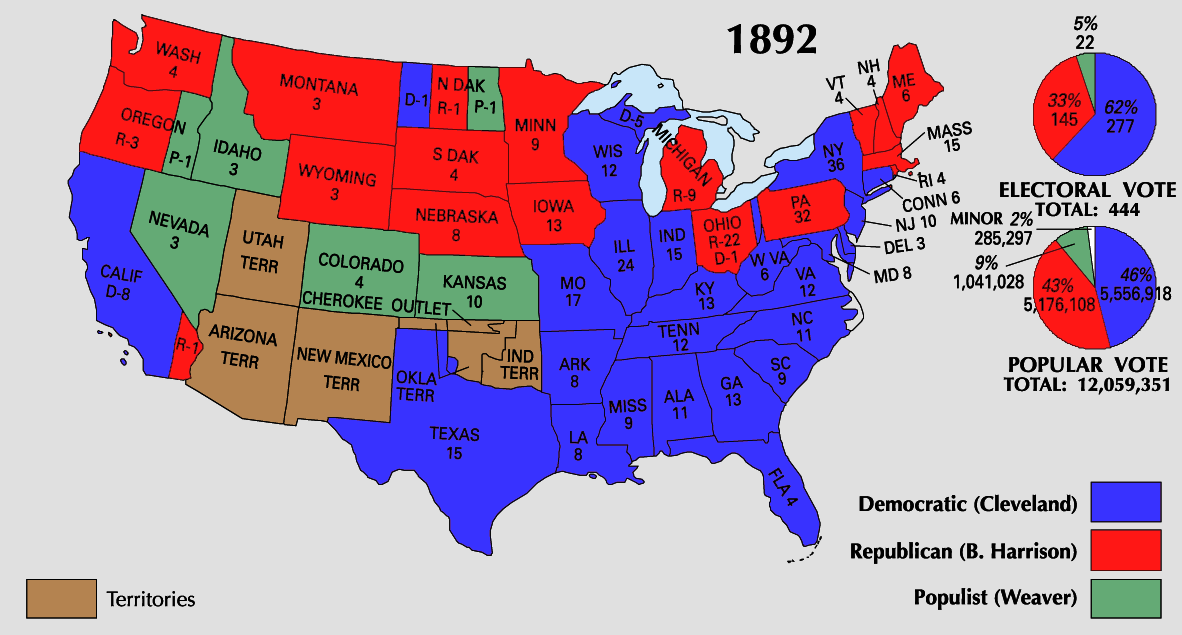
The map above shows the result of the 1892 US presidential election between Grover Cleveland, Benjamin Harrison and James B. Weaver. Turnout for the election was 75.80%.
Here are the key details:
| Winner: | Runner-Up: | |
|---|---|---|
| Name: | Grover Cleveland | Benjamin Harrison |
| Political Party: | Democratic | Republican |
| Home state: | New York | Indiana |
| VP Name: | Adlai Stevenson I | Whitelaw Reid |
| States: Won (Out of 44): | 23 | 16 |
| Electoral College Votes (out of 444): | 277 | 145 |
| Percentage of Popular Vote | 46.02% | 43.00% |
| Total Votes | 5,553,898 | 5,190,819 |
| Margin % | 3.01% | – |
| Margin (votes) | 363,099 | – |
| 3rd Place | 4th Place | |
|---|---|---|
| Name: | James B. Weaver | John Bidwell |
| Political Party | Populist | Prohibition |
| Electoral College Votes | 22 | 0 |
| Number of Votes: | 1,026,595 | 270,879 |
| Percentage of Popular Vote: | 8.61% | 2.24% |
What were the key issues in the 1892 election?
The election featured three main candidates: the incumbent Republican President Benjamin Harrison, the former Democratic President Grover Cleveland, and the People’s Party (Populist) candidate, James B. Weaver.
Here’s where each stood on key issues:
1. Tariffs and Trade
- Grover Cleveland (Democratic Party): Opposed high tariffs, which he argued only benefited big businesses and hurt consumers. He advocated for lower tariffs to reduce the cost of goods and promote free trade.
- Benjamin Harrison (Republican Party): Supported high protective tariffs to shield American industries from foreign competition. The McKinley Tariff, passed under his administration in 1890, raised tariffs to historically high levels, which was controversial and became a major campaign issue.
- James B. Weaver (Populist Party): Opposed the high tariffs, aligning more with Cleveland’s view. Weaver and the Populists believed high tariffs enriched the wealthy and oppressed farmers and the working class.
2. Monetary Policy
- Grover Cleveland: Supported the gold standard, which he believed would stabilize the economy and maintain foreign investment in the U.S. He opposed the unlimited coinage of silver, a stance that did not resonate well with agrarian voters who favored silver.
- Benjamin Harrison: Had a mixed position, as he was sympathetic to the gold standard but also signed the Sherman Silver Purchase Act in 1890, which increased government silver purchases to appease pro-silver factions in his party.
- James B. Weaver: Advocated for the free and unlimited coinage of silver (“Free Silver”) to increase the money supply and help indebted farmers and workers. This was a core stance of the Populist Party, appealing to agrarian voters who felt crushed by deflation and debt.
3. Labor Rights and Economic Reform
- Grover Cleveland: Had a cautious stance on labor, often siding with big business. During his previous administration, he opposed federal intervention in labor disputes, which did not sit well with labor unions.
- Benjamin Harrison: Supported some labor protections, but his administration did not strongly advocate for workers’ rights. The 1890 Sherman Antitrust Act, which was intended to curb monopolies, had limited impact under his administration.
- James B. Weaver: Strongly supported labor rights and the Populist Party’s platform, which included government ownership of railroads, a progressive income tax, and direct election of Senators. Weaver’s platform aimed to support working-class Americans against the power of big business and monopolies.
4. Agrarian Issues and Populism
- Grover Cleveland: Though he received some rural support, Cleveland did not focus heavily on agrarian issues and was more aligned with urban and business interests.
- Benjamin Harrison: Favored policies that primarily benefited industry and business, leaving many farmers dissatisfied. His administration’s focus on tariffs and gold backed currency alienated many rural voters.
- James B. Weaver: As the Populist candidate, Weaver directly addressed the struggles of farmers and rural Americans, advocating for policies that would alleviate their debts and increase their economic independence.
Why did Cleveland win?
Here are the main factors that contributed to Cleveland’s victory:
1. Backlash Against High Tariffs
The McKinley Tariff of 1890, passed under Harrison, was one of the highest tariffs in U.S. history. It raised prices on many goods, angering consumers and particularly farmers who felt burdened by the increased cost of goods and limited export markets.
Cleveland campaigned against high tariffs, arguing they were unfairly enriching big businesses at the expense of ordinary Americans, which resonated with voters.
2. Economic Hardships and Agrarian Unrest
Farmers, particularly in the South and West, were facing economic hardships due to falling crop prices and rising debts. Harrison’s policies, including his support of the gold standard, were seen as favoring wealthy industrialists and Eastern business interests over farmers and laborers.
Cleveland’s promise to reduce tariffs and his alignment with moderate economic policies won him support among those feeling left behind by Harrison’s administration.
3. Labor Discontent and Popular Disapproval of the Republicans
Harrison’s administration was viewed as out of touch with the needs of working-class Americans. Although Cleveland was not an outright labor champion, he had previously earned a reputation as a reformer willing to challenge corruption.
Many laborers were unhappy with the Republican Party, which was often seen as supportive of big business and indifferent to workers’ issues. Cleveland’s reputation as an honest, conservative reformer appealed to voters tired of perceived corruption and favoritism.
4. Intra-Party Divisions Among Republicans
The Republican Party was internally divided on issues like monetary policy. Harrison’s hesitant support for both gold and silver through the Sherman Silver Purchase Act did not satisfy pro-silver factions or those committed to the gold standard, creating fractures within the party. These divisions weakened Republican support and pushed some voters towards Cleveland.
5. Rise of the Populist Party
James B. Weaver, running as the candidate for the Populist Party, attracted many disillusioned farmers and laborers, particularly in the West and South. While the Populists drew votes away from both major parties, they hurt Republicans more than Democrats.
By siphoning off some of Harrison’s base, especially in rural areas, the Populist Party indirectly helped Cleveland secure victory.
6. Cleveland’s Unique Appeal as a Former President
Cleveland had the advantage of name recognition and was seen as a steady and competent leader from his first term. Despite losing in 1888, he remained popular, particularly among Democrats, and was able to successfully position himself as a moderate and stable choice.
His victory marked him as the only president to serve two non-consecutive terms, highlighting the voters’ comfort with returning him to office during a period of economic frustration.
7. Low Voter Turnout and Changing Electoral Dynamics
Voter turnout was slightly lower than in previous elections, which may have impacted Republican support more than Democratic support. Additionally, Democrats had managed to solidify a strong base in the South and had made gains in the West, partly due to aligning with agrarian and labor concerns, which helped secure Cleveland’s electoral advantage.
1892 Election Results Map By County

1892 Map From The National Atlas of the United States (now sadly permanently offline)
Other US Presidential Election Maps: