
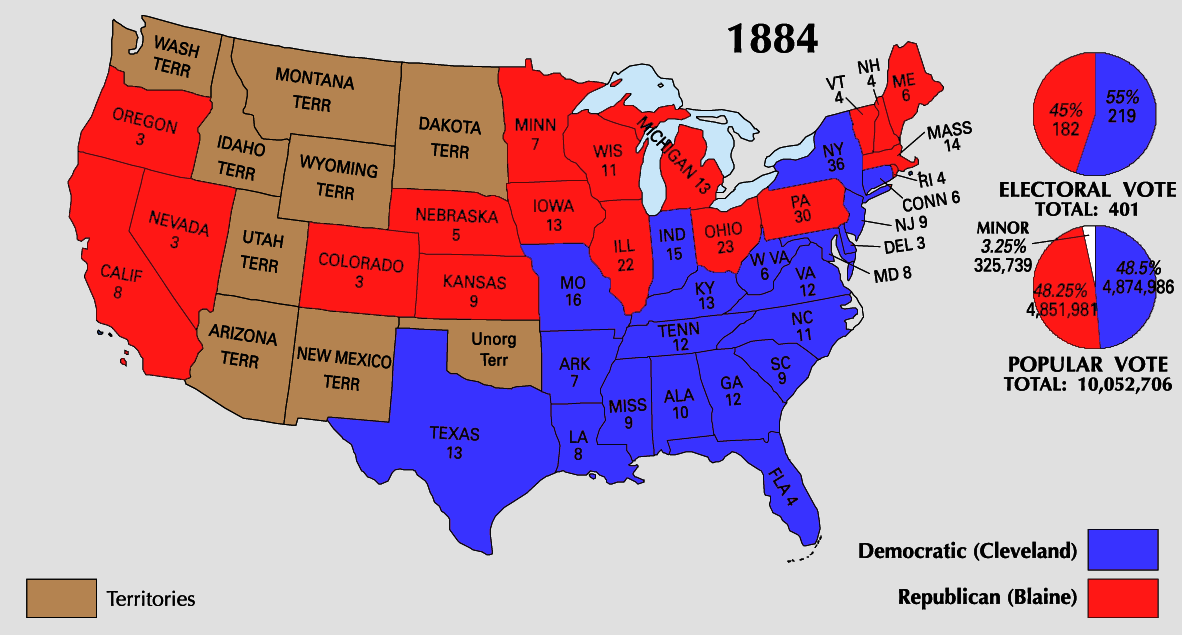
The map above shows the result of the 1884 US presidential election between Grover Cleveland and James G. Blaine. Turnout for the election was 78.20%.
Here are the key details:
| Winner: | Runner-Up: | |
|---|---|---|
| Name: | Grover Cleveland | James G. Blaine |
| Political Party: | Democratic | Republican |
| Home state: | New York | Maine |
| VP Name: | Thomas A. Hendricks | John A. Logan |
| States: Won (Out of 38): | 20 | 18 |
| Electoral College Votes (out of 401): | 219 | 182 |
| Percentage of Popular Vote | 48.85% | 48.30% |
| Total Votes | 4,914,482 | 4,856,903 |
| Margin % | 0.57% | – |
| Margin (votes) | 57,579 | – |
| 3rd Place | 4th Place: | |
|---|---|---|
| Name: | John St. John | Benjamin Butler |
| Political Party | Prohibition | Greenback |
| Electoral College Votes | 0 | 0 |
| Number of Votes: | 147,482 | 134,294 |
| Percentage of Popular Vote: | 1.50% | 1.33% |
What were the key issues of the 1884 election?
The 1884 U.S. presidential election was a heated contest primarily between Democrat Grover Cleveland, then Governor of New York, and Republican James G. Blaine, a former Speaker of the House and Senator from Maine.
This election was marked by intense personal attacks and political controversies. Here are the key issues and the candidates’ positions:
1. Political Reform and Corruption
Background: The election came at a time of widespread political corruption. Previous administrations, particularly under Ulysses S. Grant, had seen scandals that damaged public trust. Reformers within both parties demanded cleaner, more transparent governance.
- Grover Cleveland: Known as an honest, reform-minded politician, Cleveland had a reputation for fighting corruption. As Governor of New York, he had taken a stand against Tammany Hall and supported civil service reform. His campaign promised an honest, efficient government.
- James G. Blaine: Blaine was more controversial in this area. Although he had a long political career, he was associated with several allegations of corruption, especially in connection with his relationships with business interests and railroads. These scandals led to the slogan “Blaine, Blaine, James G. Blaine, the Continental Liar from the State of Maine.”
2. Tariff Policy
Background: Tariff policy was a significant economic issue, with high tariffs generally supported by Republicans to protect American industries and low tariffs advocated by Democrats to lower consumer costs and promote free trade.
- Grover Cleveland: Cleveland opposed high tariffs, believing they unnecessarily increased the cost of goods for consumers and benefited only a few wealthy industrialists. He advocated for tariff reform and sought to lower rates.
- James G. Blaine: Blaine and the Republican Party were in favor of high protective tariffs, arguing that they were necessary to protect American jobs and industries from foreign competition.
3. Civil Service Reform
Background: The spoils system was still influential, with many government jobs awarded based on political connections rather than merit. Civil service reformers wanted a system based on qualifications rather than patronage.
- Grover Cleveland: Cleveland was a strong advocate for civil service reform, aligning with reformers who wanted to reduce patronage and establish a merit-based system. His stance won him support from independents, known as “Mugwumps,” who typically voted Republican but supported Cleveland due to his reformist stance.
- James G. Blaine: Blaine was more ambiguous about civil service reform and was seen as part of the Republican establishment that benefited from patronage. This made him less appealing to reformers.
4. Personal Morality and Scandals
Background: Both candidates were subjected to personal attacks and scandals. Blaine faced accusations of corruption, while Cleveland was embroiled in a scandal involving a past relationship.
- Grover Cleveland: Cleveland was accused of fathering an illegitimate child, which became a central issue in the campaign, with the Republicans using the slogan “Ma, Ma, where’s my Pa?” Cleveland admitted to the possibility but maintained an honest approach, which some voters found commendable.
- James G. Blaine: Blaine was tainted by allegations of accepting bribes in the past. The “Mulligan Letters” scandal suggested he had exploited his office for personal gain, damaging his reputation among voters who valued honesty.
Outcome and Legacy
The election was extremely close, and Cleveland ultimately won, marking the first time a Democrat had won the presidency since before the Civil War. Cleveland’s victory was attributed largely to his reputation as an honest reformer, which resonated with voters weary of corruption. His win also showed the influence of independent voters, particularly the “Mugwumps” who crossed party lines to support him.
Why did Cleveland win?
Here’s a breakdown of why and how he won:
1. Reputation for Honesty and Reform
- Cleveland was known as an honest, principled politician with a strong record for reform, especially during his tenure as Mayor of Buffalo and Governor of New York. His stance against corruption and machine politics set him apart at a time when the public was disillusioned with scandals and corruption in government.
- Cleveland’s honesty and reformist image helped him attract independent-minded voters, including reformers known as “Mugwumps.” These were Republicans who, disillusioned with their own candidate, chose to support Cleveland.
2. Scandals and Blaine’s Tarnished Reputation
- James G. Blaine, the Republican candidate, was deeply controversial due to his involvement in several scandals, most notably the “Mulligan Letters.” These letters suggested he had misused his political influence to enrich himself through railroad deals, which many saw as emblematic of corruption.
- The Democrats played on Blaine’s scandalous reputation, using slogans like “Blaine, Blaine, James G. Blaine, the Continental Liar from the State of Maine.” This image hurt Blaine, especially with voters who were tired of corruption.
3. Support from Mugwump Republicans
- A significant group of Republicans, known as Mugwumps, broke away from their party and backed Cleveland because of his reputation for integrity and their frustration with Blaine’s scandals. The Mugwumps were influential reformers and intellectuals who wielded substantial influence in swing states, particularly in the Northeast.
- The Mugwumps’ support gave Cleveland critical votes in states like New York, which would ultimately decide the election.
4. Appeal to Working-Class and Immigrant Voters
- Cleveland’s opposition to high tariffs appealed to working-class and immigrant voters who were frustrated by the high cost of consumer goods. Many of these voters were skeptical of Republican support for high tariffs, which they saw as benefiting wealthy industrialists at the expense of ordinary Americans.
- This stance allowed Cleveland to gain traction among voters in urban areas and key swing states.
5. Handling of the Personal Scandal
- During the campaign, Cleveland was accused of fathering an illegitimate child. While this scandal could have been damaging, Cleveland’s approach—admitting the possibility and refusing to deny the allegations—was seen as a rare act of honesty. This approach blunted the attacks and even earned him a degree of respect from voters who valued straightforwardness.
- In contrast, Blaine’s alleged corruption was seen as more problematic and damaging to public interest than Cleveland’s personal indiscretions.
6. Blaine’s Missteps and the “Rum, Romanism, and Rebellion” Incident
- In the final days of the campaign, a Protestant clergyman supporting Blaine described the Democrats as the party of “Rum, Romanism, and Rebellion,” a statement that was widely interpreted as an attack on Catholics, immigrants, and Southern Democrats.
- Blaine did not immediately repudiate the comment, which angered Catholic voters, especially in New York. This last-minute blunder is believed to have swayed enough voters in New York to tip the state in Cleveland’s favor, ultimately providing his margin of victory.
7. The Narrow Margin in New York
- New York, Cleveland’s home state, was the key battleground and provided the decisive electoral votes. Cleveland won New York by a margin of just over 1,000 votes, out of over a million cast. Without New York, he would have lost the election.
- The combined effect of his reformist appeal, Blaine’s scandals, and the last-minute controversy surrounding the “Rum, Romanism, and Rebellion” remark helped Cleveland clinch New York and, consequently, the presidency.
1884 Election Results Map By County

1884 Map From The National Atlas of the United States (now sadly permanently offline)
Other US Presidential Election Maps: