
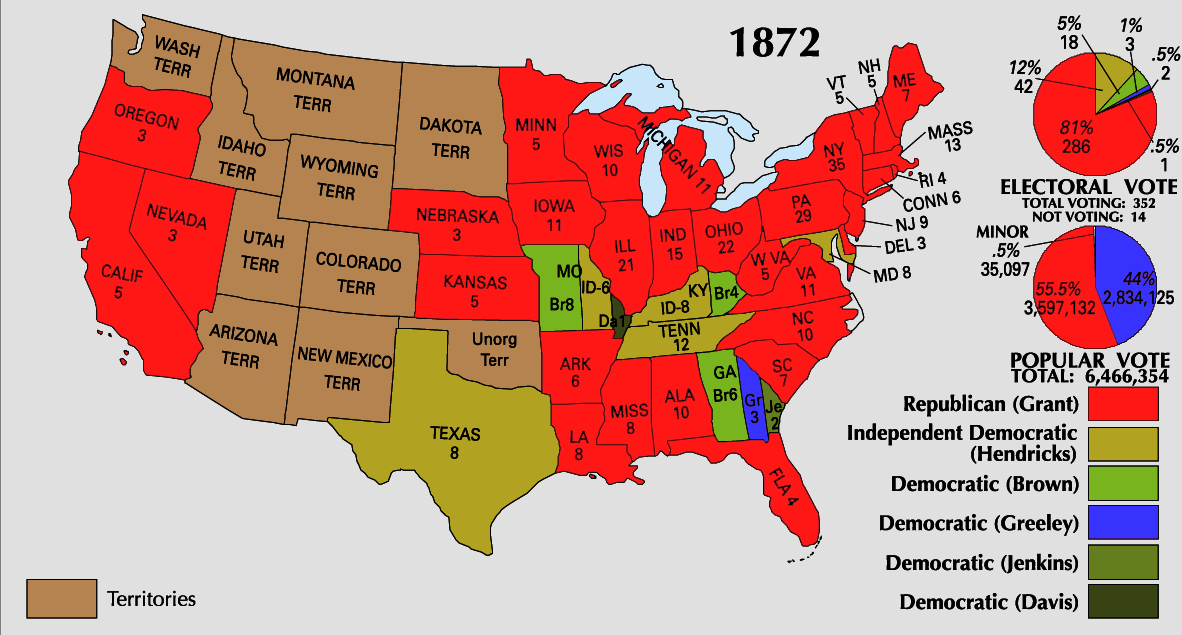
The map above shows the result of the 1872 US presidential election between Ulysses S. Grant and Horace Greeley. Turnout for the election was 72.10%.
Here are the key details:
| Winner: | Runner-Up: | |
|---|---|---|
| Name: | Ulysses S. Grant | Horace Greeley |
| Political Party: | Republican | Liberal Republican |
| Home state: | Illinois | New York |
| VP Name: | Henry Wilson | Benjamin Gratz Brown |
| States: Won (Out of 37): | 29 | 6 |
| Electoral College Votes (out of 352): | 286 | 66 |
| Percentage of Popular Vote | 55.60% | 43.80% |
| Total Votes | 3,597,439 | 2,834,761 |
| Margin % | 11.80% | – |
| Margin (votes) | 763,729 | – |
| 3rd Place | 4th Place | |
|---|---|---|
| Name: | Thomas A. Hendricks | Benjamin Gratz Brown |
| Political Party | Democratic | Liberal Republican/ Democratic |
| Electoral College Votes | 42 | 18 |
| Number of Votes: | – | – |
| Percentage of Popular Vote: | – | – |
What were the key issues in the 1872 election?
The 1872 U.S. presidential election, which pitted incumbent Republican President Ulysses S. Grant against Horace Greeley, a newspaper editor and candidate of the newly formed Liberal Republican Party (also endorsed by the Democrats), was shaped by several key issues.
These included Reconstruction, civil service reform, and corruption in the government. Here’s a breakdown of where each candidate stood:
1. Reconstruction and Civil Rights
Ulysses S. Grant: Grant supported continued Reconstruction efforts to protect the rights of freed Black citizens in the South.
His administration aimed to enforce the 14th and 15th Amendments, using federal power to counteract white supremacist violence, such as the activities of the Ku Klux Klan. Grant and the Republicans argued that Reconstruction was necessary to ensure equality and uphold Union victory.
Horace Greeley: Greeley and the Liberal Republicans opposed the federal government’s direct involvement in Southern affairs, advocating instead for “home rule” or self-governance for the Southern states. He believed it was time for the South to govern itself without interference, which many Southern Democrats saw as a pathway to re-establishing racial hierarchy.
2. Civil Service Reform
Ulysses S. Grant: While Grant expressed some interest in reforming the patronage system, his administration was often criticized for corruption and cronyism. The spoils system was widely used, which hurt his reputation among reformers.
Horace Greeley: Greeley and the Liberal Republicans campaigned strongly on civil service reform, calling for an end to the spoils system and for positions in government to be awarded based on merit rather than political connections. This appeal resonated with reform-minded voters frustrated with corruption in Grant’s administration.
3. Government Corruption
Ulysses S. Grant: Despite his popularity as a war hero, Grant’s administration faced numerous scandals, including the Crédit Mobilier and Whiskey Ring scandals. Grant’s opponents accused him of either being complicit in or turning a blind eye to the widespread corruption.
Horace Greeley: Greeley leveraged these scandals to argue for change, promoting his candidacy as an alternative to what he saw as a corrupt government. The Liberal Republicans positioned themselves as reformers who would clean up the federal government and restore integrity to the office.
4. Economic Issues and Tariffs
Ulysses S. Grant: The Republicans generally favored a high tariff policy to protect American industries. This position was popular among Northern industrialists but faced criticism from Southern and Western farmers who bore the cost of higher goods.
Horace Greeley: Although Greeley himself was personally inconsistent on tariffs (having supported them previously as a Whig), the Liberal Republicans took a generally more moderate stance on tariffs, appealing to free-trade advocates, especially in the South and West.
Why did Grant win?
Ulysses S. Grant’s victory in the 1872 election was due to a combination of factors, including his popularity as a Civil War hero, the fragmentation of the opposition, and voter loyalty to the Republican Party’s Reconstruction policies.
Here’s a closer look at why Grant won and what happened to Horace Greeley’s electoral votes after his death:
Reasons for Grant’s Victory
- Popularity as a War Hero: Grant was still celebrated as the Union general who helped win the Civil War, which continued to bolster his appeal, particularly in the North.
- Support for Reconstruction Policies: Grant maintained significant support among Northern voters who saw Reconstruction as essential for ensuring civil rights for freed Black citizens. His stance against the Ku Klux Klan and use of federal power to enforce civil rights laws resonated with those who believed that Reconstruction should be continued.
- Lack of Unity Among Opponents: Greeley’s coalition, the Liberal Republicans, was an uneasy alliance with the Democrats. Liberal Republicans opposed many of Grant’s policies, particularly Reconstruction and patronage, while the Democrats were largely concerned with ending federal control over the South. This alliance between former anti-slavery Republicans and pro-Southern Democrats was awkward and failed to fully unify the opposition. Many traditional Democrats were also skeptical of Greeley, given his former abolitionist views.
- Greeley’s Unpopularity and Erratic Campaigning: Horace Greeley was known for his eccentric personality and inconsistent views, which made him an unconventional and, in many ways, an unpopular candidate. He struggled to convince voters, especially those who had supported Grant’s administration or were committed to Reconstruction, to switch sides. Greeley’s erratic public statements and previous criticisms of the South made it difficult for him to gain widespread support, especially among Democrats.
- The Strength of the Republican Party: By 1872, the Republican Party was well-established as the party of Union victory and national unity. Many voters viewed the Democrats with suspicion, associating them with Southern interests and opposition to civil rights.
What Happened to the Electoral College Votes After Greeley’s Death
Horace Greeley passed away on November 29, 1872, shortly after the popular vote and before the Electoral College convened in December. His death created a unique situation in Electoral College history, as a presidential candidate had never died after the popular vote but before the electors met.
As a result:
- Greeley’s 66 Electoral Votes Were Not Awarded to Him: Since Greeley had died, his pledged electors could not legally vote for him.
- Electors Split Their Votes Among Other Candidates: The 66 electoral votes that would have gone to Greeley were divided among several other candidates. Most of these votes went to various Democratic figures, including Thomas A. Hendricks, B. Gratz Brown (Greeley’s vice-presidential running mate), and others. The split highlighted the lack of unity within Greeley’s coalition.
- Grant’s Electoral Victory Was Unaffected: Grant had already won a large majority of the Electoral College votes, with 286 electoral votes, so Greeley’s death did not impact the outcome of the election. Grant’s victory was decisive even without Greeley’s votes in the mix.
Legacy of the 1872 Election
After Greeley’s death and the disbanding of the Liberal Republican Party, the Democratic Party remained the main opposition to the Republicans. Grant’s second term, however, was marred by continued scandals, leading to a growing demand for reform.
The 1872 election is remembered for its unprecedented outcome, with Greeley being the only presidential candidate to die during the Electoral College voting process.
1872 Election Results Map By County

1872 Map From The National Atlas of the United States (now sadly permanently offline)
Other US Presidential Election Maps: