
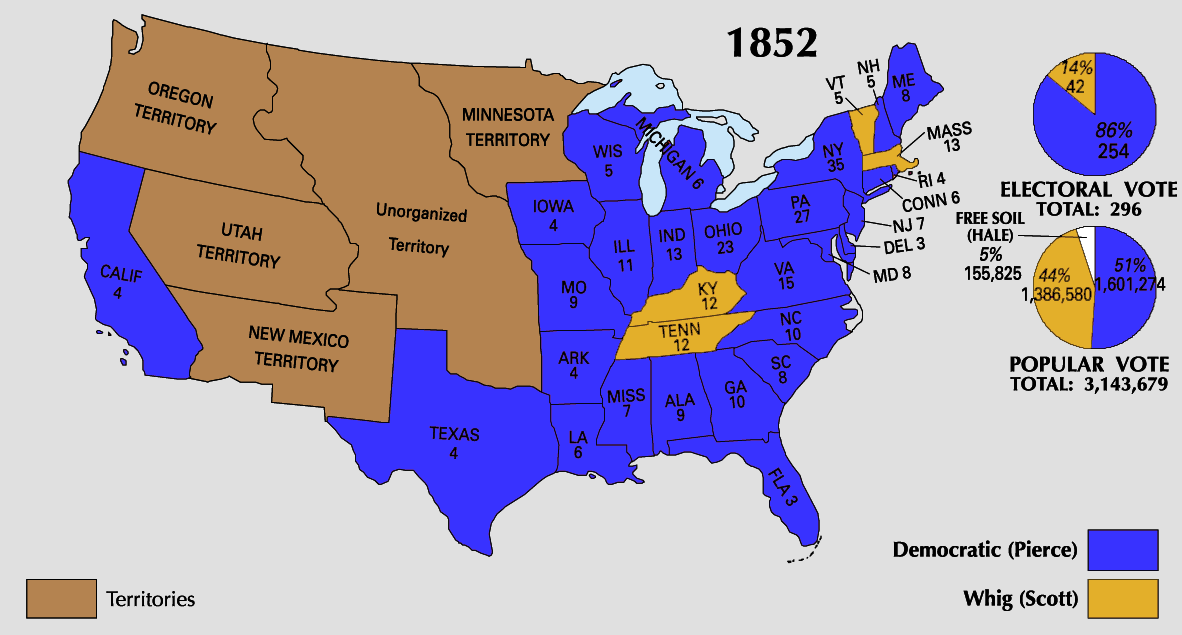
The map above shows the result of the 1852 US presidential election between Franklin Pierce and Winfield Scott. Turnout for the election was 69.50%.
Here are the key details:
| Winner: | Runner-Up: | |
|---|---|---|
| Name: | Franklin Pierce | Winfield Scott |
| Political Party: | Democratic | Whig |
| Home state: | New Hampshire | New Jersey |
| VP Name: | William R. King | William A. Graham |
| States: Won (Out of 31): | 27 | 4 |
| Electoral College Votes (out of 296): | 254 | 42 |
| Percentage of Popular Vote | 50.83% | 43.90% |
| Total Votes | 1,605,943 | 1,386,942 |
| Margin % | 6.95% | – |
| Margin (votes) | 219,525 | – |
| 3rd Place | 4th Place: | |
|---|---|---|
| Name: | John P. Hale | Daniel Webster |
| Political Party | Free Soil | Union |
| Electoral College Votes | 0 | 0 |
| Number of Votes: | 155,210 | 6,994 |
| Percentage of Popular Vote: | 4.90% | 0.22% |
What were the key issues of the 1852 election?
The 1852 U.S. presidential election was primarily shaped by the ongoing national debate over slavery and sectional tensions between the North and South.
Here’s a breakdown of the main issues and where each candidate stood:
1. Slavery and the Compromise of 1850
- The Compromise of 1850 was intended to ease tensions between free and slave states by addressing the status of slavery in new territories and enacting a stricter Fugitive Slave Law. This law required citizens, even in free states, to assist in the capture of runaway enslaved people, which outraged many Northerners.
- Both candidates, Franklin Pierce (Democratic Party) and Winfield Scott (Whig Party), supported the Compromise of 1850. However, they differed slightly in how they presented their support, which reflected their party bases. Pierce, from New Hampshire, appealed to the Southern states by promising full enforcement of the Fugitive Slave Law, while Scott had difficulty reconciling Northern and Southern Whigs on the issue, weakening his support in both regions.
2. Expansionism and Manifest Destiny
- Manifest Destiny, the belief that the U.S. was destined to expand across North America, remained a popular concept, though less pressing than in previous elections.
- Pierce, an advocate for expansion, was open to acquiring new territories, particularly in the South and West. His administration later pursued efforts to acquire Cuba (the Ostend Manifesto) and promoted further western expansion.
- Scott did not prioritize territorial expansion in his campaign, and his focus remained more on domestic stability and maintaining the Union.
3. Internal Divisions within the Whig Party
- The Whig Party was severely divided by 1852, especially over slavery. Northern Whigs, generally anti-slavery, opposed the Fugitive Slave Act, while Southern Whigs supported it.
- Scott’s support for the Compromise of 1850 alienated anti-slavery Whigs, while his Northern background made Southern Whigs wary of his commitment to upholding the Compromise fully. This division weakened Scott’s appeal, especially compared to the unified Democratic front under Pierce.
4. Party Loyalty and Regionalism
- The Democrats capitalized on Pierce’s image as a moderate who would uphold the Union, uniting around him as a pro-Compromise candidate who could appeal to both Northern and Southern interests.
- The Whigs’ inability to unite around Scott, combined with dissatisfaction in both the North and South, undermined their party’s cohesion, signaling the beginning of the end for the Whig Party as a major political force.
Summary of Candidate Positions:
- Franklin Pierce (Democrat): Supported the Compromise of 1850, particularly the Fugitive Slave Law, and took a pro-expansionist stance, aligning with Southern Democrats who sought new slave territories.
- Winfield Scott (Whig): Endorsed the Compromise of 1850 but struggled to appeal to both Northern and Southern Whigs, who were deeply divided over slavery.
Pierce ultimately won in a landslide, largely due to his party’s unity and the Whigs’ fragmentation, signaling a shift that would soon lead to the formation of the anti-slavery Republican Party.
1852 Election Results Map By County

1852 Map From The National Atlas of the United States (now sadly permanently offline)
Other US Presidential Election Maps: