
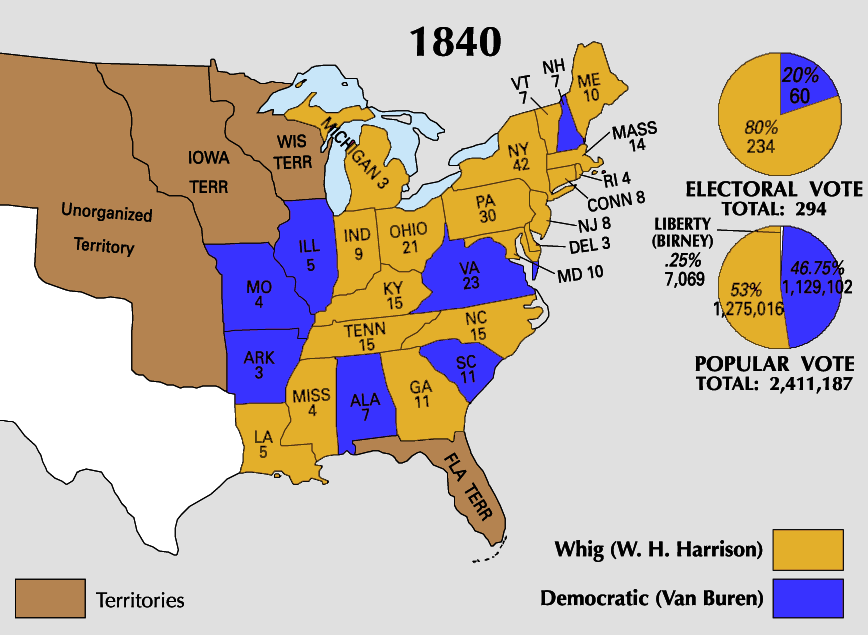
The map above shows the result of the 1840 US presidential election between William Henry Harrison and Martin Van Buren. Turnout for the election was 80.30%.
Here are the key details:
| Winner: | Runner-Up: | |
|---|---|---|
| Name: | William Henry Harrison | Martin Van Buren |
| Political Party: | Whig | Democratic |
| Home state: | Ohio | New York |
| VP Name: | John Tyler | NA |
| States: Won (Out of 26): | 19 | 7 |
| Electoral College Votes (out of 294): | 234 | 60 |
| Percentage of Popular Vote | 52.87% | 46.80% |
| Total Votes | 1,275,583 | 1,128,854 |
| Margin % | 6.05% | – |
| Margin (votes) | 145,938 | – |
What were the key issues of the 1840 election?
The 1840 U.S. presidential election between incumbent Democratic President Martin Van Buren and Whig candidate William Henry Harrison centered on several key issues that defined the political and economic climate of the time.
Here’s a summary of the major issues and where each candidate stood:
1. Economic Depression and the Panic of 1837
Issue: The Panic of 1837, a financial crisis triggered by bank failures, currency devaluation, and falling land prices, led to a severe economic depression that lasted well into Van Buren’s presidency. Unemployment rose, and many people lost their savings and property.
- Martin Van Buren (Democrat): Van Buren was largely blamed for the economic downturn, even though the policies that led to the Panic were put in place by his predecessor, Andrew Jackson. Van Buren advocated for the Independent Treasury System, which would separate government funds from private banks, aiming to stabilize the economy.
- William Henry Harrison (Whig): Harrison and the Whigs criticized Van Buren’s handling of the economy and blamed the Democrats for the depression. While Harrison didn’t outline specific economic policies during the campaign, the Whigs proposed a stronger central banking system and opposed Van Buren’s Independent Treasury idea, favoring more active government involvement in stimulating economic growth.
2. Government Reform and Corruption
Issue: The Democrats under Jackson and Van Buren had been criticized for the spoils system, which awarded government jobs based on political loyalty rather than merit. The Whigs positioned themselves as reformers who opposed what they saw as Democratic corruption and cronyism.
- Van Buren: As a member of Jackson’s administration and a defender of its policies, Van Buren faced criticism over the spoils system but did not propose significant reforms.
- Harrison: The Whigs used this issue to portray Harrison as a clean alternative who would restore integrity to government. They promised to end Democratic abuses of power and emphasized that Harrison would lead a more transparent administration.
3. Expansion and Manifest Destiny
Issue: Although not yet a fully developed doctrine, the idea of Manifest Destiny (the belief that the U.S. was destined to expand across the continent) was gaining popularity.
- Van Buren: Van Buren had been cautious about territorial expansion, particularly due to the divisive issue of slavery, which would come with admitting new states. He did not take any aggressive stance on expansion during the campaign.
- Harrison: Harrison didn’t focus heavily on expansion either, but Whigs generally leaned toward a pro-expansion stance, seeing it as a way to bolster economic growth and assert U.S. strength.
4. Tariffs and the Role of Government in the Economy
Issue: The role of tariffs and the extent to which the federal government should support American industries was a contentious issue.
- Van Buren: As a Democrat, Van Buren supported lower tariffs and limited federal involvement in the economy, consistent with the party’s preference for states’ rights and limited government.
- Harrison: The Whigs generally supported higher protective tariffs to benefit American manufacturers, a stance that was popular in the industrial Northern states. However, this issue was downplayed during the campaign to avoid alienating Southern voters.
5. Campaign Style and “Log Cabin and Hard Cider” Image
Issue: The Whigs capitalized on Harrison’s image as a common man to appeal to the average voter. This election marked a shift toward a more populist and media-focused campaign strategy.
- Van Buren: Van Buren was portrayed by the Whigs as an elite, out-of-touch aristocrat who was indifferent to the struggles of common Americans. This image hurt him, as voters facing economic hardship felt disconnected from the Democratic Party.
- Harrison: Harrison’s campaign crafted a “log cabin and hard cider” image, portraying him as a humble, rugged frontiersman who understood the needs of ordinary people, even though he was actually wealthy. This campaign approach was highly effective in attracting voters from diverse backgrounds.
Why did Harrison win?
Here’s an in-depth look at why and how Harrison won:
1. The Economic Depression and Blame on Van Buren
The Issue: The Panic of 1837, which triggered a severe economic depression, left much of the U.S. population struggling with unemployment, foreclosures, and general economic hardship. Although many of the economic policies that led to the depression had originated with Andrew Jackson’s administration, Van Buren’s inability to remedy the situation made him the target of widespread blame.
The Impact: The Whigs skillfully used the economic downturn to portray Van Buren and the Democrats as inept and indifferent to the people’s suffering. They painted Harrison as a candidate who would bring change and restore prosperity, making Van Buren’s economic record a focal point in the campaign.
2. The “Log Cabin and Hard Cider” Campaign Strategy
The Approach: The Whigs crafted an image of Harrison as a “man of the people,” symbolized by the log cabin and hard cider, despite his own aristocratic background. They spread the narrative that Harrison was a rugged frontiersman and war hero, someone who understood and sympathized with the struggles of ordinary Americans.
Why It Worked: This populist image resonated with voters who felt disconnected from Van Buren, who was painted as an elitist, out-of-touch aristocrat. The “log cabin and hard cider” symbols became powerful, even iconic, representations of Harrison’s campaign and helped him attract a broad coalition of working-class voters, farmers, and frontiersmen. This strategy demonstrated the growing power of image over policy in American electoral politics.
3. A More Organized and Energetic Whig Campaign
The Strategy: The Whigs employed innovative and energetic campaign tactics, focusing on rallies, parades, songs, slogans, and other means of energizing voters. They turned Harrison’s campaign into a celebration of the “common man,” organizing public events to showcase his “humble” lifestyle and war hero persona.
Grassroots Appeal: The Whigs outmatched the Democrats in grassroots organization, employing volunteers, distributing campaign materials, and mobilizing a broad network of supporters across states. The Whigs’ organizational efforts helped Harrison’s message reach more voters effectively, marking one of the earliest uses of a modern, media-savvy campaign strategy.
4. Harrison’s Reputation as a War Hero
The Hero Persona: Harrison’s military reputation, particularly as a hero of the Battle of Tippecanoe (1811) during conflicts with Native American tribes, gave him national fame and a strong, appealing backstory. His military background was contrasted with Van Buren, who lacked such a heroic image.
Symbolism and Voter Appeal: Harrison’s war hero status helped position him as a strong, dependable leader in a time of national crisis, which appealed to voters who wanted stability and strength in the face of economic hardship. The slogan “Tippecanoe and Tyler Too” (referring to his running mate, John Tyler) capitalized on this, reminding voters of Harrison’s military accomplishments.
5. Effective Use of Slogans and Symbols
“Tippecanoe and Tyler Too” and “Log Cabin and Hard Cider”: These slogans were catchy, easy to remember, and conveyed Harrison’s image as both a hero and a man of the people. The symbols associated with Harrison became widely recognized, and the Whigs turned them into a rallying cry for voters frustrated with the Democratic administration.
Democratizing Appeal: By using these slogans and images, the Whigs connected with voters on an emotional level rather than relying solely on policy arguments. This was an early example of brand-oriented campaigning, which helped Harrison gain broad appeal among voters of different backgrounds.
6. Van Buren’s Weak Response and Defensive Position
Inability to Shift the Narrative: Van Buren struggled to respond effectively to the Whig attacks. His defense of the Independent Treasury System and his cautious approach to the depression did little to convince voters that he could bring rapid economic relief.
Seen as Out of Touch: The Whigs successfully portrayed Van Buren as an aristocrat who lived in luxury while ordinary Americans suffered. His failure to connect with voters on an emotional level made him appear aloof, further exacerbating the damage from the economic downturn.
7. Whig Unity and Strategy of Avoiding Divisive Issues
Unified Message: The Whigs presented a unified front, with their message focused on Harrison’s character and the failings of Van Buren’s administration rather than delving into potentially divisive issues, such as slavery or states’ rights.
Broad-Based Appeal: By avoiding these contentious issues, the Whigs managed to attract a broader range of voters, including Southerners who might have been alienated by anti-slavery sentiment and Northerners who wanted economic protectionism.
1840 Election Results Map By County

1840 Map From The National Atlas of the United States (now sadly permanently offline)
Other US Presidential Election Maps: