
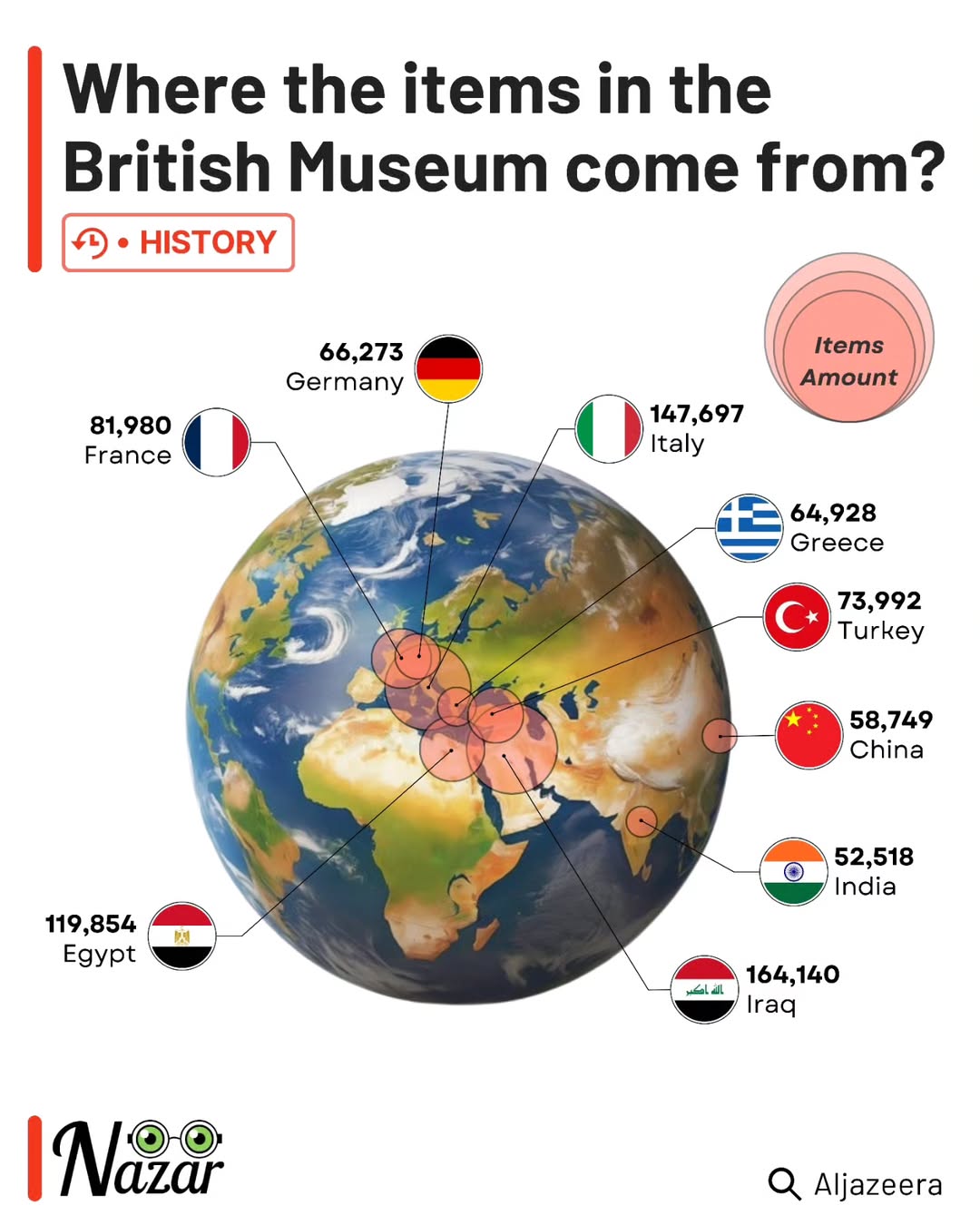
The map above shows the country of origin where of items in the British Museum’s collection. It based on the research by Al Jazeera..
An analysis by Al Jazeera of the British Museum’s online database, as of August 30, found that 2.2 million items from at least 212 different countries around the world had been catalogued.
Here are their findings by country:
| Country / Territory | Number of Items In Collection |
|---|---|
| England | 625,371 |
| Iraq | 164,140 |
| Italy | 147,697 |
| Egypt | 119,854 |
| France | 81,980 |
| Turkey | 73,992 |
| Germany | 66,273 |
| Greece | 64,928 |
| China | 58,749 |
| India | 52,518 |
| Iran | 50,652 |
| Japan | 42,649 |
| USA | 29,280 |
| Israel | 25,652 |
| Palestine | 23,766 |
| Syrian | 22,021 |
| Papua New Guinea | 18,171 |
| Nigeria | 16,496 |
| Netherlands | 16,489 |
| Mexico | 16,440 |
| Switzerland | 16,040 |
| Scotland | 14,637 |
| Afghanistan | 14,589 |
| Sudan | 14,501 |
| Cyprus | 13,993 |
| Ireland | 12,067 |
| Spain | 11,613 |
| South Africa | 10,991 |
| Pakistan | 10,407 |
| Australia | 10,068 |
| Indonesia | 10,062 |
| Belgium | 9,492 |
| Ghana | 9,439 |
| Congo | 9,353 |
| Peru | 9,269 |
| DRC | 8,810 |
| Solomon Islands | 8,727 |
| Russia | 8,666 |
| Canada | 8,580 |
| Austria | 8,114 |
| Wales | 7,487 |
| Kenya | 7,240 |
| Jamaica | 6,955 |
| North Macedonia | 6,533 |
| Lebanon | 5,986 |
| New Zealand | 5,909 |
| Libya | 5,796 |
| Sri Lanka | 5,533 |
| Belize | 4,963 |
| Tunisia | 4,927 |
| Myanmar | 4,418 |
| Croatia | 4,405 |
| Denmark | 4,265 |
| Malaysia | 4,229 |
| Tanzania | 4,214 |
| Bulgaria | 4,182 |
| Ecuador | 4,044 |
| Algeria | 4,003 |
| Jordan | 3,901 |
| Sweden | 3,816 |
| Uganda | 3,723 |
| Guatemala | 3,714 |
| Turkmenistan | 3,710 |
| Nepal | 3,703 |
| Ukraine | 3,534 |
| Thailand | 3,489 |
| Poland | 3,464 |
| Vietnam | 3,300 |
| Argentina | 3,289 |
| Yemen | 3,207 |
| Colombia | 3,106 |
| Hungary | 3,027 |
| Zimbabwe | 3,012 |
| Chile | 2,981 |
| Ethiopia | 2,923 |
| Brazil | 2,889 |
| Morocco | 2,887 |
| Fiji | 2,767 |
| Niger | 2,756 |
| Vanuatu | 2,749 |
| Portugal | 2,462 |
| Chad | 2,438 |
| Bolivia | 2,415 |
| Zambia | 2,374 |
| Somalia | 2,280 |
| Northern Ireland | 2,232 |
| Angola | 2,136 |
| Malta | 2,079 |
| Norway | 2,055 |
| Guyana | 2,054 |
| Taiwan | 1,838 |
| Uzbekistan | 1,797 |
| Madagascar | 1,789 |
| South Sudan | 1,775 |
| Romania | 1,749 |
| Greenland | 1,746 |
| Tonga | 1,716 |
| Malawi | 1,706 |
| French Polynesia | 1,643 |
| Saudi Arabia | 1,627 |
| Honduras | 1,599 |
| Hong Kong | 1,569 |
| Cameroon | 1,487 |
| Micronesia | 1,462 |
| Panama | 1,431 |
| Samoa | 1,409 |
| Philippines | 1,373 |
| Serbia | 1,349 |
| Vatican City | 1,204 |
| Costa Rica | 1,076 |
| Albania | 1,073 |
| Oman | 1,019 |
| Finland | 1,000 |
| Czech Republic | 997 |
| Sierra Leone | 997 |
| Paraguay | 962 |
| Latvia | 895 |
| Maldives | 866 |
| Trinidad and Tobago | 788 |
| Mali | 735 |
| Cook Islands | 716 |
| Mozambique | 681 |
| Kiribati | 672 |
| Rwanda | 657 |
| Jersey | 650 |
| Bangladesh | 639 |
| UAE | 636 |
| Botswana | 604 |
| Isle of Man | 599 |
| Venezuela | 596 |
| Lesotho | 595 |
| Singapore | 592 |
| Cambodia | 579 |
| New Caledonia | 568 |
| Gabon | 552 |
| Tajikistan | 491 |
| Georgia | 483 |
| Gibraltar | 482 |
| South Korea | 444 |
| Benin | 439 |
| Togo | 438 |
| Bhutan | 435 |
| Ivory Coast | 419 |
| Armenia | 418 |
| Barbados | 415 |
| Bahrain | 405 |
| Brunei | 405 |
| Mauritius | 397 |
| Liberia | 387 |
| Mauritania | 343 |
| Gambia | 341 |
| Suriname | 334 |
| Iceland | 333 |
| Nicaragua | 331 |
| Guinea-Bissau | 329 |
| Namibia | 328 |
| Haiti | 327 |
| Senegal | 319 |
| Cuba | 314 |
| Guernsey | 306 |
| Guinea | 295 |
| Kyrgyzstan | 288 |
| Azerbaijan | 284 |
| Luxembourg | 274 |
| Slovakia | 273 |
| Estonia | 269 |
| Kuwait | 245 |
| Burkina Faso | 244 |
| Dominican Republic | 240 |
| Uruguay | 240 |
| Bermuda | 232 |
| Grenada | 216 |
| North Korea | 210 |
| Montenegro | 210 |
| Laos | 205 |
| Lithuania | 204 |
| Bosnia and Herzegovina | 197 |
| Kazakhstan | 180 |
| Tuvalu | 175 |
| Palau | 166 |
| Mongolia | 163 |
| Seychelles | 163 |
| Burundi | 155 |
| Bahamas | 150 |
| Equatorial Guinea | 142 |
| Central African Republic | 141 |
| Marshall Islands | 140 |
| Monaco | 135 |
| Djibouti | 128 |
| El Salvador | 112 |
| Macau | 100 |
| Eritrea | 95 |
| Belarus | 91 |
| Dominica | 88 |
| Cayman Islands | 84 |
| Slovenia | 84 |
| Cape Verde | 72 |
| Eswatini | 70 |
| Qatar | 63 |
| Martinique | 61 |
| Guadeloupe | 51 |
| Aruba | 37 |
| San Marino | 35 |
| Moldova | 33 |
| Faroe Islands | 30 |
| French Guiana | 29 |
| Nauru | 27 |
| East Timor | 24 |
| Guam | 18 |
| Liechtenstein | 13 |
| Anguilla | 5 |
| Andorra | 4 |
Top 10 Countries of Origin In The British Museum Collection

Here’s summary of some of the limits of the information above:
The British Museum has been expanding its database for over 40 years, but has only catalogued about half of its collection, which contains over two million records.
Despite ongoing errors and omissions, the museum chooses to make this data publicly available. In April 2020, the museum revamped its online collection, making 4.5 million objects and 1.9 million images accessible to the public.
The digitisation process is ongoing, aiming for completion as soon as possible.
As of August 30, Al Jazeera’s analysis showed 2.2 million items from 212 countries catalogued, with the UK having the largest share (649,727 items), primarily from England.
Significant numbers of items also come from countries such as Iraq, Italy, Egypt, France, Turkey, Germany, Greece, China, and India.
What controversies are there with the British Museum’s collection?
The British Museum faces several controversies regarding its collection:
- Theft and Mismanagement: Recently, the museum has been embroiled in a scandal involving the theft of approximately 2,000 items, suspected to be an inside job. This incident has highlighted the issue of poor inventory management, as many items in the collection are uncatalogued, making it difficult to track or identify missing objects (Physorg).
- Repatriation of Artifacts: The British Museum has been under pressure to return several contested items to their countries of origin. Notable examples include the Elgin Marbles (Parthenon Marbles) and the Benin Bronzes. Greece has long requested the return of the Elgin Marbles, arguing that they were taken illegally by Lord Elgin. Similarly, Nigeria has demanded the return of the Benin Bronzes, looted by British forces in 1897. The museum has resisted these requests, citing the British Museum Act of 1963, which restricts the deaccessioning of objects except under specific conditions (Observer) (British Museum).
- Imperial Legacy: The museum’s collection, which includes many items acquired during the British Empire’s expansion, has been criticized for representing colonial exploitation. There are ongoing debates about whether these items were acquired legitimately or through coercion and plunder during periods of imperial rule (British Museum).
- Legal and Ethical Issues: The British Museum’s legal framework complicates the repatriation of items. The British Museum Act 1963 and other related laws prevent the return of objects unless they are duplicates, damaged, or unfit for the collection. Critics argue that these laws are outdated and serve to maintain the status quo rather than address historical injustices (Observer).
What are the 10 must see items at the British Museum?
Here are ten must-see items at the British Museum, showcasing its diverse and rich collection:
- Rosetta Stone: Located in Room 4, this granodiorite stele from 196 BC was crucial in deciphering Egyptian hieroglyphs, making it one of the museum’s most famous artifacts (British Museum) (Four Thousand Weeks).
- Parthenon Marbles (Elgin Marbles): These classical Greek marble sculptures from the Parthenon in Athens are displayed in Room 18. They are central to ongoing repatriation debates (World by Isa) (Four Thousand Weeks).
- Hoa Hakananai’a: A significant Moai statue from Easter Island, located in Room 24. It features carvings associated with the Birdman cult, making it a notable example of Rapa Nui art (British Museum) (Four Thousand Weeks).
- Bust of Ramesses the Great: This colossal granite bust of the Egyptian Pharaoh Ramesses II, weighing 7.5 tonnes, is a striking piece in Room 4 (British Museum) (World by Isa).
- The Lewis Chessmen: Housed in Room 40, these medieval chess pieces were likely made in Norway around AD 1150-1200. They reflect the cultural connections between the British Isles and Scandinavia (Four Thousand Weeks).
- Benin Bronzes: These brass plaques from the Kingdom of Benin, displayed in Room 25, date back to the 16th-17th centuries and are important cultural artifacts seized during British colonial rule (Four Thousand Weeks).
- The Book of the Dead – Papyrus of Ani: This well-preserved funerary text, located in Room 62, contains spells to assist the dead in the afterlife and is one of the oldest books in the world (World by Isa).
- Tree of Life: Created from decommissioned weapons by artists from Mozambique, this sculpture in Room 25 symbolizes peace and transformation after civil war (British Museum).
- The Ife Head: A naturalistic brass head from the 14th-15th century, representing the Ooni of Ife, an important cultural and spiritual figure in West African history, displayed in Room 25 (British Museum).
- The Akan Drum: This 18th-century drum from Ghana, found in Virginia, USA, is the earliest African-American object in the museum’s collection and is located in Room 25 (British Museum).
Also see:
What do you think of the British Museum? Leave your comments below:




Aquiles Vaesa says
Perhaps the objects out of their original sites cause sensible critiques from nationalism and chauvinism, but, it is very well known that if British were not collect the items the were still lost and, we currently would not know about history as we do. Reading this interesting map, I can realize that, eventually, British Museum has more objects than Colombians.
Upadhyay Rathi Raj says
Funny. It like saying, “Had we not looted you, your wealth would have been kept hidden from us!” Taking away the properties, treasures, artefacts, etc, without consent, is still called robbery, I presume.