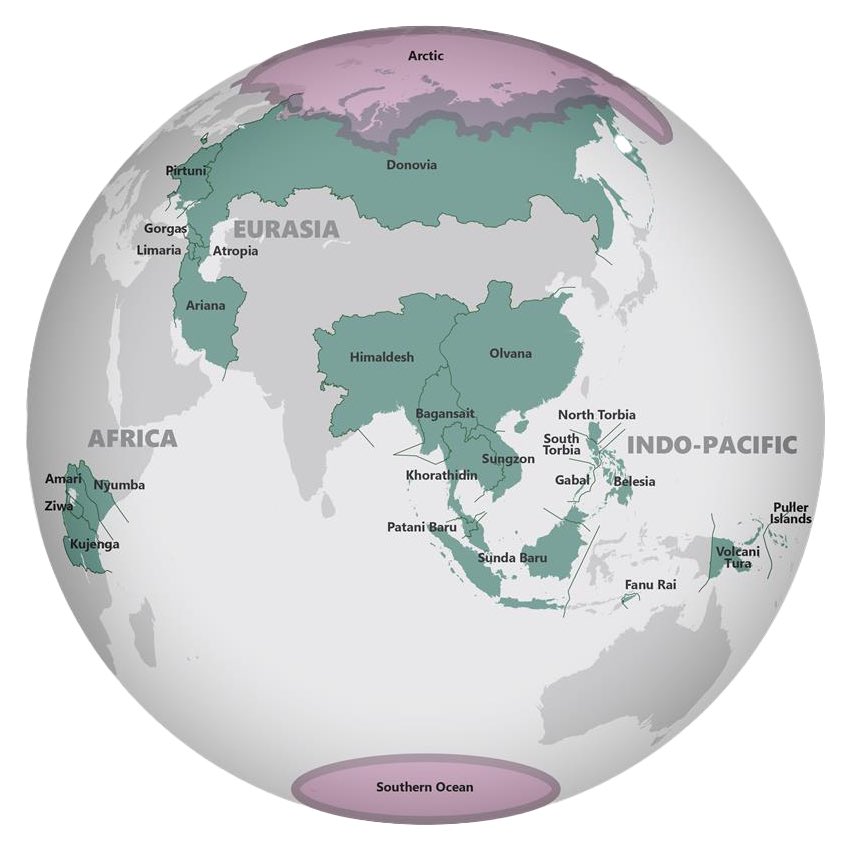
It is essentially the U.S. Army’s enormous fictional geopolitical universe for training exercises.
More about it:
It is a bit like a military version of a very detailed strategy-game world: invented countries have governments, ethnic groups, religions, territorial disputes, economies, pipelines, political parties, armed forces, cyber capabilities, insurgents and decades of invented history.
The important twist is that the fictional states are deliberately constructed from real-world geography and real-world adversaries.
They are not supposed to be exact replicas, but in some cases the inspiration is extremely obvious.
Today DATE has grown into a global system of 24 notional countries across five interconnected regions, but the original and probably best-known setting is the Caucasus.
Why did the Army create it?
DATE emerged around 2012, as the Army began moving away from almost exclusively preparing units for Iraq and Afghanistan. Rather than telling a brigade, “You’re going to Iraq, here is the Iraqi situation,” the Army wanted an environment in which units could face almost anything: conventional armies, guerrillas, terrorists, criminal networks, cyberattacks, information warfare, drones, refugees and political crises simultaneously.
The Army describes it as an unclassified, intelligence-informed foundation for scenario development.
A DATE country can be friendly, neutral or hostile depending on the exercise. The fictionalization also allows the Army to reproduce realistic Russian-, Iranian-, Chinese- or North Korean-style capabilities without literally declaring “Russia attacks NATO” every time soldiers train. Current Army guidance explicitly says the countries are composites of real states and threat characteristics and that DATE deliberately avoids directly depicting specific real-world governments as the adversary.
The original Caucasus DATE world is particularly fascinating.
| DATE country | Obvious real-world inspiration | Basic role in the lore |
|---|---|---|
| Donovia | Russia | Resurgent former regional hegemon; powerful military; frequently the principal adversary |
| Ariana | Iran | Revolutionary Islamic regional power opposed to Western influence |
| Atropia | Azerbaijan | Oil-rich, strategically important state often looking to the West for help |
| Gorgas | Georgia | Small pro-Western state threatened by Donovia and separatist territories |
| Limaria | Armenia | Small landlocked state allied closely with Donovia and involved in a territorial conflict with Atropia |
| Pirtuni | Ukraine | Later addition: Western-oriented former Donovian/Soviet sphere state threatened by Donovia |
The parallels go considerably beyond vague inspiration.
Atropia: essentially fictional Azerbaijan
Atropia’s capital is actually Baku. It borders the Caspian Sea, possesses major oil and gas reserves and is the starting point for a strategically important westward petroleum pipeline. Its security problem revolves around a disputed territory called Lower Janga.
Atropia usually plays the role of a vulnerable state in which American forces have a reason to intervene.
One frequently used National Training Center storyline has Donovia invade Atropia and capture the city of Razish, threatening the region’s hydrocarbon exports. U.S. forces then deploy to defend or liberate Atropia.
That particular invasion isn’t necessarily “the definitive DATE canon,” exercise designers can change events, but it became so commonly used that generations of American soldiers have jokingly talked about repeatedly having to save Atropia.
Limaria: fictional Armenia
Limaria’s capital is Yerevan, it is landlocked and it maintains strong military and economic relations with Donovia.
Its central issue is Lower Janga, a region legally associated with Atropia but overwhelmingly populated by ethnic Limarians and occupied by Limaria. Hundreds of thousands of people have been displaced by the conflict.
The analogy is barely disguised:
Atropia + Limaria + Lower Janga = Azerbaijan + Armenia + Nagorno-Karabakh.
An interesting bit of DATE history is that Limaria used to be called Minaria.
In DATE 2.2 in 2015, the Army renamed Minaria to Limaria and renamed the disputed province from Artzak to Lower Janga, “Artzak” was presumably considered rather too close to Artsakh, the Armenian name associated with Nagorno-Karabakh.
That is why older Army material sometimes says Minaria while newer material says Limaria.
Gorgas: fictional Georgia
This one is equally transparent. Its capital is Tbilisi.
Gorgas wants closer relations with NATO and the EU, while Donovia tries to prevent that. Donovia supports two separatist regions called Zabzimek and South Ostremek.
They correspond rather neatly to:
Abkhazia and South Ossetia.
The basic lore has Gorgas locked in a “frozen conflict” with its much larger Donovian neighbour while simultaneously trying to orient itself towards the West, essentially a fictionalized version of Georgia’s post-Soviet geopolitical position.
Ariana: fictional Iran
Ariana may be the least disguised of all. Its capital is Tehran, its population is predominantly Shia Muslim, it sits on the Persian Gulf and Strait of Hormuz, and its government is described as a revolutionary theocracy seeking regional hegemony.
Ariana opposes Western influence, supports sympathetic movements elsewhere, has major oil and gas resources and fields sophisticated conventional, irregular, cyber and missile-related capabilities.
Older DATE lore even gives Ariana nuclear ambitions, clandestine forces abroad and a strategy of preventing outside intervention, essentially allowing Army exercises to reproduce many of the strategic problems associated with Iran without simply calling the enemy Iran.
Donovia: fictional Russia
Donovia is the great power around which much of the original universe revolves.
Its capital is Moscow. It was once the overwhelmingly dominant regional state before undergoing a period of political and economic weakness. Rising energy revenues subsequently allow it to rebuild its military and attempt to restore its former sphere of influence.
That’s essentially the narrative of:
Soviet collapse → weak 1990s Russia → resurgent Russia.
Donovia possesses the region’s largest army, navy and air force as well as nuclear, cyber and space capabilities. It interferes in neighbouring countries and regards Western penetration of its traditional sphere of influence as threatening.
The Army actually updated Donovia substantially in 2024, merging previously separate versions of the country so that one Donovia could function across multiple theaters and better support large-scale combat exercises.
Pirtuni: fictional Ukraine
Pirtuni is a more recent and astonishingly explicit addition.
It is situated on the northern Black Sea, wants EU and NATO membership and contains eastern populations oriented towards Donovia. Donovia claims some Pirtunian territory.
Its military facilities include Kyiv, Odesa, Mariupol and Sevastopol, and its history involves independence from the fictional United Federation of Socialist Republics. Donovia’s Black Sea Fleet even operates from Sevastopol.
So:
- UFSR = USSR
- Donovia = Russia
- Pirtuni = Ukraine.
It’s an excellent example of how DATE can be simultaneously “fictional” and extremely recognizable.
The central Caucasus lore
Put everything together and the fictional universe looks something like this:
Donovia once dominated the region but lost control of several neighbouring states. It now wants its influence back.
Gorgas and Atropia increasingly look westward for security.
Limaria depends heavily on Donovia.
Ariana wants to push Western influence out while becoming the dominant power farther south.
Meanwhile Atropia and Limaria are locked in their own ethnic territorial conflict over Lower Janga, Gorgas has Donovian-backed separatists, Caspian oil and gas must pass through vulnerable pipelines, ethnic minorities cross borders, and criminal and insurgent groups exploit the instability.
The original DATE document explicitly describes the Caucasus as a web of unresolved ethnic disputes, energy interests, pipelines, organized crime, refugee movements and competing great powers.
That complexity is deliberate.
Why invent all that background?
Because the Army isn’t only testing whether soldiers can shoot accurately.
A commander might suddenly have to decide:
- whether destroying a bridge stops an enemy division but also cuts humanitarian supplies;
- whether an armed group is an enemy proxy, local militia or criminal gang;
- how to defend a pipeline while fighting conventional forces;
- how to deal with refugees moving through a combat zone;
- whether social-media reports are genuine or Donovian information warfare;
- how ethnic Limarians living in Atropia might react to American troops;
- how to operate when GPS, communications or computer networks are attacked.
DATE therefore models PMESII-PT: Political, Military, Economic, Social, Information, Infrastructure, Physical Environment and Time, rather than simply providing an enemy order of battle.
So the enormous amount of apparently unnecessary lore is actually the point. A fake country with nothing beyond “the bad guys live here” wouldn’t force intelligence officers, logistics planners, civil-affairs specialists or commanders to think through the wider consequences of their decisions.
And DATE has now become much bigger
The Caucasus was only the beginning. DATE subsequently expanded into Africa, Europe, the Indo-Pacific and the polar regions, with the different settings gradually becoming a single interconnected “DATE World.”
The Army currently describes it as 24 notional countries and one interwoven global narrative.
The Indo-Pacific version includes states such as Olvana, the region’s huge would-be hegemon and obvious vehicle for reproducing Chinese capabilities; North Torbia, an extremely militarized state suited to North Korean-style scenarios; Himaldesh, a huge nuclear-armed democracy; and numerous Southeast Asian and island states.
So what began as “American troops fight Donovia in Atropia” has evolved into something approaching an entire alternate geopolitical Earth.
And some of the lore is remarkably deep. the 2015 Caucasus DATE manual alone runs to more than 800 pages, which you can read here.
More about some of the expanded universe:
Indo-Pacific
This is now DATE’s largest and probably most interesting region (as you can see in the map above).
Its overarching geopolitical story is essentially a China-like great power trying to dominate a collection of democracies, authoritarian states, divided nations and smaller island countries, with the United States and allies potentially becoming involved.
The Army specifically identifies Olvana and North Torbia as “pacing threats.”
| DATE country | Closest real-world inspiration | Main idea |
|---|---|---|
| Olvana | 🇨🇳 China | Communist regional superpower seeking hegemony |
| North Torbia | 🇰🇵 North Korea | Militarized totalitarian state |
| South Torbia | 🇰🇷 South Korea | Wealthy democracy threatened by the North |
| Himaldesh | 🇮🇳 India | Huge non-aligned nuclear democracy |
| Bagansait | 🇲🇲 Myanmar | Military junta and ethnic conflict |
| Khorathidin | 🇹🇭 Thailand + parts of Laos/Cambodia | Monarchy, coups, U.S.-friendly regional state |
| Sungzon | 🇻🇳 Vietnam | Communist but increasingly independent regional power |
| Belesia | 🇵🇭 Philippines | Fragmented island democracy with insurgencies |
| Gabal | Palawan + Pacific island-state characteristics | Tiny vulnerable island democracy |
| Sunda Baru | 🇮🇩 Indonesia + much of 🇲🇾 Malaysia | Expansionist Malay-Indonesian regional power |
| Patani Baru | Northern Malaysia/Pattani | Weak decentralized federation |
| Volcani Tura | 🇵🇬 Papua New Guinea | Resource-rich but weak Melanesian state |
| Puller Islands | 🇸🇧 Solomon Islands | Small post-conflict Pacific state |
| Fanu Rai | 🇹🇱 Timor-Leste | Young oil-rich democracy |
Olvana: the China analogue
Olvana is probably the most important current DATE adversary.
It is the largest country and economy in the Indo-Pacific region, ruled by the Olvanan Communist Party, possesses a huge military, nuclear weapons, sophisticated cyber capabilities, missiles, satellites, aircraft carriers and a genuinely global navy.
Its strategic objective is straightforward: become the regional hegemon and keep outside powers, especially Western powers, from dominating its neighbourhood.
It provides weapons and advisers to friendly governments, supports North Torbia and attempts to draw smaller countries into its economic and political orbit. Official DATE material even describes Olvanan fishing vessels entering Gabal’s waters, which rather obviously echoes disputes involving Chinese fishing fleets and maritime militias.
For training purposes, Olvana = the peer opponent. It lets the Army practise a China-type war involving missiles, cyberwarfare, satellites, amphibious operations, air defence, naval warfare and contested logistics.
One established DATE scenario, Operation Steel Sentinel, actually has Olvana invade the Belesian island of Panay, prompting an Australian-led multinational intervention.
North Torbia: North Korea
North Torbia is perhaps even less subtle.
It calls itself the Democratic People’s Republic of Torbia, occupies northern Luzon and is a totalitarian one-party state based around militarism, self-reliance and a cult of personality.
More than half a million personnel are on active duty, it spends roughly 20% of GDP on defence, maintains massive reserves and directs most of its army toward South Torbia. DATE also gives it nuclear and ICBM ambitions.
So politically:
North Torbia = North Korea.
But geographically it isn’t Korea: DATE has transplanted the Korean division onto the Philippine island of Luzon.
That makes the setting useful without literally staging a war on the Korean Peninsula.
South Torbia: South Korea
South Torbia occupies the southern half of Luzon and is essentially North Torbia’s mirror image.
It is a wealthy, stable constitutional democracy with a powerful modern military and universal male military service, created largely because of the threat posed by North Torbia.
North Torbia wants reunification under its regime; South Torbia wants to deter an invasion. Olvana backs the North while South Torbia increasingly acquires American equipment and doctrine.
So its strategic model is overwhelmingly:
South Korea + Philippine geography.
DATE’s Operation Bronze Achilles has a U.S.-led multinational coalition fighting North Torbian forces in South Torbia.
Himaldesh: India
Himaldesh is one of the more obvious analogues.
It is a:
- gigantic constitutional democracy;
- nuclear-armed state;
- traditionally non-aligned power;
- enormous military power;
- operator of Western, indigenous and Donovian-derived equipment;
- increasingly important counterweight to Olvana.
That is essentially India.
The interesting part is that Himaldesh isn’t automatically America’s ally. It continues relations with Donovia while simultaneously developing stronger Western relationships.
Its role is therefore the strategic swing power: powerful enough to counter Olvana but sufficiently independent that the Americans cannot simply assume it will join them.
Bagansait: Myanmar
Bagansait is almost unmistakably Myanmar.
Officially it is a constitutional republic, but in practice the military junta controls the country. It suffers from ethnic conflicts, insurgencies, political repression and repeated military coups.
Its Army is particularly experienced in jungle warfare and counterinsurgency.
The geopolitics are equally revealing. Bagansait borders Olvana, and Olvana values Bagansait because it provides access to the Indian Ocean. International sanctions have also pushed Bagansait toward Olvanan weapons and political support.
So it lets exercises explore civil war, insurgency, junta politics and a China-like power obtaining strategic access to the Indian Ocean.
Khorathidin: Thailand
Khorathidin is centered on Bangkok, was historically known as Siam, has a constitutional monarchy and has repeatedly swung between civilian government and military coups.
So the Thailand connection could hardly be clearer.
Interestingly, DATE enlarges it beyond modern Thailand: its fictional historical territory incorporates Khmer and Lao populations as well.
The lore says the country has gradually democratized but periodically experiences military intervention, the latest fictional history even retains 2014 as the date of a coup, exactly matching Thailand.
In Army professional military education scenarios, Khorathidin is normally friendly to the United States, and one storyline involves the U.S. coming to its assistance following an Olvanan invasion.
It is therefore an excellent “regional partner threatened by China-like great power” scenario.
Sungzon: Vietnam
Sungzon is another very recognizable one.
It is a single-party socialist republic that has retained authoritarian Communist politics while gradually introducing a market economy and attracting foreign investment.
Its military is large, heavily ground-oriented and historically dependent on Donovian equipment. It also possesses considerable coastal anti-ship capabilities.
Most importantly, although Sungzon is Communist, it is wary of Olvana’s dominance. The Army describes it as a “foil” to Olvana’s maritime power.
That’s almost exactly the strategic situation of Vietnam relative to China.
So DATE isn’t simply:
Communists = one bloc.
Instead, Sungzon demonstrates that a socialist authoritarian country could nevertheless cooperate with the U.S. because it fears a more powerful neighbour.
Belesia: Philippines
Belesia is a young federal island democracy struggling with terrorism, political instability, weak infrastructure and the tension between local autonomy and central government authority.
Its geography includes real Philippine locations such as Panay, and one major DATE exercise involves an Olvanan invasion of Panay.
So it is strongly Philippine-inspired.
There’s actually an entertaining geographic trick here:
DATE effectively breaks the real Philippines into several fictional countries.
Luzon becomes North and South Torbia, much of the central/southern archipelago becomes Belesia, and Palawan-like territory becomes Gabal.
That allows exercise designers to create Korean-, Philippine- and Pacific-island-style problems within the same geographically realistic battlespace.
Gabal: Palawan/Pacific island-state composite
Gabal is much harder to assign to one real country.
Its physical setting draws heavily from Palawan, but its political history resembles various small Pacific island countries.
It gained independence in 1977 after being jointly administered by two Western European powers, has a deeply federalized tribal political structure, is vulnerable to climate change and possesses a tiny military primarily concerned with:
illegal fishing, smuggling and natural-resource protection.
It cannot realistically defend itself against Olvana.
That is exactly why it exists in DATE: Gabal creates a scenario where great-power competition occurs below the threshold of war.
Olvana does not necessarily need to invade Gabal. Fishing fleets, economic pressure, political influence and military assistance can gradually shift the country’s orientation.
Sunda Baru: an Indonesian-Malaysian superstate
This one has particularly fun alternate-history lore.
The Sunda Baru Federation was supposedly created in 1985 through the union of Indonesia with the Malaysian states of Johor, Sarawak, Pahang, Selangor, Terengganu, Melaka and Negeri Sembilan.
By 2005 it had become an expansionist regional military power.
Sunda Baru believes that both:
Patani Baru
and Singapore
are illegitimate breakaway governments and believes the entire Malay Peninsula should ultimately be reunited.
So it isn’t merely “fictional Indonesia.” It is an alternate-history Indonesia–Malaysia superstate with irredentist ambitions.
Its military includes airborne forces, submarines, sophisticated air defences and cyberwarfare capabilities.
This gives DATE a medium-sized regional adversary: more powerful than the small Pacific states but nowhere near Olvana.
Patani Baru: the Malay buffer state
Patani Baru is Sunda Baru’s much weaker neighbour.
It consists of five highly autonomous provinces:
four are constitutional monarchies and one is a constitutional republic.
Each province has its own constitution and leadership, leaving the federal government comparatively weak.
That arrangement strongly resembles aspects of Malaysia’s federal monarchy system, mixed with the history and geography of the Malay Peninsula and Pattani.
Its central problem is Sunda Baru.
Sunda Baru regards Patani Baru’s independence as illegitimate, while Patani Baru lacks the military strength to resist a major invasion without foreign assistance. Its navy also operates around one of the world’s most strategically important waterways, the Strait of Malacca.
Hence the training problem is:
How do you defend a small partner against a much larger regional neighbour while keeping the Strait of Malacca open?
Volcani Tura: Papua New Guinea
Volcani Tura is extremely close to Papua New Guinea.
It occupies the eastern half of New Guinea, became independent in 1975, maintains strong Australian connections and even has military units descended from Australian-led indigenous forces raised during WWII.
It is democratic and enormously resource-rich but suffers from poverty, poor infrastructure, weak state capacity and limited military resources.
Its location is strategically important because it sits between the Coral and Arafura Seas close to Australia.
So DATE can use Volcani Tura for:
HADR/disaster relief, peacekeeping, resource competition, foreign influence, jungle operations and protection of maritime approaches to Australia.
Puller Islands: Solomon Islands
The Puller Islands are essentially the Solomon Islands with the serial numbers filed off.
The fictional country contains around 1,000 islands and balances relationships with Australia, America and Olvana while dealing with corruption, weak institutions and limited resources.
Even the name is a joke: the islands are named after legendary U.S. Marine Lewis “Chesty” Puller.
It provides a near-perfect setting for contemporary Pacific great-power competition without saying “Solomon Islands and China.”
Fanu Rai: Timor-Leste
Fanu Rai is one of the newest DATE countries, added in the 2025 Indo-Pacific expansion.
The Army describes it as:
a semi-presidential republic on the eastern half of Timor, shaped by a history of resistance followed by democratic consolidation and possessing significant offshore oil and gas resources.
So yes:
Fanu Rai = Timor-Leste.
Its purpose is less about creating another enemy and more about reproducing the strategic problems surrounding small developing states: maritime boundaries, energy resources, foreign investment, infrastructure, political influence and competition between larger powers.
DATE Africa
The African setting is somewhat different. The four states are far more composite than Olvana = China or Himaldesh = India.
DATE Africa overlays fictional states onto East African geography around Lake Victoria, Kenya, Tanzania and the Horn of Africa, combining characteristics from numerous real countries.
The overall theme is that local conflicts involving ethnicity, religion, resources or insurgencies can become much bigger conflicts once outside powers begin supporting different sides.
Amari: Kenya-heavy Western partner
Amari’s capital is Kisumu, and it is probably best understood as a Kenya-heavy composite, although its DATE borders do not simply reproduce Kenya.
It is one of the region’s more successful states:
relatively stable democracy → pro-Western → receives considerable American assistance → professional military → significant peacekeeping experience.
But underneath that stability are ethnic political rivalries, corruption, terrorism and border-security problems.
Its training role is therefore the reasonably capable African partner that the U.S. might assist rather than fight. The Army describes it as a functioning democracy receiving significant U.S. and Western support.
Kujenga: Tanzania-heavy state
Kujenga is strongly Tanzania-inspired geographically and historically.
It contains places such as the Tanga area and has a post-colonial history involving a powerful single political party dominating politics for decades.
The fictional People of Change became the governing party around independence and subsequently developed into an entrenched political elite.
The government is formally constitutional but increasingly authoritarian, with corruption, shrinking democratic space and unrest, particularly involving the Tanga region.
This gives exercise designers scenarios involving:
government repression, separatists, guerrillas, corruption, insurgency and external intervention.
So Kujenga is more of a Tanzania-based political composite than a direct fictional Tanzania.
Nyumba: Somalia/Horn-of-Africa conflict state
Nyumba is DATE Africa’s nightmare scenario.
It has experienced coups, authoritarian rule and eventually an Islamist government based partly on its interpretation of Sharia law.
Tribal, ethnic, economic and religious divisions have fueled decades of civil war.
Some areas have effectively become safe havens for:
terrorists, insurgents, criminals and other armed groups.
Refugees and armed organizations then spill across the country’s borders.
So the influences seem to come from several places:
Somalia + Sudan + other Horn/East African civil conflicts.
Its purpose is to create a complicated failed/fragile-state environment where American troops might simultaneously face terrorism, militias, refugees, government troops and criminal groups.
Ziwa: Great Lakes composite
Ziwa is a small landlocked country on the southern end of Lake Victoria.
Unlike Nyumba, it possesses significant mineral wealth and a growing technology-based economy, and its leaders want it to become an important African power.
But its history contains political turmoil, ethnic conflict, rebellions and unstable relations with its neighbours.
I wouldn’t assign Ziwa to a single country. It looks more like a blend of Rwanda, Burundi, Uganda, Tanzania and Great Lakes/central African political themes.
Its role is particularly useful because it isn’t simply “poor failed African state.” It is a potentially successful but politically fragile country whose mineral wealth attracts foreign powers.
The five Legacy Europe countries
These are worth knowing because you’ll encounter them in older DATE material, but the current Army site labels them explicitly as “Legacy Europe”, so they’re not part of the modern 24-country count.
Their origin is fascinating.
They were inherited from NATO’s fictional Skolkan exercise world. NATO needed countries on realistic European terrain without having real NATO countries become fictional aggressors.
So Sweden and Finland allowed their geography to be divided into fictional countries for the exercises. NATO created an entire fictional history involving the collapse of a former Skolkan Empire.
| Country | Basic character |
|---|---|
| Bothnia | Authoritarian socialist aggressor allied with Donovia |
| Torrike | Nationalistic remnant of the old Skolkan Empire |
| Framland | Wealthy, neutral, Western-leaning democracy |
| Otso | Finland-like buffer state squeezed between larger powers |
| Arnland | Weak neutral democracy seeking closer European integration |
Bothnia
Bothnia was originally conceived by NATO as an authoritarian state based partly on old East Germany.
It is socialist, heavily militarized, hostile toward NATO and closely linked with Donovia. In several exercise storylines Bothnia threatens or attacks Baltic territory.
Essentially it gives NATO/Army exercises a Russian-aligned European aggressor that isn’t Russia.
Torrike
Torrike is the surviving core of the old fictional Skolkan Empire.
It considers itself the historic regional leader and has nationalist and authoritarian tendencies. Its relationship with Bothnia is complicated because both countries seek regional influence and have territorial disputes.
So they’re not automatically allies just because both dislike NATO.
Framland
Framland is a prosperous, stable, historically neutral country.
Think of the traditional foreign-policy position of Sweden or Finland during the Cold War: Western economically and culturally, but reluctant to formally join competing military blocs.
That gives commanders the political problem of operating around a friendly neutral country whose government does not necessarily want to become a belligerent.
Otso
Otso is perhaps the most Finnish-looking geographically.
It functions as a buffer between Donovia and the other Nordic fictional states and historically attempts to preserve its neutrality.
The exercise dilemma is therefore classic Finnish geopolitics:
How much can a smaller country cooperate with the West without provoking the giant power next door?
Arnland
Arnland is a weaker democratic republic on the southern part of the fictional Nordic peninsula.
It wants stronger integration with Western Europe but suffers from political and military weaknesses.
It can therefore function as a vulnerable partner/failing-state type environment rather than a major adversary.
The cleverest part of DATE
What makes DATE particularly interesting is that the countries aren’t simply renamed real states.
The designers sometimes deliberately mix geography from one country with politics from another.
For example:
North Torbia = North Korean political system + Philippine geography
South Torbia = South Korean strategic situation + Philippine geography
Gabal = Palawan geography + Pacific microstate politics
Khorathidin = Thai core + Lao/Khmer territory
Sunda Baru = Indonesia + much of Malaysia
That makes it harder for soldiers to simply think:
“Olvana is China, therefore just apply everything I know about China.”
Instead they have to analyse the fictional intelligence in front of them.
And that is really the point of DATE. The Army explicitly says that DATE provides the environment, not the scenario. The same state could be an enemy in one exercise, a neutral actor in another and a coalition partner in a third.
The overall DATE world therefore gives the Army something remarkably close to its own alternate-history geopolitical Earth, complete with wars, disputed borders, former empires, ethnic grievances, alliances, nuclear weapons, terrorist groups and competing great powers.
Further Reading
- U.S. Army – Decisive Action Training Environment (DATE)
- U.S. Army – Decisive Action Training Environment: Future Training Grounded in Today’s Intelligence
- Decisive Action Training Environment (DATE) – Caucasus Scenario Manual PDF
- U.S. Army – U.S. Forces Fight in the Atropian City of Razish
- U.S. Army – DATE Update: One Donovia
- U.S. Army – DATE World Users Blog: What Is DATE World?
- Australian Army DATE – Atropia
- Australian Army DATE – Limaria
- Australian Army DATE – Gorgas
- Australian Army DATE – Ariana
- Australian Army DATE – Donovia
- Australian Army DATE – Pirtuni
- Australian Army DATE – Indo-Pacific Operating Environment
- Australian Army DATE – Olvana
- Australian Army DATE – North Torbia
- Australian Army DATE – South Torbia
- Australian Army DATE – Himaldesh
- Australian Army DATE – Bagansait
- U.S. Army – Decisive Action Training Environment: Khorathidin
- Australian Army DATE – Sungzon
- Australian Army DATE – Belesia
- Australian Army DATE – Gabal
- Australian Army DATE – Sunda Baru
- Australian Army DATE – Patani Baru
- Australian Army DATE – Volcani Tura
- Australian Army DATE – Puller Islands
- U.S. Army – DATE Indo-Pacific Expansion
- Australian Army DATE – Africa Operating Environment
- U.S. Army Operational Environment – Africa/Amari Material
- U.S. Army – Kujenga Geospatial Content
- U.S. Army – Nyumba Geospatial Content
- U.S. Army – Ziwa Geospatial Content
- NATO Joint Warfare Centre – Three Swords Magazine No. 21
- NATO Joint Warfare Centre – Three Swords, May 2016





Leave a Reply