
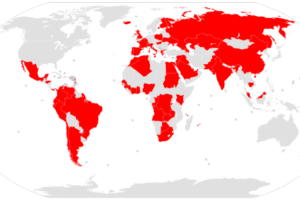
This map provides information on the countries where the burqa, a full-body covering which covers the body and face and is worn by some Muslim women, is subject to various types of bans.
The map uses different colors to indicate the type of restriction in each country:
Why do some countries Ban The Burqa?
ountries ban the burqa for various reasons, often rooted in cultural, security, and social considerations. Here are some common reasons:
- Security Concerns:
- Identification Issues: The burqa covers the entire face, making it difficult to identify individuals. This can pose security risks in public places and create challenges for law enforcement.
- Prevention of Crime: Authorities argue that concealing the face can facilitate criminal activities or terrorist actions, as it makes it easier for individuals to hide their identity.
- Secularism and Integration:
- Secular Values: In countries like France, where there is a strong emphasis on secularism (laïcité), the burqa is seen as a symbol of religious expression that contradicts the secular nature of the state.
- Social Integration: Some governments believe that the burqa hinders social integration and interaction, arguing that face-to-face communication is essential for social cohesion and the integration of minority communities into broader society.
- Women’s Rights and Equality:
- Symbol of Oppression: Some view the burqa as a symbol of female oppression and believe that banning it will promote gender equality and women’s liberation.
- Pressure and Coercion: There are concerns that some women are forced to wear the burqa against their will, and a ban is seen as a measure to protect them from coercion.
- Public Order and Social Norms:
- Cultural Norms: In some societies, covering the face is seen as contrary to cultural norms and traditions of public behavior and dress codes.
- Public Order: Governments may argue that face coverings can disrupt public order and are not in line with the country’s cultural and societal expectations.
- Legal and Policy Considerations:
- Uniformity in Dress Codes: Some countries implement uniform dress codes for public spaces to ensure consistency and adherence to local norms.
- Legislation on Religious Symbols: In some places, laws banning the burqa are part of broader legislation restricting religious symbols in public institutions to maintain state neutrality on religious matters.
Hijab vs Burqa vs Niqab vs Abaya
The terms hijab, burqa, niqab, and abaya refer to different types of clothing worn by some Muslim women, each with its own distinct characteristics:
- Hijab:
- Description: The hijab is a headscarf that covers the hair, neck, and sometimes the shoulders, but leaves the face clear.
- Purpose: It is worn as a symbol of modesty and privacy in accordance with Islamic principles.
- Styles: Hijabs come in various styles, fabrics, and colors, and can be styled in numerous ways to suit personal preference.
- Burqa:
- Description: The burqa is the most concealing of all Islamic veils. It covers the entire face and body, leaving just a mesh screen to see through.
- Purpose: It is worn in some cultures to adhere to a strict interpretation of modesty and privacy.
- Regions: The burqa is most commonly associated with Afghanistan and some regions of Pakistan and India.
- Niqab:
- Description: The niqab is a face veil that covers the face, leaving only the eyes visible. It is usually worn with a headscarf or other garments that cover the hair and neck.
- Purpose: Like the burqa, the niqab is worn for reasons of modesty and privacy, but allows the eyes to remain visible.
- Regions: The niqab is prevalent in the Arabian Peninsula, particularly in Saudi Arabia, as well as in some other Middle Eastern and North African countries.
- Abaya:
- Description: The abaya is a long, flowing black robe that covers the entire body except the face, hands, and feet. It is usually worn over regular clothing.
- Purpose: It is worn for modesty and to conform to cultural and religious norms in certain Muslim-majority countries.
- Regions: The abaya is commonly worn in Gulf countries such as Saudi Arabia, the UAE, and Qatar.
Visual Representation:
- Hijab: Covers the hair, neck, and sometimes shoulders, face remains clear.
- Burqa: Covers the entire body and face, with a mesh screen to see through.
- Niqab: Covers the face, leaving only the eyes visible, usually worn with a headscarf.
- Abaya: A long black robe covering the body except for the face, hands, and feet.
Each of these garments serves to express varying levels of modesty and adherence to cultural and religious practices among Muslim women.



Leave a Reply