
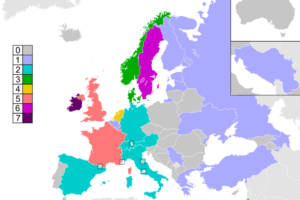
You can also see a more detailed map below which also includes Georgian and Armenian:

Latin (Dark Blue)
- Iceland
- Ireland
- United Kingdom
- Portugal
- Spain
- France
- Belgium
- Netherlands
- Luxembourg
- Germany
- Denmark
- Norway
- Sweden
- Finland
- Estonia
- Latvia
- Lithuania
- Poland
- Czech Republic
- Slovakia
- Hungary
- Austria
- Switzerland
- Italy
- Slovenia
- Croatia
- Albania
Cyrillic (Red)
Latin & Cyrillic (Purple)
- Kazakhstan (partially shown)
- Serbia
- Bosnia and Herzegovina
- Montenegro
- North Macedonia
Greek (Green)
Greek & Latin (Teal)
- Cyprus
Georgian (Olive Green)
Armenian (Yellow)
- Armenia
The Latin, Cyrillic, and Greek alphabets are three distinct writing systems that have been used across different languages and regions.
While they share some historical connections and visual similarities due to common ancestral scripts, they differ in origin, character sets, usage, and the languages they represent.
1. Origins and Historical Development
Latin Alphabet:
- Origin: Developed around the 7th century BCE.
- Ancestry: Derived from the Etruscan alphabet, which was influenced by the Western Greek alphabet.
- Development: Used by the Romans to write Latin; spread throughout Europe with the expansion of the Roman Empire.
- Evolution: Adapted over centuries to accommodate sounds in various languages, leading to the modern 26-letter English alphabet and additional characters in other languages.
Cyrillic Alphabet:
- Origin: Created in the First Bulgarian Empire during the 9th–10th centuries CE.
- Ancestry: Based on the Greek uncial script with additions from the Glagolitic alphabet.
- Creators: Developed by disciples of Saints Cyril and Methodius to aid in the Christianization of the Slavic peoples.
- Purpose: Designed to represent Slavic sounds not found in Greek, facilitating the writing of Slavic languages.
Greek Alphabet:
- Origin: Emerged around the 8th century BCE.
- Ancestry: Adapted from the Phoenician consonantal script.
- Innovation: Introduced vowels for the first time in a writing system, greatly influencing subsequent alphabets.
- Continuity: Used continuously for over 2,500 years to write the Greek language.
2. Character Sets and Letter Forms
Latin Alphabet:
- Letters: Typically 26 letters in modern English; other languages may have additional letters or use diacritics (e.g., accents).
- Characteristics: Letters like A, B, C, D, E, etc.
- Variations: Some languages use modified letters (e.g., Ñ in Spanish, Ç in French and Turkish).
Cyrillic Alphabet:
- Letters: Varies by language; Russian uses 33 letters, while other languages may have more or fewer.
- Characteristics: Includes letters like А, Б, В, Г, Д, Е, Ё, Ж, З, И, Й, etc.
- Unique Letters: Contains letters to represent sounds specific to Slavic languages (e.g., Щ, Ъ, Ы, Ь).
Greek Alphabet:
- Letters: Consists of 24 letters.
- Characteristics: Includes letters like Α (Alpha), Β (Beta), Γ (Gamma), Δ (Delta), Ε (Epsilon), etc.
- Mathematical Use: Widely used as symbols in mathematics and science (e.g., π for Pi, Σ for summation).
3. Language Usage
Latin Alphabet:
- Languages: Used by a majority of languages worldwide, including English, Spanish, French, German, Italian, and many others.
- Global Spread: Its adoption has been facilitated by colonialism, globalization, and technological influence.
Cyrillic Alphabet:
- Languages: Primarily used for Slavic languages like Russian, Bulgarian, Serbian (in Cyrillic script), Ukrainian, and Belarusian.
- Expansion: Also adapted for non-Slavic languages in Central Asia and Siberia during the Soviet era.
Greek Alphabet:
- Languages: Used exclusively for the Greek language.
- Cultural Significance: Holds a strong cultural and historical identity for Greek speakers.
4. Visual Similarities and Differences
- Shared Letters: Due to historical connections, some letters look similar across the alphabets (e.g., A in Latin and Cyrillic, or Β in Greek and Cyrillic).
- Different Sounds: Similar-looking letters may represent different sounds in each alphabet. For example:
- Cyrillic ‘В’ is pronounced as ‘V’, not ‘B’.
- Greek ‘Ρ’ (Rho) corresponds to the Latin ‘R’, not ‘P’.
- Unique Letters: Each alphabet has letters that are unique or have distinct features, catering to the phonetic requirements of their respective languages.
5. Phonetic Representation
- Latin Alphabet: Adapted with additional letters and diacritics to represent a wide array of sounds across different languages.
- Cyrillic Alphabet: Includes specific letters to represent Slavic phonetics, such as palatalization.
- Greek Alphabet: Tailored to the sounds of the Greek language, with a clear distinction between vowels and consonants.
6. Cultural and Historical Impact
- Latin Alphabet:
- Science and Technology: Dominant in scientific literature and international communication.
- Colonial Influence: Spread globally through European colonization.
- Cyrillic Alphabet:
- Orthodox Christianity: Its spread is closely tied to the Eastern Orthodox Church.
- Political History: Influenced by the expansion of the Russian Empire and the Soviet Union.
- Greek Alphabet:
- Foundation of Western Literature: Used in ancient texts that are foundational to Western philosophy, science, and literature.
- Symbolism: Greek letters are used symbolically in various fields like mathematics, physics, and fraternities/sororities.
How Many Letters Does Each Country’s Alphabet Have?

Read the full explanation here.
Which letter in any alphabet do you like best? I’ve always always liked the French e-circumflex aka e with a hat on, Ê, ê.






Leave a Reply