
In any case here’s a ranking of countries by the number letters in their alphabet from lowest to highest:
Number of Letters in Each Country’s Alphabet
18 letters
- Ireland (Irish Gaelic)
- Scotland (Scottish Gaelic)
21 letters
- Italy (Italian)
24 letters
- Greece (Greek)
25 letters
- Slovenia (Slovene)
26 letters (standard Latin)
27 letters
- Spain (Spanish)
- Netherlands (Dutch)
29 letters
- Norway (Norweigan)
- Sweden (Sweedish)
- Finland (Finish)
- Denmark (Danish)
- Wales (Welsh)
- Turkey (Turkish)
30 letters
- Germany (German)
- Austria (German)
- Croatia (Croatgian)
- Serbia (Serbian)
- Bosnia & Herzegovina (Bosnian)
- Bulgaria (Bulgarian)
31 letters
- Romania (Romanian)
- Moldova (Moldavan)
- North Macedonia (Macedonian)
32 letters
- Iceland (Icelandic)
- Estonia (Estonian)
- Lithuania (Lithuanian)
- Poland (Polish)
- Belarus (Belorussian)
- Kosovo (Kosovan)
33 letters
36 letters
- Albania (Albanian)
42 letters
- Czech Republic (Czech)
44 letters
- Hungary (Hungarian)
46 letters
- Slovakia (Slovakian)
Examples of EXTRA Letters (Countries Above 26)
Czech Republic (42 letters)
Extra characters include:
- Č, Š, Ř, Ž
- Ě, Ň, Ť, Ď
Slovakia (46 letters)
Adds:
- Á, É, Í, Ó, Ú, Ý
- Č, Ď, Ľ, Ň, Š, Ť, Ž
- Ô, Ä
Hungary (44 letters)
Includes multi-letter characters treated as letters:
- Cs, Dz, Dzs
- Gy, Ly, Ny
- Sz, Ty, Zs
- Plus accented vowels: Á, É, Í, Ó, Ö, Ő, Ú, Ü, Ű
Russia / Ukraine (33 letters – Cyrillic)
Extra letters like:
- Ё, Й, Ь, Ы (Russian)
- Ї, Є, Ґ (Ukrainian)
Poland (32 letters)
Adds:
- Ą, Ć, Ę, Ł, Ń, Ó, Ś, Ż, Ź
Examples of MISSING Letters (Countries Below 26)
Ireland – 18 letters
Missing letters include:
- J, K, Q, V, W, X, Y, Z
Italy – 21 letters
Traditionally missing:
- J, K, W, X, Y
Greece – 24 letters
Greek alphabet does not include Latin letters, and has:
- No equivalents of J, Q, W, X, Y, Z (Latin sense)
Why the difference?
Here are the main reasons why alphabet sizes vary so much in Europe:
Languages Have Different Sounds
Each language has its own set of sounds.
If a language has more sounds, it often needs more letters to represent them.
Examples:
- Polish (32 letters) adds letters like Ł, Ś, Ż to represent sounds English doesn’t have.
- Hungarian (44 letters) treats sound combinations like “Sz” and “Cs” as separate letters.
- Irish (18 letters) has fewer distinct sounds, so it needs fewer letters.
Some Alphabets Treat Digraphs as Real Letters
Some countries count letter pairs as single letters in their alphabet.
Example (Hungary & Slovakia):
- Cs, Dz, Gy, Ny, Sz, Ty, Zs
These count as one letter each, inflating the alphabet size.
English uses digraphs too (sh, ch, th), but does NOT count them as letters.
Different Writing Systems, Not Just Latin
Not all countries use the Latin alphabet.
Examples:
- Russia & Ukraine → Cyrillic
- Greece → Greek alphabet
These alphabets developed independently, so their letter counts reflect different linguistic histories.
Historical & Cultural Evolution
Languages change over centuries, and alphabets change with them.
- Some letters disappear if sounds fade out
- Some letters are added to clarify pronunciation
- Political or cultural reforms sometimes redesign alphabets
Example:
- Turkey switched from Arabic script to Latin (1928)
- German spelling reforms adjusted letter use
- Czech & Slovak added accented letters to better match speech
Accent Marks vs New Letters
Some languages:
- Treat accented letters as new letters (e.g., Czech, Polish)
- Treat accents as variants, not separate letters (e.g., French, Spanish in some systems)
That changes the official count.
Spelling Philosophy: Phonetic vs Traditional
Some writing systems aim to:
- Match pronunciation very precisely → more letters
- Preserve historical spelling → fewer letters, more ambiguity
Example:
- Hungarian spelling = highly phonetic
- English spelling = historical & irregular
National Identity & Standardization
Alphabet rules are often decided by academies, governments, and education systems.
Adding or removing letters can be a political or cultural choice, not just linguistic.
An alternative map design:
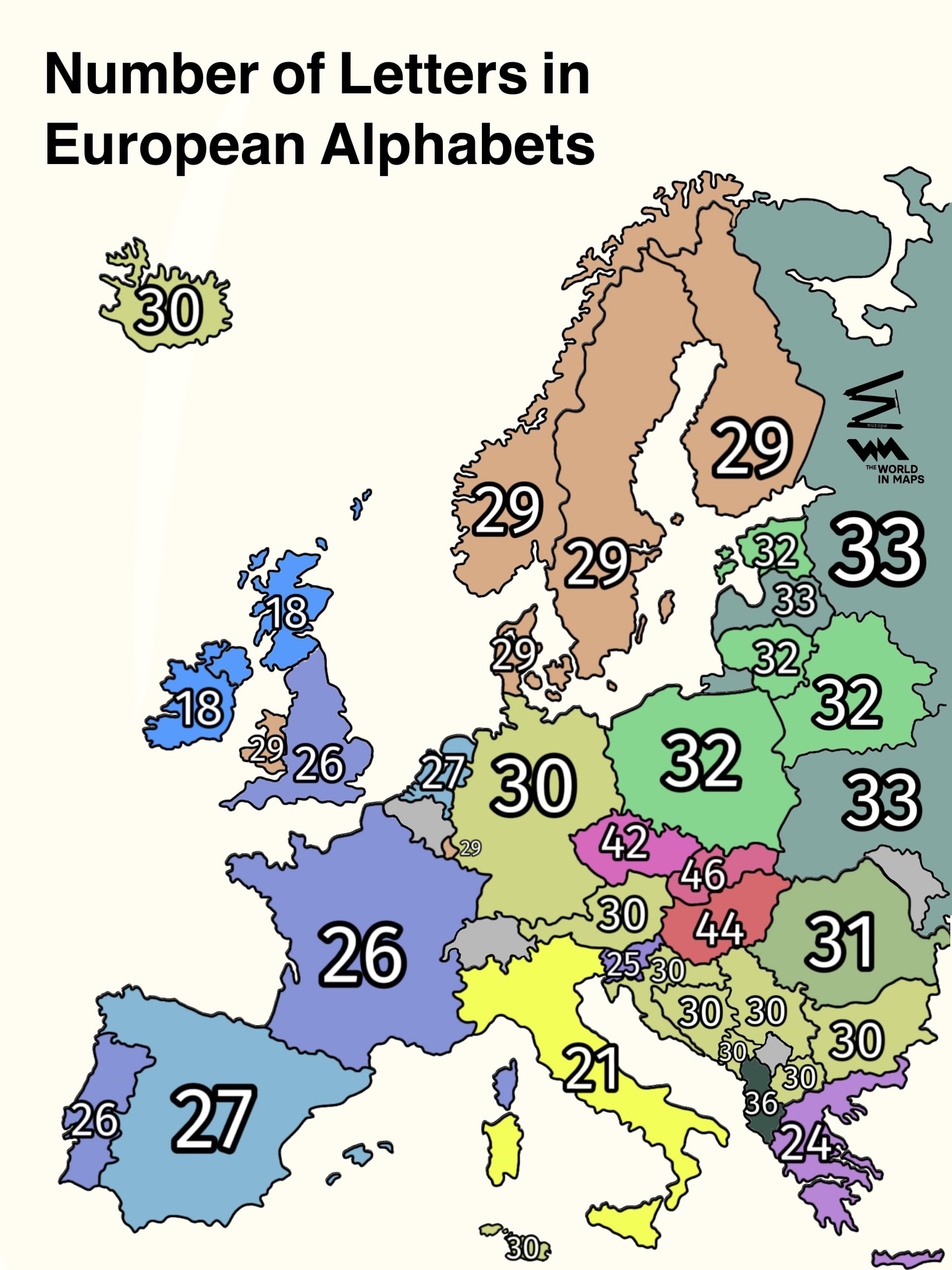
Which one surprises you the most?






Steve Hodgson says
Curious why poor little Malta and its 30-letter alphabet was missed-out? You don’t want to make a Maltese Cross! 😂
Notofimportance says
Dutch only has 26 letters, not 27. Bulgarian is cyrillic too
Y.D. Robinson says
I can’t help but notice that all the languages of the main countries that settled the New World (English, French, Dutch, Spanish, and Portuguese) – plus Slovenian – have almost exactly the same amount of letters. In bilingual parts of the New World, like Canada and white South Africa, this makes the two languages less incompatible than otherwise.
note-sk says
Slovakia also have Ch, Dz, Dž, ĺ, ŕ (if I forgot any others not mentioned before..)