
- In Canada: There are an estimated 500,000 to 1,000,000 moose, with 150,000 in Newfoundland in 2007 descended from just four that were introduced in the 1900s.
- In United States: There are estimated to be around 300,000:
- Alaska: The state’s Department of Fish and Game estimated 200,000 in 2011.
- Northeast: A wildlife ecologist estimated 50,000 in New York and New England in 2007, with expansion expected.
- Rocky Mountain states: Wyoming is said to have the largest share in its six-state region, and its Fish and Game Commission estimated 7,692 in 2009.
- Upper Midwest: Michigan 2000 on Isle Royale (2019) and an estimated 433 (in its Upper Peninsula) in 2011, Wisconsin, 20–40 (close to its border with Michigan) in 2003, Minnesota 5600 in its northeast in 2010, and under 100 in its northwest in 2009; North Dakota closed, due to low moose population, one of its moose-hunting geographic units in 2011, and issued 162 single-kill licenses to hunters, each restricted to one of the remaining nine units.
Here is another map scaling the size of each state based on its moose population:

Moose Distribution In Europe
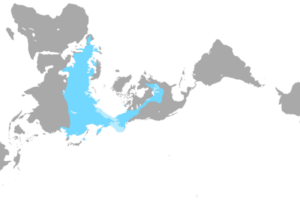
Finally the map below shows the distribution of moose in Europe:

Europe and Asia:
- Finland: In 2009, there was a summer population of 115,000.
- Norway: In 2009, there were a winter population of around 120,000 In 2015 31,131 moose were shot. In 1999, a record number of 39,422 moose were shot.
- Latvia: in 2015, there were 21,000.
- Estonia: 11,000 – 7,000
- Lithuania: around 14,000 in 2016
- Poland: 28,000
- Czech Republic: maximum of 50
- Russia: In 2007, there were approximately 600,000.
- Sweden: Summer population is estimated to be 300,000–400,000. Around 100,000 are shot each fall. About 10,000 are killed in traffic accidents yearly.
What are Moose?
Moose (Alces alces) are fascinating animals, especially known for their impressive size and antlers.
Here’s a breakdown of information about them:
Size and Physical Characteristics
- Height: Adult moose stand 5 to 7 feet (1.5 to 2.1 meters) tall at the shoulder.
- Weight: Males (bulls) weigh 800 to 1,500 pounds (360 to 680 kilograms), while females (cows) weigh 600 to 800 pounds (270 to 360 kilograms).
- Antlers: Only males grow antlers, which can span up to 6 feet (1.8 meters) across and weigh up to 40 pounds (18 kilograms). They shed and regrow their antlers annually.
- Coat: Their thick, dark brown to black fur insulates them during cold winters.
Diet
Moose are herbivores with a diet primarily composed of:
- Leaves, twigs, and buds: They favor willow, aspen, and birch.
- Aquatic plants: They are excellent swimmers and often feed on plants like water lilies and pondweed. They may even submerge fully underwater to reach food.
- Seasonal variation: In winter, moose rely on bark and twigs when other food sources are scarce.
Habitat
- Moose are found in northern forests and wetlands across North America, Europe, and Asia.
- They prefer cool climates and are adapted to survive in snowy and cold environments.
Behavior
- Solitary animals: Moose are generally solitary except during mating season (rut) or when a cow is with her calves.
- Swimmers: They are strong swimmers, capable of swimming several miles at a time and diving up to 20 feet underwater.
- Territorial males: During the rut, males become highly aggressive and will spar with other bulls for mates.
Reproduction
- Mating season: Occurs in the fall (September to October).
- Gestation period: Around 8 months.
- Calves: Typically, a cow gives birth to one or two calves, which stay with her for about a year.
Predators and Threats
- Predators: Wolves, bears, and humans are their primary predators. Calves are particularly vulnerable.
- Parasites and disease: Moose can be severely affected by parasites like winter ticks and brainworm.
- Vehicle collisions: In regions with high moose populations, vehicle collisions are a significant hazard.
Interesting Facts
- Largest deer species: Moose are the largest members of the deer family.
- Sensitive noses: They have an excellent sense of smell, which helps them locate food and detect danger.
- Unique adaptations: Moose have specialized hooves that allow them to walk on snow and soft ground easily.
- Communication: Moose communicate using grunts, moans, and other vocalizations, especially during mating season.
- Symbolic importance: In many cultures, moose are symbols of strength, endurance, and wilderness.
Moose vs Elk
Reddit user Alecsyr posted this interesting comment about how Europeans and North Americans call moose:
Just to try to clear up the confusion between elk and moose here, in a simplified manner:
North American perspective: moose and elk
European perspective: elk and wapiti
Explanation:
- The elk (Alces alces) was eradicated from the British Isles. So the word ‘elk’ still survived, but it was used about an animal most people did not exactly interact with. Namely, the massive deer-like animals still roaming mainland Europe.
- Brits emigrated to North America.
- They saw big-ass deer (Cervus canadensis) there and decided to call it elk, because that was the biggest deer-like animal they knew from Europe.
- Then they realized that the original ‘elk’ (Alces alces) was also present in North America. So they used a word from a Native American language to fill in the vacuum. And thus we now have the word ‘moose’.
- In Britain, meanwhile, they needed a word for the big-ass deer (Cervus canadensis) that they’d learned of from North America. They too turned to the natives and took a Native American word: ‘wapiti’.
- And so it came to be that we now have the word ‘elk’ used for both wapiti and moose depending on whether you’re European or American.
Ironically, many Brits seem to be unaware of this. I am Norwegian, but I lived in the US, so I use the words elk and moose like Americans would, but my British friends living in Norway somehow do too. I used to compare the Norwegian word ‘elg’ (Alces alces) to the word ‘elk’ to try to help them remember the word when learning Norwegian. But they always point out that an ‘elg’ is a moose and an ‘elk’ is a different animal.
I then ask them to explain why they would be using a Native American word to refer to a European animal, but then they get more riled up. I don’t think Brits like to accept American influence very much.
Have you ever seen a moose in the wild before?







Leave a Reply