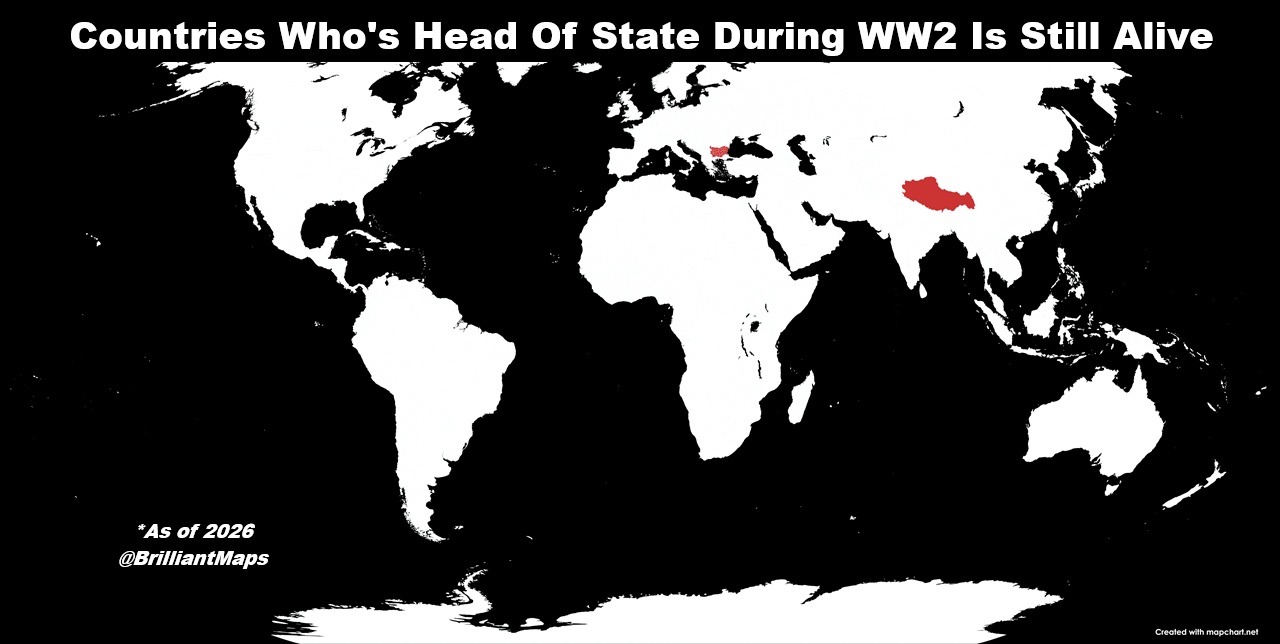
The map above shows a rather sunrising fact: as of mid-2026 two countries in the world still have people alive who served as Heads of State for their country during World War 2.
The two men:
Bulgaria: Simeon II (the six-year-old Tsar)
Simeon II was born in Sofia on 16 June 1937.
His father, Tsar Boris III, died unexpectedly on 28 August 1943, when Bulgaria was an Axis power.
Six-year-old Simeon immediately became Tsar of Bulgaria, although naturally he could not govern. A three-man Regency Council exercised royal authority for him.
Bulgaria’s wartime position was rather unusual.
It had joined the Axis in 1941 and declared war on Britain and the United States, but Boris III resisted German demands to declare war on the Soviet Union.
Bulgaria also notably prevented the deportation of most Jews living within its pre-war borders, although Jews in Bulgarian-occupied territories in Greece and Yugoslavia were deported.
Everything changed in September 1944.
The Soviet Union declared war on Bulgaria, Soviet troops entered the country and the Soviet-backed Fatherland Front seized power on 9 September.
Simeon’s original regents, including his uncle Prince Kiril, were removed.
Kiril and many members of the old political establishment were subsequently executed.
Simeon technically remained king for another two years. In September 1946, a referendum abolished the monarchy and Bulgaria became the People’s Republic of Bulgaria. Simeon, then nine, and his family were sent into exile.
Communist rule would last until 1989.
His story then took an extraordinary turn…
After decades abroad, mainly in Spain, Simeon returned to Bulgaria in 1996.
In 2001 he created a political movement, won the parliamentary election and became Prime Minister of the republic that had abolished his throne.
He served from 2001–05, an exceptionally rare case of a former hereditary monarch later returning to govern his country through democratic elections.
As of August 2026, he is 89 years old.
Tibet: The 14th Dalai Lama (enthroned during WWII)
The future Dalai Lama was born Lhamo Dhondup on 6 July 1935 in north-eastern Tibet.
He was identified as the reincarnation of the 13th Dalai Lama and formally enthroned in Lhasa on 22 February 1940, aged four.
This is where the “WWII head of state” claim becomes slightly misleading.
Historically, the Dalai Lamas combined spiritual and temporal leadership of Tibet.
However, because the 14th Dalai Lama was a small child, a regent actually governed Tibet throughout WWII. His own official chronology says that he did not assume “full temporal (political) power” until 17 November 1950, at age fifteen.
So he was certainly the enthroned Dalai Lama during WWII, but calling him the functioning wartime head of state requires a fairly broad definition.
Tibet itself occupied an unusual position.
From the fall of China’s Qing dynasty in 1912 until 1950, the government in Lhasa exercised substantial de facto independence, administering its own territory, army and institutions. However, its international legal status was disputed and the Republic of China continued to claim sovereignty over Tibet.
What happened to Tibet after WWII?
The decisive event was not the end of WWII itself but the end of the Chinese Civil War.
Mao Zedong’s Communist Party established the People’s Republic of China in 1949, and People’s Liberation Army forces entered eastern Tibet in 1950, defeating Tibetan forces around Chamdo.
The crisis prompted the fifteen-year-old Dalai Lama to assume full political authority.
In 1951, Tibetan representatives signed the Seventeen Point Agreement with Beijing.
It formally placed Tibet under the sovereignty of the People’s Republic of China while promising considerable autonomy and preservation of Tibet’s traditional institutions and religion. The Chinese government describes this as Tibet’s “peaceful liberation”; the Tibetan exile leadership maintains that the agreement was imposed under coercion.
Relations deteriorated during the 1950s.
In March 1959, an uprising erupted in Lhasa. After Chinese forces suppressed it, the Dalai Lama fled across the Himalayas into India, where he established a Tibetan administration in exile. He has lived in India ever since.
In 1965, Beijing formally established the Tibet Autonomous Region, which remains part of the People’s Republic of China today. The political and historical interpretation of China’s incorporation of Tibet remains deeply contested.
The Dalai Lama gradually democratized the Tibetan exile administration and in 2011 formally gave up his remaining political authority, leaving an elected leadership to run the exile government.
He turned 91 in July 2026.
The Comparison
| Simeon II | 14th Dalai Lama | |
|---|---|---|
| Born | 1937 | 1935 |
| Elevated during WWII | 1943 | 1940 |
| Age | 6 | 4 |
| Actual government exercised by | Regency Council | Regent |
| Traditional state transformed by | Soviet-backed communist takeover | Chinese Communist takeover |
| Lost effective political position | 1944–46 | 1951–59 |
| Went into exile | 1946 | 1959 |
| Later political role | Bulgarian PM, 2001–05 | Leader of Tibetan exile administration |
| Relinquished political power | 2005 as PM | 2011 |
| Age in Aug. 2026 | 89 | 91 |
Other WW2 Leaders Who Survived Until the 21st Century
The most recent undisputed WWII-era head of state to die was King Michael I of Romania, who died on 5 December 2017, aged 96.
At the time, he was widely described as the last surviving head of state who had actually exercised the office during the Second World War.
Michael had become King of Romania for the second time in September 1940, aged 18. Although Marshal Ion Antonescu initially held most real political power and aligned Romania with Nazi Germany, Michael eventually played a major personal role in the war.
On 23 August 1944, Michael organised a coup in which Antonescu was arrested.
Romania abandoned its alliance with Germany, sought an armistice with the Allies and subsequently fought alongside the Soviets against Germany. This significantly accelerated the Red Army’s advance through southeastern Europe.
But, his reward was rather grim.
As Soviet influence over Romania increased after the war, the communists gradually stripped the monarchy of power.
On 30 December 1947, Michael was forced to abdicate and Romania was proclaimed a people’s republic. He spent decades in exile, mainly in Switzerland, before being permitted to return permanently after communism collapsed.
So the rough sequence of the exceptionally long-lived WWII monarchs is:
- King Zahir Shah of Afghanistan: died 2007, aged 92.
- King Norodom Sihanouk of Cambodia: died 2012, aged 89.
- King Michael I of Romania: died 2017, aged 96.
- Simeon II of Bulgaria: still7 alive, born 1937.
- 14th Dalai Lama: still alive, born 1935, though as mentioned his status as a wartime head of state is debatable because Tibet was governed by a regent.
Michael is particularly interesting because, unlike the child Simeon or Dalai Lama, he was old enough to make a genuinely consequential political decision during WWII.
His 1944 coup makes him arguably the last person alive into the 2010s who had personally taken a major head-of-state decision affecting the course of the Second World War.



D Olson says
There is a podcast, The Butterfly King, about Boris III. I recommend it.