
However, after extensive Googling I haven’t been to find the original report it’s supposedly based on. (Obviously if you have the link please do share it below in the comments).
The map itself is rather odd given that it gives a very broad view of the “Western Core” countries, with a small group of “Western Periphery” countries in Latin America and Eastern Europe and countries “Undergoing Westernization” such as Japan, South Korea, Philippines, Ukraine, Armenia, Azerbaijan and South Africa.
Without seeing the original report, it’s difficult to understand how communist Cuba is more Western than capitalist and democratic Japan and South Korea or English speaking South Africa. Beyond of course being in the Western Hemisphere, but if that’s the criteria why is Haiti omitted.
Here’s an alternative version of the west based on Samuel Huntington’s book Clash of Civilizations, published in 1993 including semi-Western/torn countries, that are either already part of the West or in the process of joining the West.

This concept, however, has evolved over time and can vary depending on the context.
Key Characteristics of the Western World
- Cultural Roots: Western countries often share cultural and philosophical roots in ancient Greece, Rome, and later Western European developments, including the Renaissance, the Reformation, and the Enlightenment.
- Political Systems: Western countries typically have democratic political systems, where individual rights, the rule of law, and political freedoms are valued.
- Economic Systems: Many Western nations have capitalist or mixed-market economies with a focus on individual enterprise, free markets, and technological innovation.
- Religion and Secularism: Historically, many Western countries have Christian roots, though they have become increasingly secular, with an emphasis on religious freedom and pluralism.
Traditional Western Countries
The “Western world” originally referred to Western Europe but has since expanded to include countries influenced by European culture, values, and political systems. The following are commonly included:
- North America: The United States and Canada
- Europe: Western European countries (such as the UK, France, Germany, Italy, Spain) and often Central and Northern Europe (such as the Netherlands, and the Scandinavian countries)
- Oceania: Australia and New Zealand
- Israel: Due to its political and cultural alignment with Western democratic values
Countries Sometimes Included
- Eastern European Nations: Since the end of the Cold War, some Eastern European countries that were once under Soviet influence (e.g., Poland, the Czech Republic, Hungary) have been more integrated into Western institutions like the EU and NATO, which has brought them closer to the “Western world.”
- Latin American Nations: Some definitions of the Western world include countries in Latin America, such as Argentina, Brazil, and Chile, which have European cultural influences but are distinct in their social and political landscapes.
Countries Generally Not Included
- Russia: Although Russia shares some cultural and historical ties with Europe, its political structure, historical alignment with the Eastern Bloc during the Cold War, and contemporary international relations often exclude it from Western categorization.
- Middle Eastern Countries: Most Middle Eastern countries are generally not considered part of the Western world, although there are exceptions like Israel.
- Asian and African Countries: Most of Asia and Africa is generally not considered Western, despite some countries being highly Westernized or politically aligned with Western nations. This is especially true of Singapore, Hong Kong, Japan, South Korea and South Africa.
The concept of the “Western world” is complex, and which countries are included can depend on the context, such as politics, culture, or economics.
And here’s an even more detailed map of Samuel Huntington’s country classifications from Clash of Civilizations:
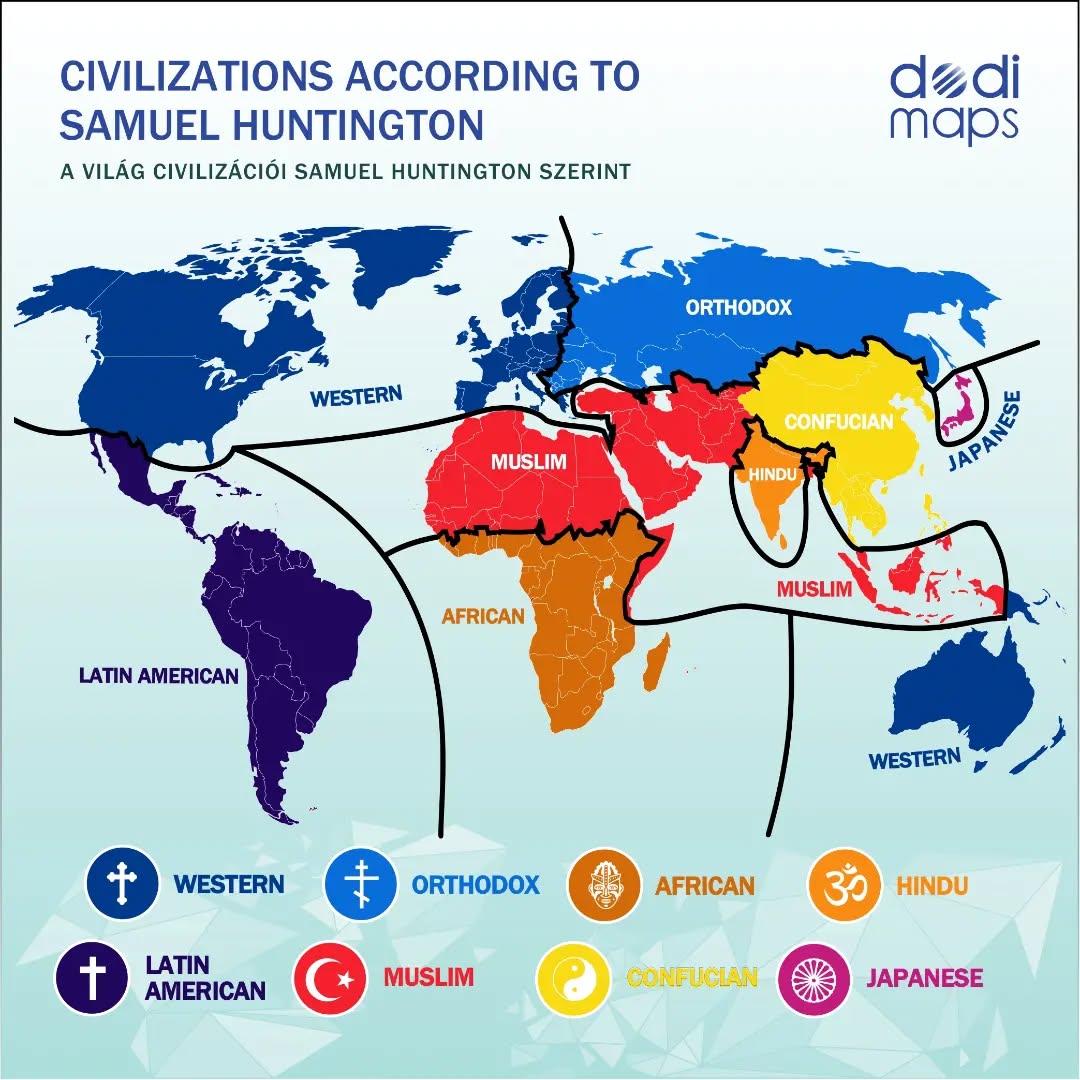
Which countries would you include in the Western world?




Y.D. Robinson says
“Some definitions of the Western world include countries in Latin America, such as Argentina, Brazil, and Chile, which have European cultural influences but are distinct in their social and political landscapes.”
Are Argentina, Uruguay, southern Brazil, and most of Chile (all of these inhabited mainly by whites) really that much different than Spain, Portugal, or Italy with regard to social and political landscapes? Yes, the latter European countries are in the European Union, which has contributed to the political and socioeconomic betterment of those countries. And yes, the aforementioned South American countries have had more recent histories of dictatorships and continue to have lower per capita GDPs than the core Western countries. But at the end of the day, all these countries have far more in common with each other on so many levels than with either Bolivia, Peru, etc. or with the UK, Germany, Sweden, etc.