
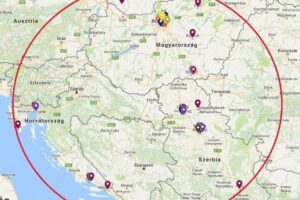
And actually, the phenomenon is not limited to the longest day of the year but the weeks leading up it and the weeks after (the map above is actually from June 28th).
Here’s why:
This intriguing phenomenon occurs due to the Earth’s axial tilt and the way our planet is positioned relative to the Sun during different seasons. Here’s a detailed explanation:
The Earth’s Tilt and the Summer Solstices
- The Earth is tilted approximately 23.5 degrees on its axis.
- This tilt causes the seasons, making different hemispheres lean toward or away from the Sun during the year.
- During the Northern Hemisphere’s summer solstice (around June 21), the Earth’s North Pole is tilted toward the Sun, resulting in the longest day of the year in the northern hemisphere and the shortest day in the southern hemisphere.
Latitude and Daylight Hours
- On the June solstice, locations in the Northern Hemisphere experience extended daylight hours, with days becoming longer the farther north you go. For instance, Scotland and Ireland (higher latitudes) experience significantly longer daylight periods than Brazil, which is closer to the equator.
- Eastern Brazil is closer to the equator, where the length of day doesn’t vary dramatically over the year, typically about 12 hours, even at the solstice.
Longitude, Time Zones, and Sunset
- Brazil is located in the Western Hemisphere, whereas Ireland and Scotland are further east in the Eastern Hemisphere (relative to Brazil).
- Due to Earth’s rotation, locations further east experience sunrise and sunset earlier in their local time zone, while locations further west see the sun set later in their local time zone.
- However, because it’s the summer solstice, northern locations (like Ireland and Scotland) have extremely long daylight hours, with sunsets occurring unusually late at night—often after 10 p.m. local time or even later.
- Meanwhile, Eastern Brazil, despite being geographically westward, has shorter days at that time (as it’s winter there), causing its sunset to occur relatively early in its local time (often around 5–6 p.m.).
Why does Eastern Brazil see the sunset first?
- Even though Brazil is further west (which normally means a later sunset time), the extremely long summer days at high northern latitudes (Ireland and Scotland) mean the sun sets significantly later there.
- As a result, on the northern summer solstice, the sun sets in eastern Brazil first (local early evening) and many hours later in Ireland and Scotland (local late night).
Surprised?






Leave a Reply