
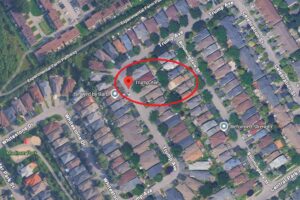
The map above shows the natural habitat of the Venus flytrap (Dionaea muscipula). It has one of the most restricted natural habitats of any plant on Earth, and that’s the main reason why its total wild range is so small.
Here’s why:
Where Venus Flytraps Live
Venus flytraps are native only to a tiny region of the U.S. East Coast, specifically:
- A 75-mile radius around Wilmington, North Carolina
- Extending slightly into South Carolina
This is the only place in the world where they grow naturally.
The Carolinas very stable, isolated microrefugium preserved the species
For millions of years, the Carolina coastal plain stayed:
- Geologically stable
- Mildly temperate
- Wet but not tropical
This stability allowed an unusual plant lineage to survive long enough to evolve complex snap-trap mechanisms.
Most places with similar soils are:
- Too dry seasonally
- Too cold
- Too tropical (which encourages competing vegetation)
- Geologically unstable
The Carolinas offered a “Goldilocks zone” for long-term evolutionary experimentation.
Evolutionary happenstance: their ancestor happened to be there
Venus flytraps evolved from a lineage related to sundews (Drosera), many of which grow in the Southeast.
The closest relatives are found nearby, meaning:
The precursor lineage was already present in the Carolinas.
Complex snap traps evolved only once in plant history. This required:
- Preexisting sticky-trap genes
- Repeated mutations in mechanosensing
- A habitat that rewarded faster, more complex prey capture
If these ancestors hadn’t lived in the Carolinas, flytraps wouldn’t either.
The habitat type is globally rare
Even though bogs exist worldwide, the specific combination of:
- Constant moisture
- Quartz-sand soils
- Frequent fire
- High light
- Long-term climatic stability
- Low competition pressure
is incredibly unusual outside this small region. Thus the opportunity for a Venus flytrap–type plant to arise is vanishingly small elsewhere.
Why Their Habitat Is So Small
They require a very rare combination of soil, water, and fire
Venus flytraps thrive in:
- Nutrient-poor, acidic, sandy peat soils
- Constantly moist but not submerged ground
- Open, sunny environments like wet pine savannas
These conditions occur only in specific coastal wetlands.
If you remove any of these factors, flytraps cannot survive.
They rely on periodic wildfire
Their habitat depends on frequent natural fires, which:
- Clear out competing shrubs and trees
- Keep the soil open to sunlight
- Maintain high water levels in the bogs
Without fire, taller plants take over and shade out flytraps, killing them. This fire-dependence greatly limits where they can live.
They evolved from local ancestors and never spread outward
Venus flytraps evolved in a very specific ecological niche and:
- Have poor seed dispersal (seeds fall near the parent plant)
- Can’t compete well in richer soils
- Can’t tolerate much shade or dryness
Because of this, they never expanded beyond their original environment.
Human impact has shrunk their radius even more
Their already tiny range has been reduced by:
- Habitat loss (development, agriculture)
- Fire suppression
- Poaching
- Wetland drainage
This makes their natural population even more concentrated.
How Climate Change May Affect the Venus Flytrap’s Range
Because Venus flytraps already exist in a tiny, specialized region, they’re highly vulnerable to climate shifts.
The main expected impacts are:
Hotter temperatures
- Increasing temperatures can dry out their wetland habitats.
- Flytraps need constantly moist soil, so prolonged droughts or heatwaves can kill them.
Changes in rainfall patterns
- More intense storms may flood habitats too deeply.
- Longer dry periods reduce groundwater and bog moisture.
Both extremes threaten their survival, since they need a very specific moisture balance.
Sea level rise
- Their habitat is close to the coast.
- Rising seas may cause saltwater intrusion, which Venus flytraps cannot tolerate.
This could permanently wipe out low-lying populations.
Altered fire regimes
- Climate change can lead to:
- More intense, uncontrolled fires, or
- More frequent fire suppression due to human activity
Flytraps need regular, low-intensity burns, so either extreme can disrupt the ecosystem.
Limited ability to migrate
Most plants can shift their range over decades, but Venus flytraps:
- Have very limited seed dispersal
- Can’t tolerate many new environments
- Are hemmed in by development (cities, farms)
So climate change could shrink their already tiny natural footprint even further.
How Flytraps Adapted to Nutrient-Poor Soils by Becoming Carnivorous
Venus flytraps live in bogs where the soil is:
- Very low in nitrogen and phosphorus
- Constantly leached by water
Plants need these nutrients to make DNA, proteins, and chlorophyll, but flytraps can’t get them from the soil.
Their evolutionary solution:
They evolved a way to get nutrients from animals instead of the soil. Over millions of years:
Leaves became traps
The flytrap’s “jaws” are actually modified leaves that:
- Snap shut when triggered
- Form a digestive chamber
Gland cells produce digestive enzymes
These glands absorb:
- Nitrogen
- Phosphorus
- Amino acids
This allows the plant to grow in soils where most plants would die.
The trigger-hair mechanism evolved to conserve energy
The plant only snaps shut when:
- Two hairs are touched within ~20 seconds, or
- One hair is touched twice
This prevents the plant from wasting energy on false alarms like raindrops.
The carnivorous habit allows them to stay small
They don’t need large leaves or roots for nutrient uptake, so they remain compact.
Differences Between Wild and Cultivated Venus Flytraps
Wild Flytraps
- Small (often only 3-5 cm traps)
- Slow-growing due to nutrient-poor environment
- Seasonal dormancy linked to local climate
- Compete with grasses and shrubs
- Fire-dependent habitat
- Genetically diverse but declining populations
Cultivated Flytraps
Grown in controlled conditions (greenhouses, pots), they often show:
- Larger traps (up to 5 cm or more) due to better care
- Faster growth because of:
- Stable moisture
- Good lighting
- Controlled temperature
- Protection from competition
- Many unique cultivars (red forms, giant traps, fused teeth mutants)
Ecological differences
Wild plants help support a unique ecosystem and insect community.
Cultivated plants generally cannot survive outside that narrow range because they lack the right soil, water table, and fire ecology.
What do you think about them?
Here were my thoughts at age 7:






rockymountains says
It is too small to eat you!