
Legend:
- Darkest Green: Conquests of Muhammad (622-632)
- Dark Green: Conquests of Abu Bakr (632-634)
- Green: Conquests of Omar (634-644)
- Light Green: Conquests of Othman and Ali (644-661)
- Lightest Green: Conquests of the Umayyad Caliphate (661-750)
- Dark Yellow: Spread of Islam (750-1300)
- Light Yellow: Spread of Islam (1300-1700)
- Red Hatched Area: Islam pushed out after the Reconquista, 1492
Time Periods:
- Core Expansion (Dark Green to Light Green): The core regions where Islam spread initially during and immediately after the life of Muhammad, including the Arabian Peninsula, parts of the Middle East, and North Africa.
- Further Expansion (Lightest Green): Expansion under the Umayyad Caliphate and subsequent periods, reaching into Spain, Central Asia, and further into North Africa.
- Continued Spread (Dark Yellow to Light Yellow): The ongoing spread of Islam into Sub-Saharan Africa, South Asia, and Southeast Asia through trade, conquests, and missionary activities from 750 to 1700.
- Reconquista Impact (Red Hatched Area): The regions in Spain and Portugal where Islam was pushed out after the Reconquista, culminating in 1492.
Here is a brief timeline of the spread of Islam from 622 until the present day:
6th Century
- 570 CE: Birth of Muhammad in Mecca.
7th Century
- 610 CE: Muhammad receives the first revelation from the Angel Gabriel.
- 622 CE: Hijra (migration) of Muhammad and his followers from Mecca to Medina; marks the beginning of the Islamic calendar.
- 630 CE: Muhammad and his followers conquer Mecca.
- 632 CE: Death of Muhammad. Islam begins to spread rapidly under the Rashidun Caliphs (Abu Bakr, Umar, Uthman, Ali).
7th-8th Century
- 634-644 CE: Conquests under Caliph Umar. Islam spreads to the Levant, Persia, Egypt, and North Africa.
- 661-750 CE: Umayyad Caliphate expands Islamic rule to Spain in the west and the Indus Valley in the east.
- 711 CE: Muslim forces enter Spain (Al-Andalus) via Gibraltar.
8th-9th Century
- 750-1258 CE: Abbasid Caliphate. Islam continues to spread into Central Asia, West Africa, and parts of South Asia.
- 800 CE: Islam reaches sub-Saharan Africa through trade routes.
10th-12th Century
- 10th Century: Islam spreads to Southeast Asia via trade routes.
- 11th-12th Century: Muslim rule consolidates in Spain, with flourishing Islamic culture in cities like Cordoba and Granada.
13th-15th Century
- 13th Century: Islam spreads into the Balkans and Eastern Europe with the rise of the Ottoman Empire.
- 14th Century: Islam spreads further into West Africa, with the Mali Empire adopting Islam.
16th-17th Century
- 16th Century: Ottoman Empire continues to expand Islamic influence in Europe, Africa, and the Middle East.
- 17th Century: Islam reaches modern-day Indonesia and Malaysia through trade and missionary activities.
18th-19th Century
- 18th Century: Islamic revival movements in Arabia and West Africa.
- 19th Century: European colonialism affects Islamic regions, but Islam continues to spread, especially in Africa.
20th Century
- 20th Century: Post-colonial period sees resurgence and reformation movements within the Islamic world.
- Late 20th Century: Immigration and globalization facilitate the spread of Islam to Western countries.
21st Century
- Early 21st Century: Islam becomes one of the fastest-growing religions globally, with significant Muslim populations in Europe, the Americas, and Asia.
How & Why did Islam spread so quickly?
The rapid spread of Islam in the 7th and 8th centuries can be attributed to a combination of religious, political, social, and economic factors. Here are some of the key reasons:
1. Religious Appeal
- Message of Equality: Islam preached a message of equality and brotherhood among believers, which was appealing to many people living under the rigid social structures of the time.
- Simple Creed: The central tenet of Islam, the belief in one God (Allah), and the acceptance of Muhammad as his prophet, was straightforward and easy to understand.
- Religious Duty: The concept of Jihad, understood in its early context as a spiritual and, at times, physical struggle, motivated early Muslims to spread their faith.
2. Military Conquests
- Effective Military Strategies: Early Muslim armies were well-organized and used effective military tactics. The use of cavalry and the mobility of their forces were significant advantages.
- Weakness of Neighboring Empires: The Byzantine and Sassanian Empires, the major powers of the time, were weakened by decades of conflict with each other, making them vulnerable to Muslim conquests.
- Religious Tolerance: Muslim conquerors often practiced relative religious tolerance, allowing Christians, Jews, and others to continue practicing their religions under the status of dhimmi (protected persons), which reduced resistance to Muslim rule.
3. Political Organization
- Strong Leadership: The Rashidun and Umayyad Caliphs provided strong, centralized leadership that helped maintain the unity and focus of the early Muslim community.
- Administrative Efficiency: The adoption and adaptation of existing administrative systems from the conquered territories allowed for efficient governance and integration of new regions into the Islamic state.
4. Economic Factors
- Trade Routes: Islam spread along major trade routes. Muslim traders and merchants played a crucial role in spreading the religion to new regions.
- Economic Benefits: Conversion to Islam sometimes brought economic benefits, such as lower taxes (Muslims paid zakat, while non-Muslims paid jizya) and better trade opportunities within the Muslim community.
5. Social and Cultural Factors
- Social Justice: The social justice aspects of Islamic teachings, such as charity (zakat), fair treatment of others, and prohibition of usury, attracted many converts, especially among the poor and marginalized.
- Cultural Exchange: The cultural and intellectual achievements of the Islamic Golden Age (8th to 14th centuries) enhanced the appeal of Islam, attracting scholars and thinkers to the religion.
6. Missionary Work
- Sufism: Sufi missionaries played a significant role in spreading Islam to regions outside the core Arab territories, including Africa, Central Asia, and Southeast Asia, through their emphasis on personal piety, spirituality, and community service.
What areas of the world were formerly under Muslim rule but no longer are?
Europe
- Spain and Portugal (Al-Andalus)
- Period of Muslim Rule: 711–1492
- History: Muslim rule in the Iberian Peninsula began with the Umayyad conquest in 711. Al-Andalus became a center of Islamic culture and learning. The Reconquista, a series of Christian campaigns to recapture territory, culminated in 1492 with the fall of Granada, the last Muslim stronghold.
- Sicily
- Period of Muslim Rule: 831–1091
- History: Muslims from North Africa conquered Sicily in the 9th century. The island was an important cultural and economic center under Muslim rule. It was gradually reconquered by the Normans by the end of the 11th century.
- Southern Italy
- Period of Muslim Rule: 9th–11th centuries
- History: Parts of Southern Italy, including areas such as Apulia and Calabria, were temporarily under Muslim control during the early medieval period.
- Balkans
- Period of Muslim Rule: 14th–19th centuries
- History: The Ottoman Empire expanded into the Balkans in the 14th century, bringing many regions under Muslim rule. The decline of Ottoman power and subsequent national independence movements resulted in the loss of these territories.
Asia
- India (various regions)
- Period of Muslim Rule: 12th–18th centuries
- History: Muslim dynasties such as the Delhi Sultanate and the Mughal Empire ruled large parts of the Indian subcontinent. British colonial rule began in the 18th century, leading to the decline of Muslim power.
- Israel (enough said)
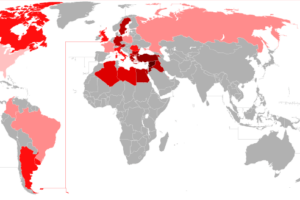
Finally here’s a map showing how long various parts of the world have spent under Muslim rulers

Find this map interesting? If so please help by sharing it:




Leave a Reply