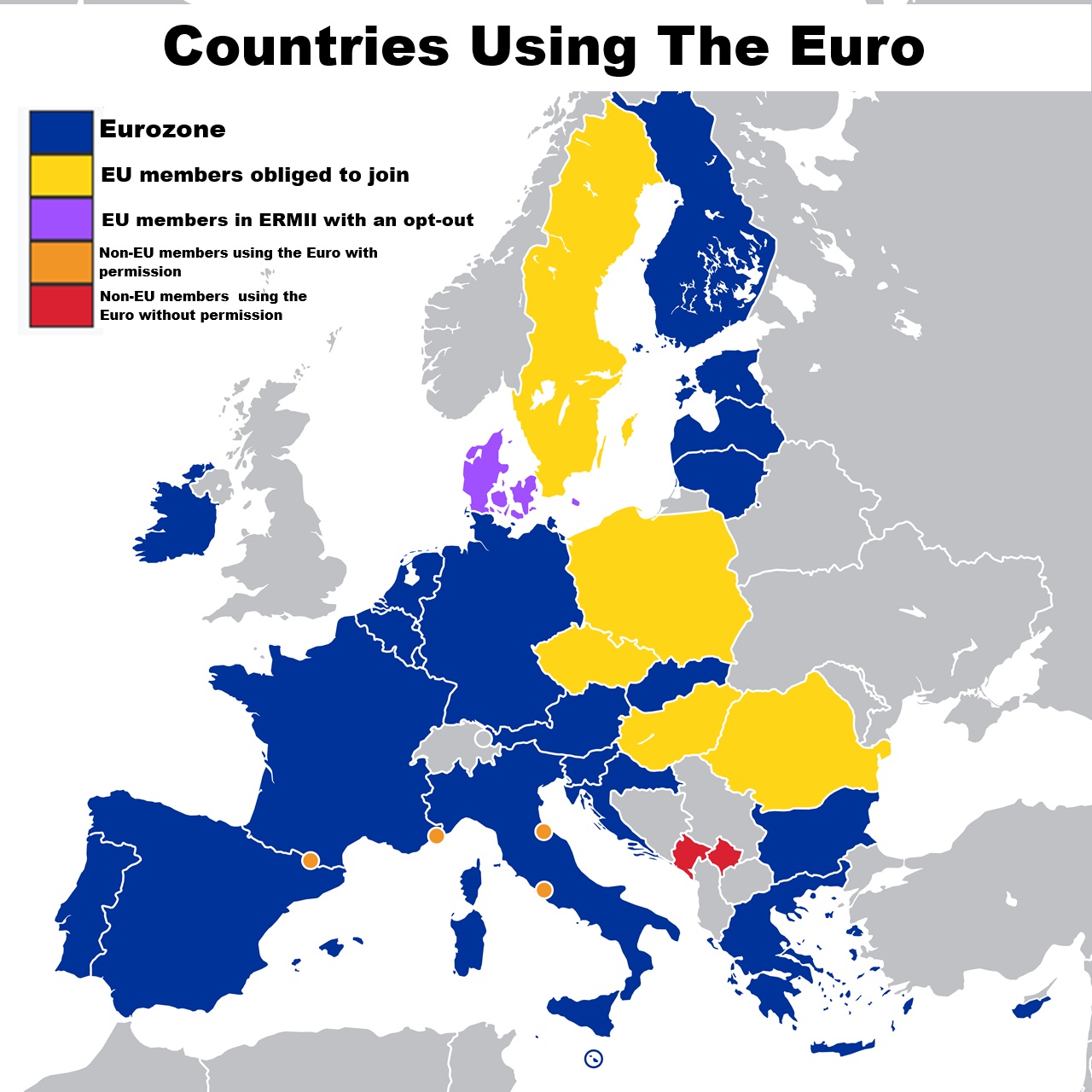
The map above shows which countries currently use the Euro (aka Eurozone), are part of the ERM II (European Exchange Rate Mechanism), countries in the EU that don’t use the Euro, and also countries not in the EU that do use the Euro (with or without the EU’s approval).
Here’s a full list:
The 21 full Eurozone members
- Austria
- Belgium
- Bulgaria
- Croatia
- Cyprus
- Estonia
- Finland
- France
- Germany
- Greece
- Ireland
- Italy
- Latvia
- Lithuania
- Luxembourg
- Malta
- Netherlands
- Portugal
- Slovakia
- Slovenia
- Spain
Microstates with a monetary agreement:
- Andorra
- Monaco
- San Marino
- Vatican City
Special territories of members of the European Economic Area who also use the Euro:
EU Outermost Regions
- France
- French Guiana
- Guadeloupe
- Martinique
- Saint Martin
- Mayotte
- Réunion
- Portugal
- Azores
- Madeira
- Spain
- Canary Islands
Overseas Territories
- France
- French Southern and Antarctic Lands
- Saint Barthélemy
- Saint Pierre and Miquelon
Special Autonomous Territories
- Finland
- Åland
- Greece
- Mount Athos
- Spain
- Ceuta
- Melilla
British Overseas Territory
- Akrotiri and Dhekelia (On Cyrpus)
Unilateral adopters: (Without EU approval)
EU members not using the Euro
- Czech Republic
- Hungary
- Poland
- Romania: Looking to adopt the euro by 2029
- Sweden
Denmark negotiated an opt-out to retain its currency. However, the Danish krone is part of the ERM II mechanism, so its exchange rate is tied to within 2.25% of the euro.
The UK also had an opt-out while it was a member, but based on the Treaty of Ascension it would have to agree to adopt the Euro if wished to re-join the EU in the future.
Timeline of The Euro
1992: Maastricht Treaty Signed
The Maastricht Treaty, also known as the Treaty on European Union, is signed, establishing the framework for the creation of a single European currency.
1995: Euro Name Adopted
The European Council officially adopts the name “Euro” for the new currency during the Madrid summit.
1999: Euro Introduced as an Electronic Currency
On January 1, the Euro is introduced as an electronic currency for banking and financial transactions in 11 EU countries. The exchange rates of these countries’ currencies are fixed to the Euro, but physical banknotes and coins are not yet introduced.
2002: Euro Banknotes and Coins Enter Circulation
On January 1, Euro banknotes and coins are introduced in 12 EU countries, replacing their national currencies. The Euro becomes the official currency for the participating member states.
2004-2007: Expansion of the Eurozone
New countries join the Eurozone, including Slovenia (2007), Cyprus (2008), and Malta (2008).
2009: Lisbon Treaty Enters into Force
The Lisbon Treaty formalizes the Euro’s status and makes the Euro the official currency of the Eurozone.
2010-2012: European Sovereign Debt Crisis
Several Eurozone countries, including Greece, Ireland, Portugal, and Spain, face severe debt crises, leading to bailouts from the European Union and the International Monetary Fund (IMF).
2014: Introduction of the Single Supervisory Mechanism (SSM)
The SSM is established to oversee banks in the Eurozone, strengthening financial stability and ensuring the resilience of the banking sector.
2015: Quantitative Easing Program Launched
The European Central Bank (ECB) launches a large-scale Quantitative Easing (QE) program to stimulate the Eurozone economy and combat deflation.
2019: 20th Anniversary of the Euro
The Euro celebrates its 20th anniversary as a currency, with 19 EU countries using it.
2023: Croatia Joins the Eurozone
On January 1, Croatia adopts the Euro as its official currency, becoming the 20th member of the Eurozone.
2026: Bulgaria Joins the Eurozone.
On January 1, Bulgaria adopts the Euro as its official currency, becoming the 21st member of the Eurozone.
What do you think, after 25 years has the Euro been a success or failure?





Leave a Reply