
Which former communist country was the least bad in your opinion?
Communist Countries and Their Fate
1. Warsaw Pact Countries (1955–1991)
The Warsaw Pact was a military alliance led by the Soviet Union in response to NATO. Its members were all communist states but transitioned away from communism after the Cold War.
| Country | Communist Era | What Happened After Communism? |
|---|---|---|
| Soviet Union (USSR) | 1922–1991 | Dissolved in 1991; split into 15 independent countries, with Russia as the largest successor state. Many republics transitioned to democracy, but some became authoritarian. |
| Poland | 1947–1989 | Became a democratic republic. Joined NATO (1999) and EU (2004). |
| East Germany (GDR) | 1949–1990 | Reunified with West Germany in 1990 after the fall of the Berlin Wall. Now part of a united Germany. |
| Czechoslovakia | 1948–1989 | Transitioned to democracy in 1989. In 1993, peacefully split into Czech Republic and Slovakia. Both joined NATO and the EU. |
| Hungary | 1949–1989 | Transitioned to democracy. Joined NATO (1999) and EU (2004). |
| Romania | 1947–1989 | Overthrew dictator Nicolae Ceaușescu in 1989. Became democratic, joined NATO (2004) and EU (2007). |
| Bulgaria | 1946–1989 | Transitioned to democracy. Joined NATO (2004) and EU (2007). |
| Albania (left Warsaw Pact in 1968) | 1946–1992 | Became democratic in the 1990s. Joined NATO (2009) and aspires to join the EU. |

2. Yugoslavia (1945–1992)
Yugoslavia was not a Warsaw Pact member but was a communist state under Josip Broz Tito. It pursued non-alignment rather than being fully under Soviet influence.
| Country | Communist Era | What Happened After Communism? |
|---|---|---|
| Yugoslavia | 1945–1992 | Dissolved into six countries (Serbia, Croatia, Slovenia, Bosnia and Herzegovina, Montenegro, North Macedonia) and later Kosovo. The 1990s saw wars and ethnic conflicts. |
| Slovenia | 1945–1991 | Left Yugoslavia peacefully. Joined NATO (2004) and EU (2004). |
| Croatia | 1945–1991 | Fought War of Independence (1991–1995). Joined NATO (2009) and EU (2013). |
| Bosnia and Herzegovina | 1945–1992 | Devastated by the Bosnian War (1992–1995). Now a fragile multi-ethnic democracy. Aspires to join the EU. |
| Serbia (as part of Yugoslavia) | 1945–2006 | After Yugoslavia’s breakup, Serbia remained in a union with Montenegro until 2006. Now independent, balancing between Russia and the West. |
| Montenegro | 1945–2006 | Became independent from Serbia in 2006. Joined NATO (2017) and aspires to join the EU. |
| North Macedonia | 1945–1991 | Left Yugoslavia peacefully. Changed its name from “Macedonia” due to a dispute with Greece. Joined NATO (2020) and is a candidate for the EU. |
| Kosovo (formerly part of Serbia) | 1945–1999 (de facto), 2008 (independence) | Declared independence from Serbia in 2008, but not fully recognized. Supported by the West, opposed by Serbia and Russia. |
3. Other Communist Countries in Europe
| Country | Communist Era | What Happened After Communism? |
|---|---|---|
| Albania | 1946–1992 | Isolated under dictator Enver Hoxha, cut ties even with the USSR and China. Transitioned to democracy, joined NATO (2009). Aspires to join the EU. |
4. Communist States in Asia
| Country | Communist Era | What Happened After Communism? |
|---|---|---|
| Mongolia | 1924–1992 | Peacefully transitioned to democracy in 1992. Now an ally of both China and the West. |
| Cambodia | 1975–1979 (Khmer Rouge) | The brutal Khmer Rouge (led by Pol Pot) killed millions. Overthrown by Vietnam in 1979. Now a one-party autocracy under former communists. |
| Vietnam | 1945–1986 (Economy was communist) | Remains a communist one-party state, but adopted a capitalist-style economy (“Đổi Mới” reforms). Strong economic growth, close ties with China but also the US. |
| Laos | 1975–1986 (Economy was communist) | Remains a communist one-party state, but has opened its economy. Close ties with Vietnam and China. |
| China | 1949–Present | Still a one-party communist state, but has embraced capitalism under “Socialism with Chinese Characteristics”. Major world power, but authoritarian. |
| Afghanistan (People’s Democratic Republic) | 1978–1992 | Soviet-backed communist regime collapsed in 1992. Entered civil war, Taliban took over in 1996. US invasion in 2001, but the Taliban returned in 2021. |
North Korea (DPRK)?
North Korea, originally established as a Marxist–Leninist state, gradually distanced itself from orthodox Marxism–Leninism.
In 1992, all references to Marxism–Leninism were removed from the Constitution of North Korea and replaced with Juche, the country’s official ideology.
By 2009, the constitution was further revised, eliminating not only Marxist–Leninist terminology but also any mention of communism altogether.
According to North Korea: A Country Study by Robert L. Worden, the regime abandoned Marxism–Leninism as early as the start of de-Stalinization in the Soviet Union and had fully replaced it with Juche by 1974.
Today, the official state ideology is Juche within the framework of Kimilsungism–Kimjongilism, rather than traditional Marxism–Leninism.
Despite this shift, the Workers’ Party of Korea (WPK) reaffirmed its long-term commitment to communism in 2021. However, many anti-revisionist communists regard North Korea as a non-Marxist socialist state rather than a true communist nation.
5. Communist States in Africa
| Country | Communist Era | What Happened After Communism? |
|---|---|---|
| Angola | 1975–1991 | Civil war between communists (MPLA) and anti-communists (UNITA) lasted until 2002. Now a semi-democracy with corruption issues. |
| Mozambique | 1975–1990 | Civil war (FRELIMO vs. RENAMO). Abandoned Marxism in 1990. Now a democracy but faces insurgency problems. |
| Ethiopia (Derg Regime) | 1974–1991 | Overthrew Emperor Haile Selassie. After years of repression, communists were overthrown in 1991. Now a federal democracy with ethnic conflicts. |
| Benin (People’s Republic of Benin) | 1975–1990 | Peacefully transitioned to democracy in 1990. Now stable but economically weak. |
| Congo-Brazzaville (People’s Republic of the Congo) | 1969–1991 | Military dictatorship collapsed in 1991. Now a multi-party state, but authoritarian. |
6. Communist States in Latin America
| Country | Communist Era | What Happened After Communism? |
|---|---|---|
| Cuba | 1959–Present | Still communist under the Cuban Communist Party. However, it has gradually introduced limited market reforms. Faces economic struggles. |
| Nicaragua (Sandinistas) | 1979–1990 | Communist Sandinistas lost power in 1990, but Daniel Ortega later returned and became increasingly authoritarian. Now a dictatorship in all but name. |
| Grenada | 1979–1983 | Pro-communist government was overthrown by the US in 1983. Returned to democracy. |
| Chile (Allende’s socialist experiment) | 1970–1973 | Not fully communist, but aligned with Marxism. Overthrown by US-backed coup in 1973 (Pinochet). Later transitioned to democracy in 1990. |
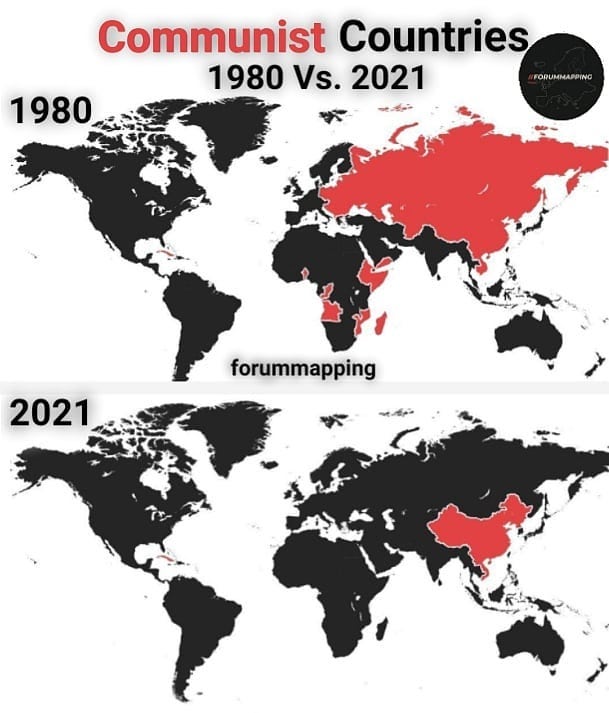
Finally the Communist World In 1980 vs 2021:
So which of these do you think was the least bad?




Tom says
My experience with these countries is limited, but the Yugoslavs had certain freedoms (travel to non-communist countries!) that others in Europe did not have. They were allowed to work abroad, send money (hard currencies) home and return later.