
The map above shows where the World’s Top 40 languages (spoken by 45+ million speakers) come from. It includes both native speakers and those speaking it as a second or additional language.
Here is a list of the most spoken languages in the world including the country (countries) of origin:
| Language | Native / First-language | Second-language or Additional Language | Total speakers | Homeland |
|---|---|---|---|---|
| English | 380 million | 1.077 billion | 1.456 billion | England |
| Mandarin Chinese | 939 million | 199 million | 1.138 billion | China |
| Hindi | 345 million | 266 million | 610 million | India |
| Spanish | 485 million | 74 million | 559 million | Spain |
| French | 81 million | 229 million | 310 million | France |
| Modern Standard Arabic (excl. dialects) | 0 | 274 million | 274 million | Saudi Arabia |
| Bengali | 234 million | 39 million | 273 million | Bangladesh |
| Portuguese | 236 million | 27 million | 264 million | Portgual |
| Russian | 147 million | 108 million | 255 million | Russia |
| Urdu | 71 million | 161 million | 232 million | Pakistan |
| Indonesian | 44 million | 155 million | 199 million | Indonesia |
| Standard German | 75 million | 58 million | 133 million | Germany |
| Japanese | 123 million | 0.2 million | 123 million | Japan |
| Nigerian Pidgin | 5 million | 116 million | 121 million | Nigeria |
| Egyptian Arabic | 77 million | 25 million | 102 million | Egypt |
| Marathi | 83 million | 16 million | 99 million | India |
| Telugu | 83 million | 13 million | 96 million | India |
| Turkish | 84 million | 6 million | 90 million | Turkey |
| Yue Chinese (incl. Cantonese) | 86 million | 1 million | 87 million | China |
| Tamil | 79 million | 8 million | 87 million | India |
| Vietnamese | 85 million | 1 million | 86 million | Vietnam |
| Wu Chinese (incl. Shanghainese) | 83 million | 0.1 million | 83 million | China |
| Tagalog | 29 million | 54 million | 83 million | Philippines |
| Korean | 82 million | — | 82 million | Korea (North and South) |
| Iranian Persian | 57 million | 21 million | 79 million | Iran |
| Hausa | 52 million | 27 million | 79 million | Nigeria |
| Swahili | 16 million | 55 million | 72 million | Tanzania, Kenya |
| Javanese | — | — | 68 million | Indonesia |
| Italian | 65 million | 3 million | 68 million | Italy |
| Western Punjabi | — | — | 67 million | Pakistan, India |
| Gujarati | 57 million | 5 million | 62 million | India |
| Thai | 21 million | 40 million | 61 million | Thailand |
| Kannada | 44 million | 15 million | 59 million | India |
| Amharic | 32 million | 25 million | 58 million | Ethiopia |
| Eastern Punjabi | 48 million | 4 million | 52 million | India |
| Bhojpuri | 52 million | 0.2 million | 52 million | India, Nepal |
| Min Nan Chinese (incl. Hokkien) | 50 million | 0.4 million | 50 million | China |
| Levantine Arabic | 47 million | 0.4 million | 48 million | Syria, Jordan, Lebanon and Palestine |
| Jin Chinese | — | — | 48 million | China |
| Yoruba | 44 million | 2 million | 46 million | Nigeria |
The data comes from Ethnologue.com and is accurate as of 2023, and the map was created using Mapchart.net.
Here is a list of the number of top 40 languages by country of origin:
- India – 9
- China – 5
- Nigeria – 3
- Indonesia – 2
- Pakistan – 2
- Bangladesh – 1
- Egypt – 1
- England – 1
- Ethiopia – 1
- France – 1
- Germany – 1
- Iran – 1
- Italy – 1
- Japan – 1
- Korea (North and South) – 1
- Nepal – 1
- Philippines – 1
- Portugal – 1
- Russia – 1
- Saudi Arabia – 1
- Spain – 1
- Syria, Jordan, Lebanon and Palestine – 1
- Tanzania – 1
- Thailand – 1
- Turkey – 1
- Vietnam – 1
What language is the official language in the most countries?
English is the official language in by far the most countries at 58, followed by French, Arabic and Spanish. The following languages hold official status (either de jure or de facto) in three or more sovereign states.
In some instances, what is considered a single language in one country may be classified as distinct languages in others. For example, this is the case with Malay and Indonesian, Serbian and Croatian and Hindi and Urdu.
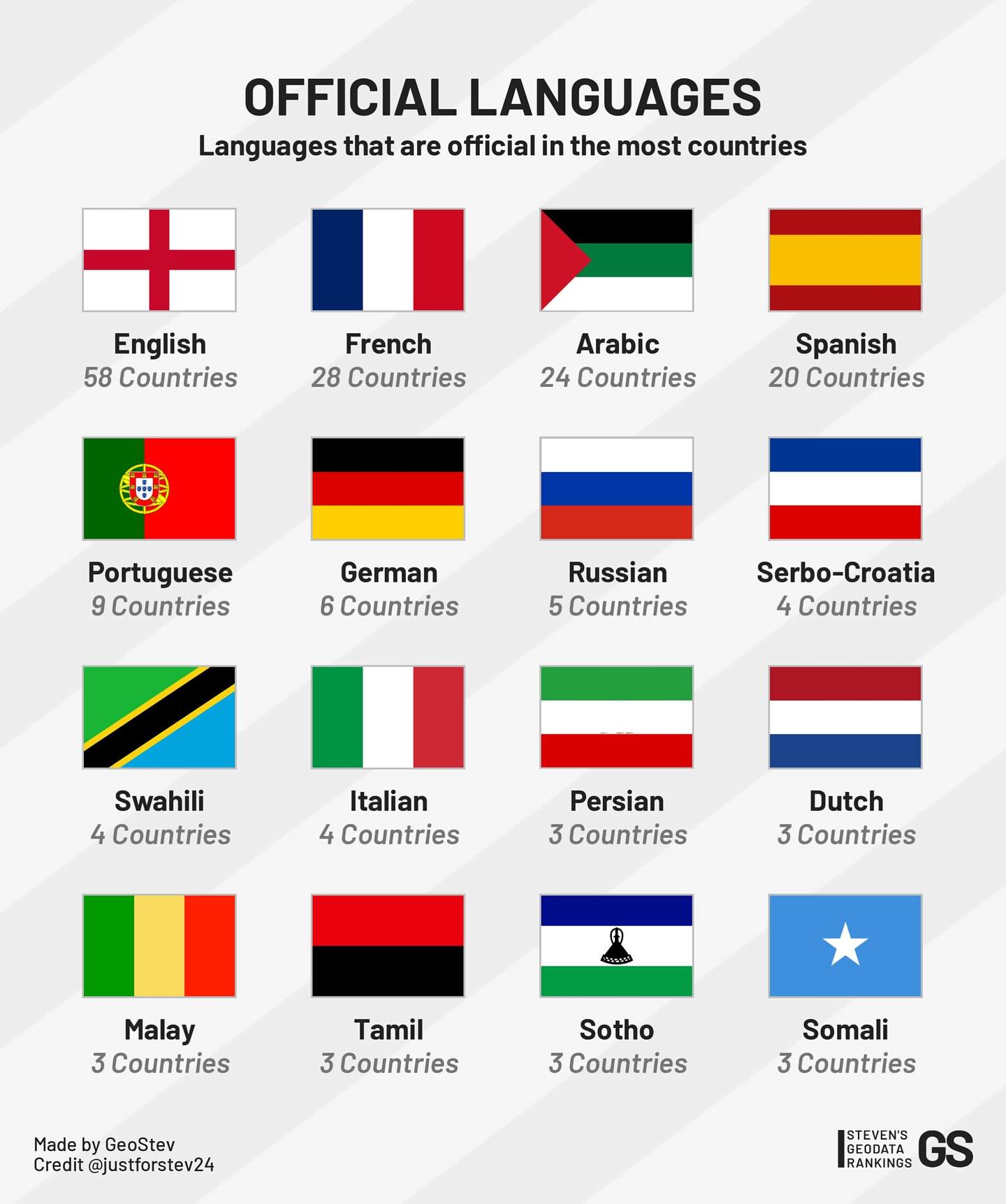
- English: 58 countries
- French: 28 countries
- Arabic: 23 countries and Palestine
- Spanish: 20 countries
- Portuguese: 9 countries
- German: 6 countries
- Russian: 5 countries
- Serbo-Croatian: 4 countries
- Malay: 4 countries
- Swahili: 4 countries (5 counting Comorian)
- Italian: 3 countries and Vatican City
- Persian: 3 countries
- Dutch: 3 countries (4 counting Afrikaans)
- Somali: 3 countries
- Sotho: 3 countries
- Standard Chinese (Mandarin): 2 countries and Taiwan
- Tamil: 3 countries
- Hindi–Urdu: 3 countries (counting Fijian Hindi)
It should also be noted that the US, UK and Australia do not have official languages although are all majority English speaking countries.
What are the most spoken languages in the world by native speakers?
The most spoken language in the world in 2024 by native speakers is Mandarin, followed by Spanish and English. Here is the latest data (note data is for 2024 rather than 2023 so differs slightly from the numbers above):
- Mandarin Chinese – 941 million
- Spanish – 486 million
- English – 380 million
- Hindi – 345 million
- Bengali – 237 million
- Portuguese – 236 million
- Russian – 148 million
- Japanese – 123 million
- Yue Chinese – 86 million
- Vietnamese – 85 million
- Turkish – 84 million
- Wu Chinese – 83 million
- Marathi – 83 million
- Telugu – 83 million
- Western Punjabi – 82 million
- Korean – 81 million
- Tamil – 79 million
- Egyptian Arabic – 78 million
- Standard German – 76 million
- French – 74 million
- Urdu – 70 million
- Javanese – 68 million
- Italian – 64 million
- Iranian Persian – 62 million
- Gujarati – 58 million
- Hausa – 54 million
- Bhojpuri – 53 million
- Levantine Arabic – 51 million
- Southern Min – 51 million
What is the most spoken second language in the world?
English is by far the most spoken second language in the world with over 1 billion speakers worldwide. This is followed by Modern Standard Arabic, Hindi and French. Below is a complete list of languages with at least 40 million second language speakers:
- English – 1.077 billion
- Modern Standard Arabic – 274 million
- Hindi – 266 million
- French – 229 million
- Mandarin Chinese – 199 million
- Urdu – 161 million
- Indonesian – 155 million
- Nigerian Pidgin – 116 million
- Russian – 108 million
- Spanish – 74 million
- Standard German – 58 million
- Swahili – 55 million
- Tagalog – 54 million
- Thai – 40 million
Which language has the most words?
This is an almost impossible question to answer, but here are the languages with the most words in the dictionary.
The following languages have 375,000+ words in their dictionary:
- Tamil (Sorkuvai) – 1,516,952 words
- Korean (Urimalsaem) – 1,149,538 words
- Portuguese (Aulete Digital) – 818,000 words
- Finnish (RedFox Pro) – 800,000 words
- English (English Wiktionary) – 755,865 words
- Swedish (Svenska Akademiens ordbok) – 600,000 words
- Italian (Grande Dizionario Hoepli Italiano) – 500,000 words
- Japanese (Nihon Kokugo Daijiten) – 500,000 words
- Lithuanian (Academic Dictionary of Lithuanian) – 500,000 words
- Northern Kurdish (Kurdish Wiktionary) – 411,864 words
- French (French Wiktionary) – 408,078 words
- Serbo-Croatian (Rječnik hrvatskoga ili srpskoga jezika) – 400,000 words
- Dutch (Woordenboek der Nederlandsche Taal) – 400,000 words
- Chinese (Hanyu Da Cidian) – 378,103 words
What is the most difficult language to learn?
The difficulty of learning a language can vary greatly depending on an individual’s native language, linguistic background, and personal aptitude. However, some languages are generally considered more difficult to learn for native English speakers. Here are a few commonly cited examples:
- Mandarin Chinese:
- Writing System: The Chinese writing system is logographic, meaning each character represents a word or a meaningful part of a word, rather than sounds as in alphabetic systems.
- Tones: Mandarin has four tones, and the meaning of a word can change based on the tone used.
- Grammar: While not as complex as some languages, Chinese grammar differs significantly from English.
- Arabic:
- Script: Arabic uses a script that is written from right to left.
- Sounds: It contains sounds that are unfamiliar to English speakers.
- Dialects: There are significant regional dialects which can differ greatly from the Modern Standard Arabic.
- Japanese:
- Writing Systems: Japanese uses three different scripts: Hiragana, Katakana, and Kanji.
- Grammar: Japanese grammar, including the use of particles and honorifics, is quite different from English.
- Vocabulary: It has a large number of loanwords from Chinese, which can be challenging.
- Korean:
- Grammar: Korean grammar can be difficult due to its use of honorifics and verb conjugations.
- Writing System: While Hangul is relatively easy to learn, understanding the language’s use of Sino-Korean characters and vocabulary can be challenging.
- Russian:
- Alphabet: Russian uses the Cyrillic alphabet, which requires learning a new script.
- Grammar: Russian grammar includes complex case systems, verb aspects, and gendered nouns.
- Hungarian:
- Grammar: Hungarian has 18 cases and a complex system of vowel harmony.
- Vocabulary: It is a non-Indo-European language, so its vocabulary is very different from that of English.
- Icelandic:
- Grammar: Icelandic has retained many archaic features and has complex grammar rules.
- Vocabulary: It has unique vocabulary and little external influence, making it difficult for non-native speakers.
These languages are considered difficult due to various factors such as unfamiliar scripts, complex grammar rules, and pronunciation challenges.



anon says
Why have you not included Welsh speakers?
Brilliant Maps says
Welsh is not one of the world’s most spoken languages.