And in case you were wondering, this is not some sort of regional division. The two companies are legally separate entities that both use the Aldi name.
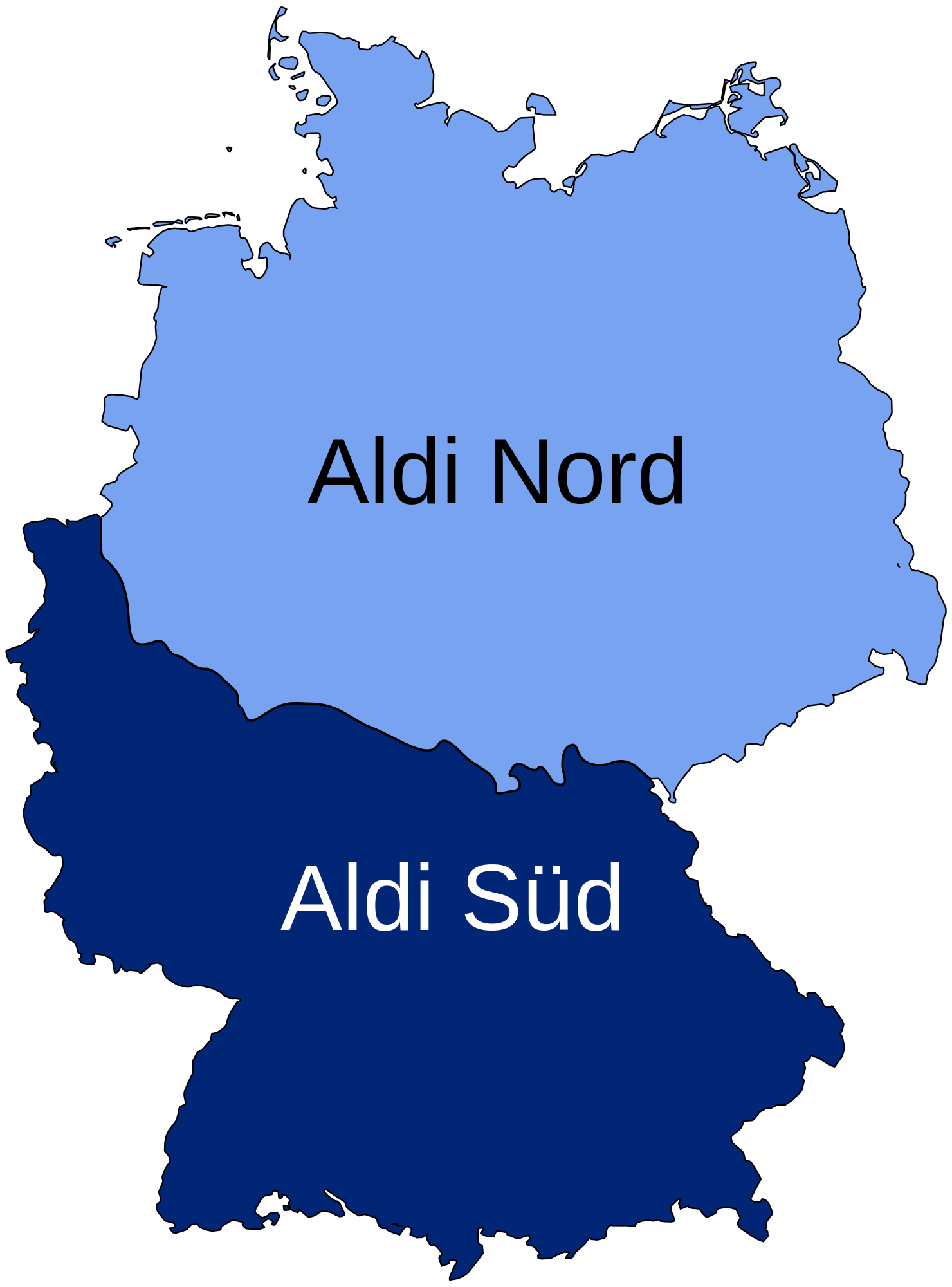
In Germany, Aldi Nord (HQ: Essen) has slightly more stores at 2,298 in western, northern, and Eastern Germany compared to Aldi Süd’s (HQ: Mülheim) 1,880 stores in western and southern Germany.
The border between their territories in Germany is commonly known as the “Aldi-Äquator” (Aldi equator). East Germany, is almost entirely severed by Aldi Nord, except for one Aldi Süd store in Sonneberg, Thuringia.
Here’s a more detailed map of that Equator:

And perhaps even more interesting is that this division carries on to the rest of the world as the map below shows:

Aldi Nord vs Aldi Süd In Europe
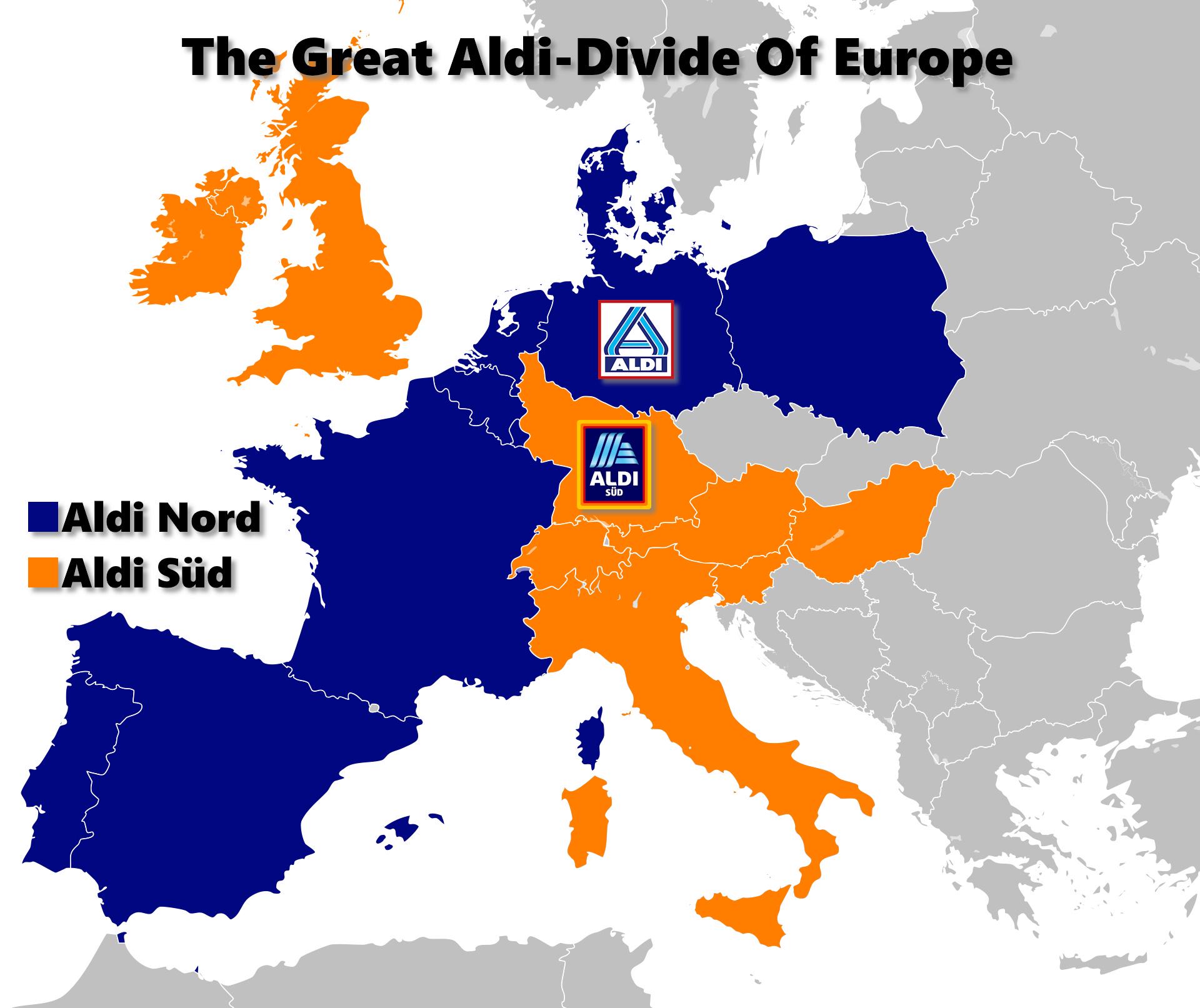
Aldi Nord has stores in:
- France: 891
- The Netherlands: 491
- United States (As Trader Joe’s): 474
- Belgium: 457
- Spain: 264
- Denmark: 222
- Poland: 124
- Portugal: 48
- Luxembourg: 12
Aldi Süd has stores in:
- United States (trading under the Aldi name): 1,750
- United Kingdom: 762
- Australia: 502
- Austria (Hofer): 480
- Switzerland: 190
- Hungary: 130
- Ireland: 130
- Slovenia: 80
- Italy: 29
Collectively the two companies have 10,555 stores (between all their various brands), employ more than 160,000 people worldwide and have collective revenues of €50 billion annually.
Aldi’s split into Aldi Nord (North) and Aldi Süd (South) happened because of a disagreement between the two founding brothers.
Here’s the story in a nutshell:
Origins
- Aldi was founded by brothers Karl and Theo Albrecht in 1946, when they took over their mother’s small grocery store in Essen, Germany.
- They pioneered the “no-frills discount supermarket” model: low prices, limited selection, fast checkout, and self-service.
- The name “Aldi” comes from Albrecht + Discount.
The Disagreement (1960)
By 1960, their business had grown to several hundred stores across West Germany.
The brothers had very similar views on frugality and business strategy, but they had one major disagreement:
- Theo Albrecht wanted to keep selling cigarettes in Aldi stores.
- Karl Albrecht opposed cigarette sales, arguing that it would attract shoplifters and cause other security problems.
They could not resolve the dispute, so they decided to split the company in two.
The Division
In 1961, the brothers formally divided Aldi along geographic lines:
- Aldi Nord (North) – run by Theo Albrecht
- Aldi Süd (South) – run by Karl Albrecht
The division line runs roughly along the Ruhr River, splitting Germany into two Aldi “territories.”
Each side kept full control over its own operations, branding, and expansion strategy, though they cooperated on certain things like product sourcing.
How They Differ Today
- Aldi Nord and Aldi Süd look similar, but they operate independently, with slightly different store layouts, product selections, and logos.
- Internationally:
- Aldi Süd operates Aldi stores in the U.S., U.K., Australia, and much of Europe.
- Aldi Nord owns Trader Joe’s in the U.S. and operates Aldi stores in France, Spain, Denmark, and Benelux countries.
Why It Worked
The split allowed each brother to run his half exactly how he wanted, preventing further conflict while maintaining the company’s ultra-efficient model.
Even though they are separate, Aldi Nord and Aldi Süd together make Aldi one of the largest grocery chains in the world.
And here’s a final map:

Find these maps interesting? Please help us by sharing:
![What Time Do Europeans Typically Wake Up? [With Data]](https://brilliantmaps.com/wp-content/uploads/Wake-up-times-300x200.jpg)



Anton Sherwood says
But Aldi Nord owns Trader Joe’s.
MJ says
“Untied” States 😂😂😂
Rainer says
Aldi Süd in Slovenia is called Hofer as in the Austrian Aldi Süd
Arfman says
This map should have shown Trader Joe’s as a puppet state of Aldi Nord.
AKM says
You are thtoopid. Can’t you keep politics out?
KingAshoka says
How is this about politics? Maybe grocery chain politics.
Nicholas says
There’s two Aldi companies because the original split in 1960, when the two brothers that owned the original company had a dispute over the sale of cigarettes (one thought they would attract shoplifters, the other didn’t).
Apparently the two companies are looking at merging by 2022.
Joel Cardoso says
What are the main differences between the two?
David says
You could really do with someone proofreading your articles before they are posted! “Severed”? Sounds dangerous! “Revered?” Not sure they love it that much. 😂
Raul says
Shouldn’t the US be purple and orange stripes???