
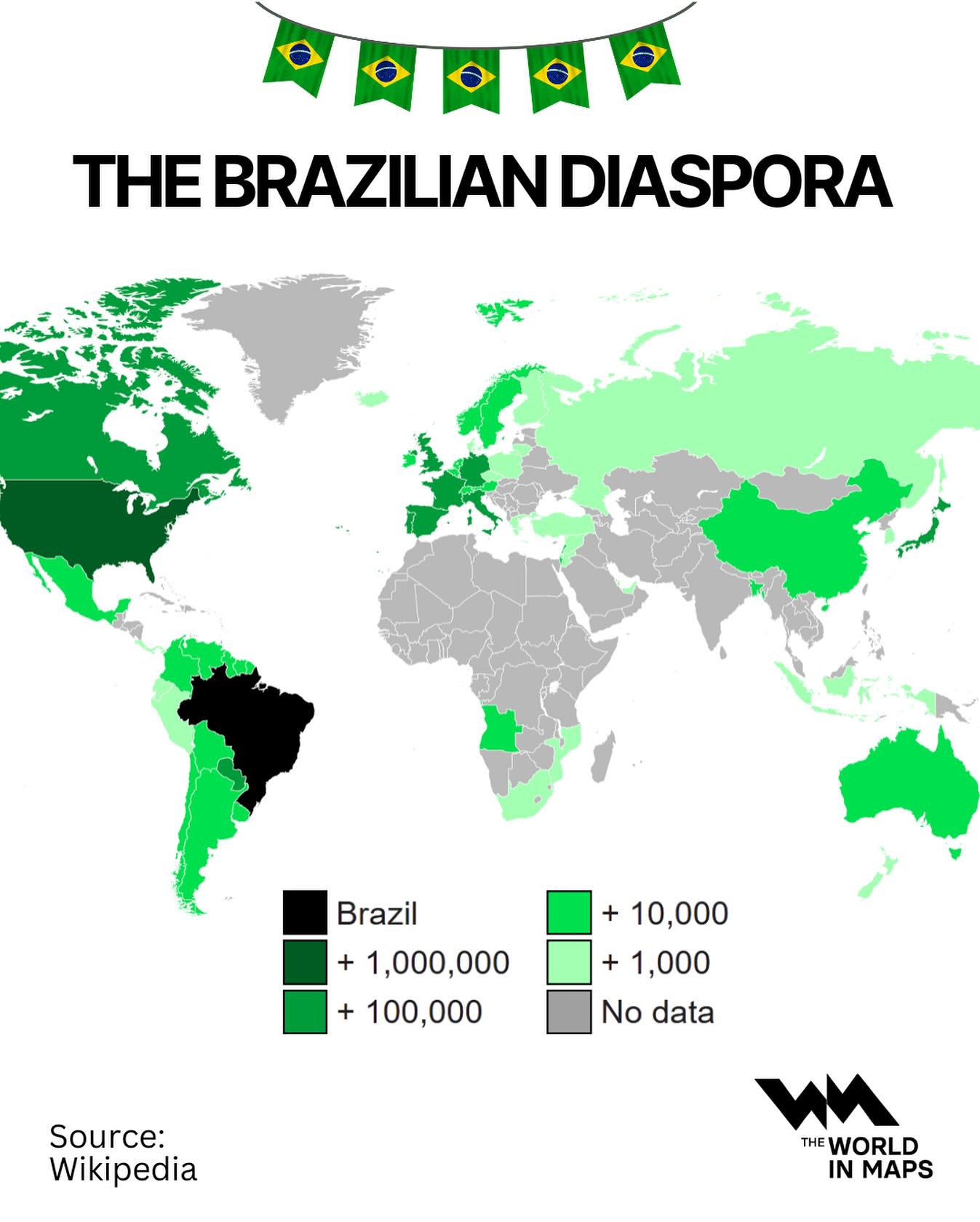
In terms of current numbers here are the best estimates by country:
- United States – 1,905,000
- Portugal – 275,000
- Paraguay – 245,850
- United Kingdom – 220,000
- Japan – 206,259
- Spain – 165,000
- Italy – 162,000
- Germany – 138,955
- Canada – 122,400
- Argentina – 90,203
- France – 90,000
- French Guiana – 82,500
- Switzerland – 77,000
- Ireland – 70,000
- Belgium – 65,000
- Netherlands – 65,000
- Australia – 60,000
- Uruguay – 46,848
- Bolivia – 42,000
- Mexico – 40,000
- Suriname – 30,000
- Lebanon – 21,000
- Chile – 18,648
- Sweden – 16,814
- Israel – 15,000
- Angola – 13,290
- Venezuela – 11,800
- Guyana – 10,700
- Norway – 10,411
- Other countries combined – 87,577
And in terms of cities here is a list with at least 10,000 Brazilians living in them:
- New York City, United States – 500,000
- Miami, United States – 475,000
- Boston, United States – 380,000
- London, United Kingdom – 220,000
- Lisbon, Portugal – 180,000
- Atlanta, United States – 120,000
- Nagoya, Japan – 119,298
- Los Angeles, United States – 115,000
- Ciudad del Este, Paraguay – 98,000
- Milan, Italy – 92,000
- Paris, France – 90,100
- Houston, United States – 90,000
- Madrid, Spain – 90,000
- Toronto, Canada – 90,000
- Buenos Aires, Argentina – 80,000
- Cayenne, French Guiana – 80,000
- Barcelona, Spain – 75,000
- Rome, Italy – 70,000
- Hartford, United States – 70,000
- Porto, Portugal – 70,000
- Dublin, Ireland – 70,000
- San Francisco, United States – 65,000
- Amsterdam, Netherlands – 65,000
- Tokyo, Japan – 56,079
- Munich, Germany – 51,000
- Copenhagen, Denmark – 48,007
- Asunción, Paraguay – 48,000
- Frankfurt, Germany – 47,955
- Sydney, Australia – 45,000
- Chicago, United States – 45,000
- Washington D.C., United States – 45,000
- Berlin, Germany – 40,000
- Geneve, Switzerland – 40,000
- Mexico City, Mexico – 40,000
- Zurich, Switzerland – 37,000
- Encarnación, Paraguay – 33,500
- Brussels, Belgium – 32,000
- Hamamatsu, Japan – 30,882
- Salto do Guairá, Paraguay – 30,000
- Paramaribo, Suriname – 30,000
- Pedro Juan Caballero, Paraguay – 29,000
- Faro, Portugal – 25,000
- Artigas, Uruguay – 23,200
- Beirut, Lebanon – 21,000
- Santa Cruz de la Sierra, Bolivia – 20,000
- Santiago, Chile – 18,644
- Stockholm, Sweden – 17,000
- Canberra, Australia – 15,000
- Tel Aviv, Israel – 15,000
- Vancouver, Canada – 15,000
- Montevideo, Uruguay – 15,000
- Luanda, Angola – 13,290
- Montreal, Canada – 12,400
- Caracas, Venezuela – 11,800
- Oslo, Norway – 10,698
- Georgetown, Guyana – 10,000
Also apparently there is 1 Brazilian national living in Pyongyang, North Korea.
Brazilians Living in Europe

According to the 2023 Data from the Brazilian Ministry of Foreign Affairs 🇧🇷, more than 1.600.000 Brazilians were living in Europe. I must warn you that this data is an estimation released by the embassies in each of these countries, therefore the numbers could be higher or lower.
We can see that Portugal 🇵🇹 is by far the country in which the most Brazilians are living in Europe, followed by the United Kingdom 🇬🇧, Italy 🇮🇹, Germany 🇩🇪 and Spain 🇪🇸.
The countries with the least Brazilians are Moldova 🇲🇩 (12) and the Vatican 🇻🇦(15).
Brazilians Living in Asia
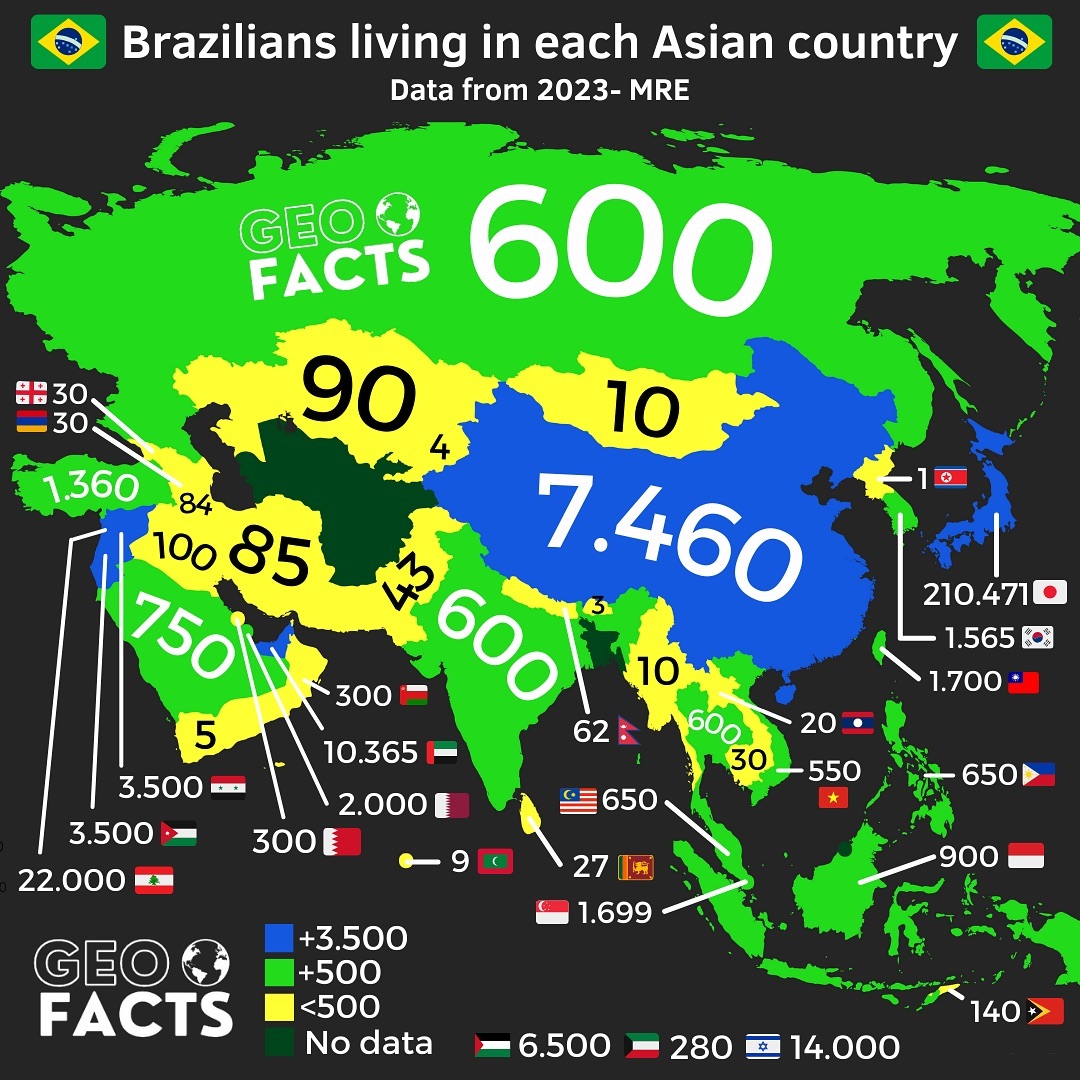
According to the Ministry of Foreign Affairs of #Brazil (MRE – Ministério das Relações Exteriores), in 2023 a total of 4.996.951 Brazilians were living abroad all over the #world
#Japan 🇯🇵 is the fifth country with the most Brazilians living outside Brazil, also the one first one in #Asia -> The exact number is 210.471!
Lebanon 🇱🇧, Israel 🇮🇱, China 🇨🇳, Palestine 🇵🇸 and the United Arab Emirates 🇦🇪 are also other 5 major places in which Brazilians live in Asia.
This is only an estimation, so the numbers can be smaller or bigger depending on the country.
Why do Brazilians emigrate from Brazil?
Brazilians emigrate from Brazil for several key reasons:
- Economic Factors: The primary driver is economic opportunity. High inflation, economic instability, and low growth rates, particularly during the 1980s and 1990s, known as the “lost decade,” prompted many Brazilians to seek better job prospects abroad. Even in more recent times, Brazil’s economic challenges have continued to push citizens to look for better opportunities elsewhere.
- Political Instability and Safety: Political turmoil and insecurity, including the impeachment of Dilma Rousseff in 2016 and the election of Jair Bolsonaro in 2018, have led many Brazilians to lose faith in the country’s stability and governance. Additionally, issues such as violence and lack of public safety are significant concerns that drive emigration.
- Educational and Professional Opportunities: Many Brazilians, particularly those from the middle and upper classes, seek higher education and professional opportunities abroad. Countries like the United States, Portugal, and Canada offer better educational facilities and professional environments, which attract Brazilian students and skilled workers.
- Quality of Life: Improved quality of life, including better public services, healthcare, and education in destination countries, is another strong motivation. For instance, public schools and safety in Portugal are highlighted as reasons for migration among Brazilian professionals.
- Family and Social Ties: The presence of family members or established Brazilian communities in countries like the United States, Japan, and Portugal makes migration easier and more attractive. Social networks play a crucial role in the decision to emigrate.
What barriers stop Brazilians from emigrating?
Brazilians face several barriers when attempting to emigrate, which can significantly hinder their ability to move abroad. These barriers include:
- Economic Constraints: High costs associated with relocation, including travel expenses, visa fees, and the cost of living in the destination country, can be prohibitive for many Brazilians. For those from lower socioeconomic backgrounds, these financial barriers are particularly challenging..
- Legal and Bureaucratic Hurdles: Obtaining visas and work permits can be complex and time-consuming. Many countries have stringent immigration policies that require extensive documentation and proof of financial stability, making the process daunting for prospective emigrants.
- Language Barriers: Lack of proficiency in the language of the destination country can deter Brazilians from emigrating. Language skills are crucial for securing employment and integrating into the new society, and the absence of these skills can make the prospect of moving abroad less appealing..
- Family and Social Ties: Strong familial and social connections in Brazil can act as a significant deterrent to emigration. The emotional difficulty of leaving behind family and friends, along with the support networks they provide, often prevents individuals from taking the step to move abroad.
- Risk of Uncertain Outcomes: The fear of the unknown, including the risk of unemployment, discrimination, and social isolation in the new country, can be a significant barrier. The uncertainty about whether the move will result in better opportunities or improved living conditions can discourage people from emigrating..
- Government Policies and International Relations: Changes in immigration policies in destination countries, such as increased restrictions and tighter border controls, can limit opportunities for Brazilians to emigrate. Geopolitical tensions and international relations also play a role in shaping the ease with which Brazilians can move to certain countries.
Do more people immigrate to or emigrate from Brazil each year?
Sources seem to vary on whether more people immigrate to or emigrate from Brazil each year. According to the World Bank Brazil’s net migration rate for 2023 was just 6,000 people. However, the CIA, puts the country -0.2 migrant(s)/1,000 population for 2024.
One final map:
- Map Showing The Italian Diaspora & Immigrants By Country
- Japanese Diaspora & Immigrants By Country
- Map Of The Irish Diaspora In The World
- Map Of The Mongolian Diaspora In The World
- British Diaspora: Absolute Numbers & Share Of The Population
Find this map interesting? Please help us by sharing it:





Leave a Reply