
Here are the numbers by country:
| Country | Population |
|---|---|
| Brazil | 32,000,000 (about 15% of the total population) |
| Argentina | 25,000,000 (about 62% of the total population) |
| United States | 18,000,000 (about 5.4% of the total population) |
| France | 5,500,000 (about 8% of the total population) |
| Venezuela | 5,000,000 (about 16% of the total population) |
| Paraguay | 2,500,000 (about 37% of the total population) |
| Colombia | 2,000,000 (about 4% of the total population) |
| Uruguay | 1,500,000 (about 44% of the total population) |
| Canada | 1,500,000 (about 4% of the total population) |
| Germany | 1,200,000 (about 1.4% of the total population) |
| Australia | 1,000,000 (about 4% of the total population) |
| Mexico | 850,000 (<1% of the total population) |
| Chile | 600,000 (about 3.5% of the total population) |
| Switzerland | 530,000 (about 7% of the total population) |
| Peru | 500,000 (about 1.6% of the total population) |
| United Kingdom | 500,000 (<1% of the total population) |
| Belgium | 450,000 (about 4% of the total population) |
| Costa Rica | 380,000 (about 7.5% of the total population) |
| Dominican Republic | 300,000 (about 3% of the total population) |
| Spain | 260,000 (<1% of the total population) |
| El Salvador | 200,000 (about 3% of the total population) |
Why did so many Italians move to Brazil and Argentina?
Many Italians moved to Brazil and Argentina in the late 19th and early 20th centuries for several key reasons:
- Economic Opportunities: Both Brazil and Argentina were experiencing economic growth and needed labor for their expanding agricultural sectors. Argentina, in particular, had a growing demand for workers to develop its vast pampas and urban areas, while Brazil’s coffee plantations required more labor.
- Land and Labor Shortages in Italy: Italy, especially in the southern regions, faced severe land shortages, overpopulation, and high unemployment rates. Many rural Italians, primarily from impoverished areas, were motivated to seek better economic prospects abroad.
- Government Policies and Incentives: The governments of Brazil and Argentina actively encouraged immigration by offering incentives such as land grants, subsidies, and assistance with travel expenses. These policies were part of broader national strategies to increase population and stimulate economic growth.
- Chain Migration: As initial waves of Italian immigrants established communities in Brazil and Argentina, they sent back positive reports to their families and friends in Italy. This encouraged subsequent waves of migration through established networks, making the transition easier for newcomers.
- Political and Social Factors in Italy: Italy during this period was marked by political instability, social unrest, and poor living conditions. These factors drove many Italians to seek a more stable and prosperous life in South America.
- Linguistic and Cultural Factors: The Spanish and Portuguese languages, spoken in Argentina and Brazil respectively, had similarities to Italian, making it easier for Italian immigrants to adapt. Moreover, the predominantly Catholic religious background in these countries provided a familiar cultural environment.
Where did Italian immigrants settle in the United States and Canada?
Italian immigrants settled in various regions of the United States and Canada, often forming vibrant communities in both urban and rural areas. Here are some notable locations:
United States
- New York City: One of the largest Italian communities formed in New York City, particularly in neighborhoods such as Little Italy in Manhattan, the Bronx, Brooklyn, and Staten Island. New York became a primary entry point for many Italian immigrants due to its status as a major port.
- Philadelphia: South Philadelphia became home to a significant Italian population, with vibrant markets and cultural institutions that reflected their heritage.
- Boston: The North End neighborhood became synonymous with Italian culture and cuisine, hosting a large number of Italian immigrants.
- Chicago: Italians settled in various parts of Chicago, particularly in neighborhoods like Little Italy on the Near West Side and Taylor Street.
- San Francisco: North Beach became the heart of the Italian community in San Francisco, with many working in the fishing and construction industries.
- New Orleans: Italian immigrants, particularly Sicilians, formed a significant community in New Orleans, contributing to the city’s cultural diversity.
- Detroit, Cleveland, and Buffalo: These industrial cities attracted Italian immigrants due to job opportunities in manufacturing and construction.
Canada
- Toronto: Toronto became a major hub for Italian immigrants, with neighborhoods like Little Italy on College Street and Corso Italia on St. Clair Avenue becoming cultural centers.
- Montreal: Montreal’s Italian community settled primarily in areas such as Little Italy in the Rosemont–La Petite-Patrie borough.
- Vancouver: Italian immigrants contributed to the cultural fabric of Vancouver, particularly in areas like Commercial Drive, known as Little Italy.
- Hamilton: This industrial city in Ontario attracted many Italian immigrants who found work in the steel mills and manufacturing plants.
- Windsor: Located near Detroit, Windsor also saw a significant influx of Italian immigrants, many of whom were involved in the automotive industry.
In both the United States and Canada, Italian immigrants established tight-knit communities, often centered around churches, social clubs, and businesses that catered to their needs and helped preserve their cultural heritage.
These neighbourhoods played a crucial role in the assimilation and integration process while maintaining strong connections to Italian traditions and customs.
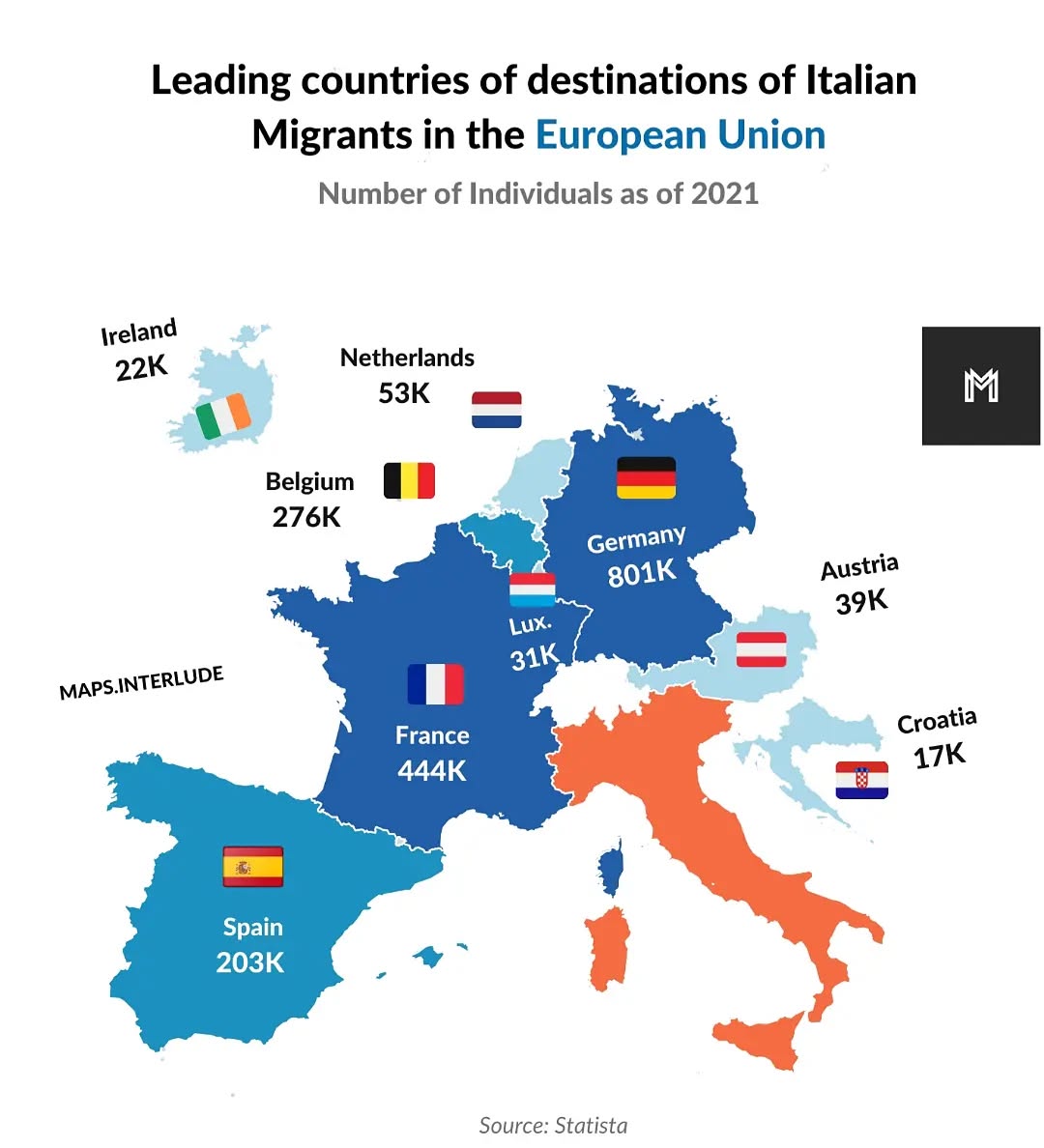
Italians In Other European Countries
Other Diaspora Maps in the series:






Y.D. Robinson says
I’m more than a little surprised that Argentina has a significantly higher percentage of Italians than its neighbour Uruguay with which it shares cultural and geographic similarities. I thought that for Uruguay it would be more in the area of 50-55%. (It’s true, though, that Argentina did attract more relative as well as absolute Italian and other European immigration during its all-time peak early in the 20th century than Uruguay.) It’s surprising that Uruguay doesn’t have a much higher percentage of Italians than Paraguay.
And it’s equally surprising that Chile, which got quite a few European immigrants though not nearly as much as Argentina, Brazil, or even Uruguay, has as little as 3.5%; I thought it would be in the area of 7-10%.
Samo says
Can’t talk for other countries, but Italians in Croatia are not migrants. They are indigenous minority, living on the same place for centuries. Italy was not always in the same borders…