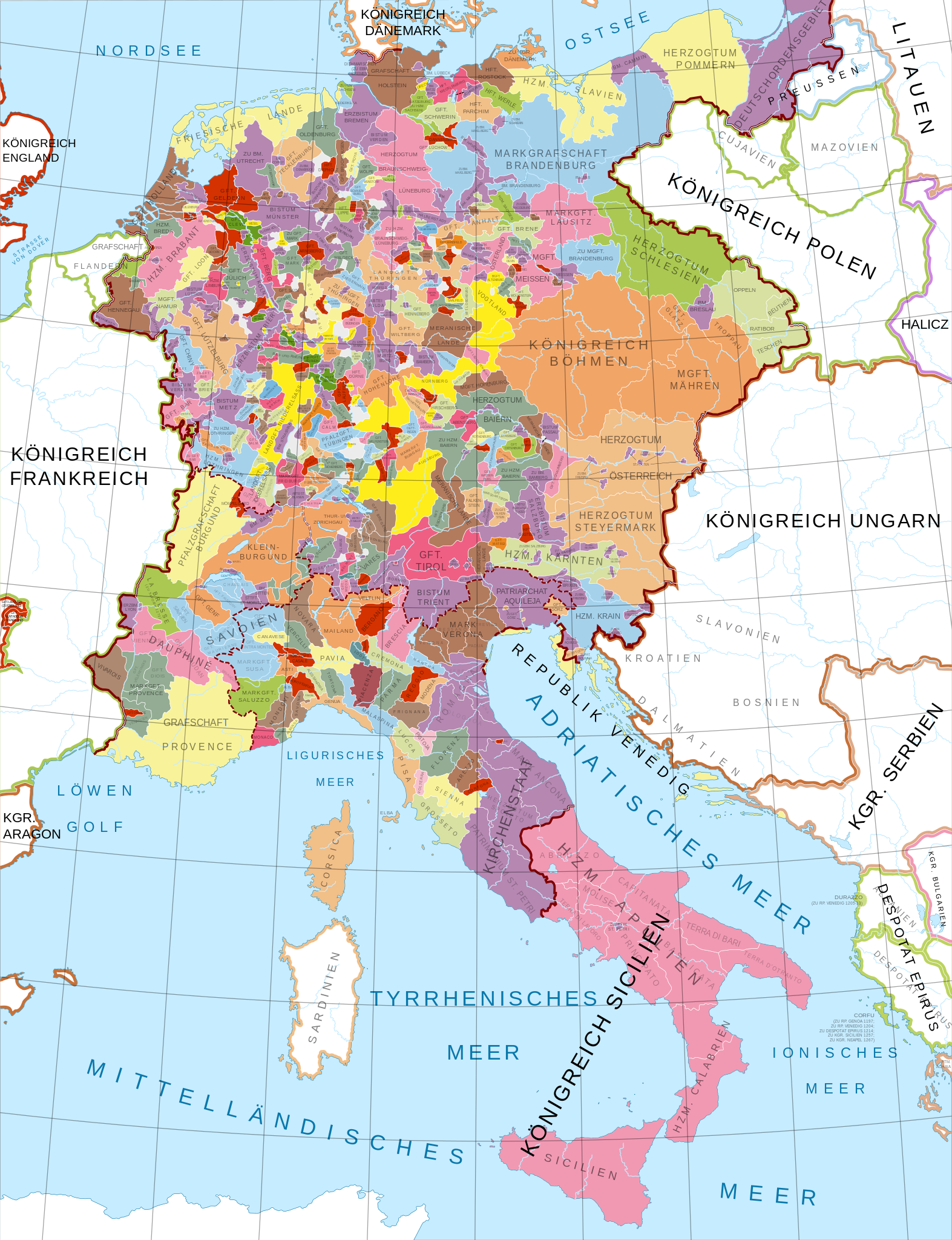
Here are some key points about this era:
Historical Context
- Hohenstaufen Dynasty: The Hohenstaufen dynasty, also known as the Staufer dynasty, ruled the Holy Roman Empire from 1138 to 1254. Notable emperors from this dynasty include Frederick I (Barbarossa) and Frederick II.
- Territorial Complexity: The Holy Roman Empire was a complex and fragmented collection of semi-independent states, including duchies, counties, free imperial cities, and bishoprics.
- Political Structure: The Empire had a decentralized political structure where local rulers held significant autonomy, although they were nominally under the authority of the Emperor.
Features of the Map
- States and Principalities: The map highlights the multitude of small states and territories within the Empire. Each color represents a different political entity.
- Neighboring Kingdoms: The map shows the neighboring kingdoms such as the Kingdom of France (Königreich Frankreich), Kingdom of Poland (Königreich Polen), Kingdom of Hungary (Königreich Ungarn), and Kingdom of Sicily (Königreich Sizilien).
- Geographical Features: Major rivers, seas, and mountain ranges are depicted, providing a sense of the geographical context of the era.
Notable Regions and Entities
- Kingdom of Bohemia (Königreich Böhmen): A significant part of the Empire, it often had a special status and its rulers held the title of King.
- Duchy of Bavaria (Herzogtum Bayern): One of the largest and most powerful duchies within the Empire.
- Duchy of Saxony (Herzogtum Sachsen): Another major duchy, influential in the politics of the Empire.
- Republic of Venice (Republik Venedig): While not part of the Holy Roman Empire, it was an important neighbor and a key player in Mediterranean and European politics.
- Kingdom of Sicily (Königreich Sizilien): At times under the control of the Hohenstaufen Emperors, it played a significant role in the politics of Southern Europe.
Political and Military Context
- Conflicts and Crusades: The period saw numerous conflicts both within the Empire and with external entities, including the Crusades in the Holy Land and wars with neighboring kingdoms.
- Frederick Barbarossa: Noted for his attempts to consolidate imperial power and his conflicts with the Papacy and the Lombard League.
- Frederick II: Renowned for his cultural patronage, administrative reforms, and conflicts with the Papacy.
Cultural and Economic Aspects
- Cultural Flourishing: The Hohenstaufen period was marked by a flourishing of culture and learning, with notable contributions to architecture, literature, and law.
- Economic Activity: The Empire was a center of trade and economic activity, with significant commercial cities and trade routes.
Notes on the Map From the Author:
Key:
| Baiern | Bavaria (modern German spelling Bayern) |
| Böhmen | Bohemia |
| Braunschweig | Brunswick |
| Deutschordensgebiet | Territory of the German/Teutonic Order |
| Kärnten | Carinthia |
| Kirchenstaat | Papal States |
| Köln | Cologne |
| Krain | Carniola |
| Lützelburg | Luxembourg (modern German Luxemburg) |
| Mähren | Moravia |
| Meer | Sea |
| Österreich | Austria |
| Pommern | Pomerania |
| Schlesien | Silesia |
| Abbreviations: | ||
|---|---|---|
| A. | Abtei | Abbey |
| BGFT. | Burggrafschaft | Burgraviate |
| BM. | Bistum | Bishopric |
| EBM. ERZBM. |
Erzbistum | Archbishopric |
| FSM. | Fürstentum | Principality |
| GFT. | Grafschaft | County |
| HFT. | Herrschaft | Lordship |
| HZM. | Herzogtum | Duchy |
| KGR. | Königreich | Kingdom |
| LANDGFT. LGFT. |
Landgrafschaft | Landgraviate |
| MARKGFT. MGFT. |
Markgrafschaft | Margraviate |
| PGFT. PFALZGFT. |
Pfalzgrafschaft | County Palatine/Palatinate |
Some of the largest and most influential cities and states at that time included:
Largest Cities
- Aachen (Aix-la-Chapelle): Often regarded as the capital of the Holy Roman Empire, especially during the reign of Charlemagne and subsequent emperors, Aachen was a significant political and religious center.
- Cologne (Köln): One of the largest and most important cities in the Empire, Cologne was a major trade hub and the seat of a powerful archbishopric.
- Mainz: Another significant archbishopric and political center, Mainz played a crucial role in the imperial elections and held considerable influence.
- Regensburg: A major city in the Duchy of Bavaria, Regensburg was an important political, economic, and cultural center.
- Nuremberg (Nürnberg): Known for its strategic location and economic importance, Nuremberg was a key trading city.
- Frankfurt: An important commercial and financial hub, Frankfurt also became a significant site for imperial elections.
- Bamberg: A prominent bishopric and cultural center, Bamberg was known for its impressive architecture and contributions to learning.
Largest States
- Duchy of Saxony: One of the most powerful duchies in the Empire, Saxony was a key player in imperial politics and had significant military strength.
- Duchy of Bavaria: Another major duchy, Bavaria was influential both politically and militarily, with a strong cultural identity.
- Duchy of Swabia: Ruled by the Hohenstaufen dynasty during this period, Swabia was a central power base for the Emperors and a major military and political force.
- Duchy of Franconia: Although it had been partitioned into smaller entities, Franconia remained an important region, with key cities like Würzburg and Bamberg.
- Duchy of Lorraine: Situated along the western edge of the Empire, Lorraine was strategically important and frequently involved in conflicts with neighboring France.
- Duchy of Austria: Initially a margraviate, Austria was elevated to a duchy in 1156 and would later become one of the most powerful states in the Empire.
- Margraviate of Brandenburg: An important northeastern territory, Brandenburg would later grow in significance and become a leading state within the Empire.
Brief Timeline of The Holy Roman Empire
Here is an overview from its inception to its dissolution:
Timeline of the Holy Roman Empire
9th to 10th Century
- 800: Charlemagne (Charles the Great) is crowned Emperor of the Romans by Pope Leo III, marking the foundation of what would later be known as the Holy Roman Empire.
- 843: Treaty of Verdun divides the Carolingian Empire among Charlemagne’s grandsons, laying the groundwork for the future Holy Roman Empire.
- 962: Otto I (Otto the Great) is crowned Emperor by Pope John XII, establishing the Holy Roman Empire in its more recognizable form.
11th to 12th Century
- 1056-1106: Reign of Henry IV, marked by the Investiture Controversy with Pope Gregory VII over the appointment of church officials.
- 1122: Concordat of Worms resolves the Investiture Controversy, establishing a compromise between imperial and papal powers.
12th to 13th Century (Hohenstaufen Dynasty)
- 1152-1190: Reign of Frederick I (Barbarossa), known for his attempts to strengthen imperial authority and his conflicts with the Lombard League.
- 1198-1250: Reign of Frederick II, noted for his cultural achievements, administrative reforms, and conflicts with the Papacy.
13th to 14th Century
- 1254-1273: Interregnum, a period of political instability and lack of central authority in the Empire.
- 1273: Rudolf I of Habsburg is elected Emperor, ending the Interregnum and beginning the rise of the Habsburg dynasty.
14th to 15th Century
- 1356: Golden Bull issued by Emperor Charles IV, establishing important constitutional aspects of the Empire, including the election process for the Emperor.
- 1438: Albert II of Habsburg becomes Emperor, initiating continuous Habsburg rule.
16th Century
- 1519-1556: Reign of Charles V, whose rule encompasses the height of Habsburg power and the Protestant Reformation.
- 1530: Charles V is crowned by Pope Clement VII, the last Emperor to be crowned by a Pope.
- 1555: Peace of Augsburg allows for the coexistence of Catholicism and Lutheranism within the Empire.
17th Century
- 1618-1648: Thirty Years’ War devastates the Empire, leading to significant political, religious, and territorial changes.
- 1648: Peace of Westphalia ends the Thirty Years’ War, significantly weakening imperial authority and recognizing the sovereignty of individual states.
18th Century
- 1740-1780: Reign of Maria Theresa, who undertakes significant administrative and military reforms.
- 1748: Treaty of Aix-la-Chapelle ends the War of Austrian Succession, confirming Maria Theresa’s rule.
19th Century
- 1806: Dissolution of the Holy Roman Empire by Emperor Francis II following defeat by Napoleon and the establishment of the Confederation of the Rhine.
Key Points:
- The Holy Roman Empire was a complex and decentralized entity, with power often shifting between the Emperor and various regional princes.
- The Investiture Controversy and the Concordat of Worms were pivotal in defining the relationship between the Empire and the Papacy.
- The Hohenstaufen dynasty, especially under Frederick Barbarossa and Frederick II, represented a high point in imperial ambition and cultural achievements.
- The Peace of Westphalia marked a significant decline in imperial authority, leading to increased sovereignty for the Empire’s constituent states.
- The Empire’s dissolution in 1806 marked the end of a millennium-long political entity in Central Europe.
Why did the Holy Roman Empire fall?
Here are the key factors that led to its dissolution:
1. Structural Weaknesses and Political Fragmentation
- Decentralized Power: The Holy Roman Empire was a loose confederation of semi-independent states, principalities, duchies, and free cities. The Emperor’s authority was limited, and the central government was weak.
- Internal Conflicts: Frequent conflicts among the empire’s constituent states and between the Emperor and powerful princes weakened the overall unity and effectiveness of the Empire.
2. Religious Divisions
- Protestant Reformation: The Reformation, initiated by Martin Luther in 1517, led to religious fragmentation within the Empire. The ensuing religious wars, particularly the Thirty Years’ War (1618-1648), devastated the Empire and led to the Peace of Westphalia, which recognized the sovereignty of individual states and further weakened imperial authority.
3. Economic and Social Changes
- Economic Shifts: The rise of nation-states and the shift of economic power to Western Europe, particularly to France, England, and the Netherlands, diminished the economic importance of the Empire.
- Social Upheaval: Changes in social structures, urbanization, and the impact of the Enlightenment contributed to the weakening of traditional feudal and imperial structures.
4. External Pressures
- Foreign Invasions and Wars: The Empire faced continuous external threats from France, the Ottoman Empire, and other European powers. These external pressures often exacerbated internal divisions.
- Napoleonic Wars: The decisive factor in the fall of the Holy Roman Empire was the rise of Napoleon Bonaparte. His military campaigns and the establishment of the Confederation of the Rhine in 1806, a group of German states allied with France, directly challenged the existence of the Empire.
5. Napoleon’s Influence
- Defeat at Austerlitz: The defeat of the Austrian and Russian armies by Napoleon at the Battle of Austerlitz in 1805 severely weakened the Austrian-led Holy Roman Empire.
- Confederation of the Rhine: Napoleon established the Confederation of the Rhine in 1806, effectively replacing the Holy Roman Empire with a new political structure aligned with French interests.
6. Dissolution by Francis II
- Emperor Francis II: Recognizing the untenable position of the Empire, Emperor Francis II abdicated the imperial throne on August 6, 1806, and declared the Holy Roman Empire dissolved. He adopted the title of Emperor of Austria, shifting his focus to the Austrian Empire.
Here’s what the Empire looked like in 1789:

And here’s the rebranded Confederation of the Rhine in 1808

And here’s how I imagine this went down:

Who said the Holy Roman Empire was neither Holy, nor Roman, nor an Empire & why?
The famous quip “neither Holy, nor Roman, nor an Empire” is attributed to the French Enlightenment writer and philosopher Voltaire. This statement was made to highlight the ironic and somewhat contradictory nature of the Holy Roman Empire.
Context and Meaning
- Not Holy: The Empire was deeply entangled in religious conflicts, most notably the Protestant Reformation and the subsequent Thirty Years’ War. These conflicts exposed the religious divisions and often led to actions that were far from “holy.” Additionally, the Empire’s rulers and states frequently acted out of political and territorial motives rather than purely religious ones.
- Not Roman: By Voltaire’s time, the Holy Roman Empire had little connection to ancient Rome. Although it claimed to be the successor to the Roman Empire, its political and cultural centers were in Germanic and Central European lands, far removed from the historical Roman Empire.
- Not an Empire: The Holy Roman Empire was a decentralized and fragmented collection of semi-independent states, duchies, principalities, and free cities. Unlike a centralized empire with strong central authority, it operated more like a loose confederation. The Emperor’s power was often limited and subject to the influence and autonomy of the various regional rulers.
Why Voltaire Made This Statement
Voltaire, as an Enlightenment thinker, was critical of institutions and traditions that he saw as irrational or inconsistent. The Holy Roman Empire, with its complex and often contradictory structure, was an easy target for his critique.
By pointing out that the Empire was neither holy, nor Roman, nor a true empire, Voltaire was emphasizing the discrepancy between its grandiose title and its actual nature. His statement was a commentary on the absurdity and the anachronistic nature of the Empire in the context of Enlightenment ideals, which favored rational governance and clear political structures.
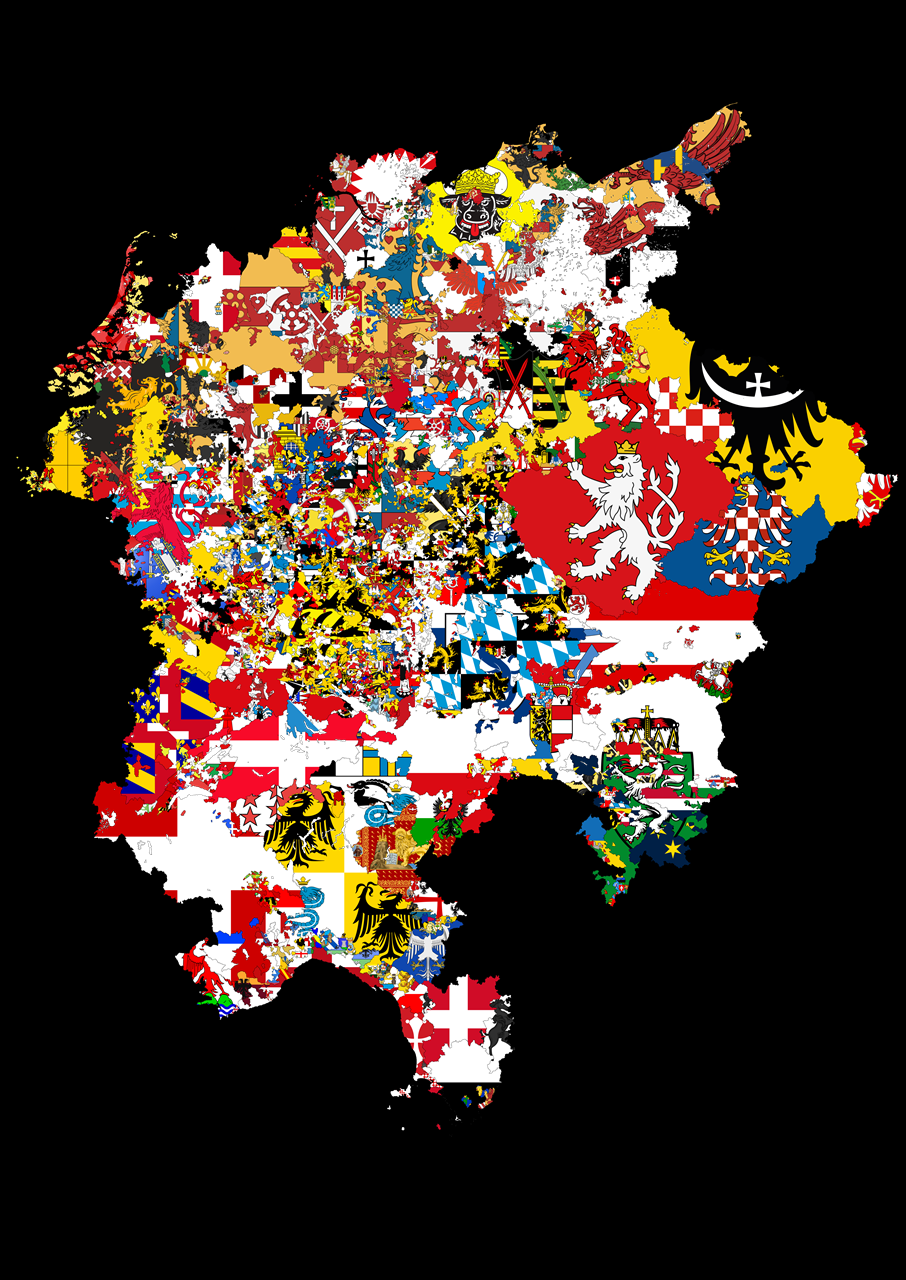
And finally a flag map of HRE in 1444:




Agnes Leaming says
Really enjoyed the Roman History letter. Thank you.
vittorio lichino says
You’re welcome 🙂