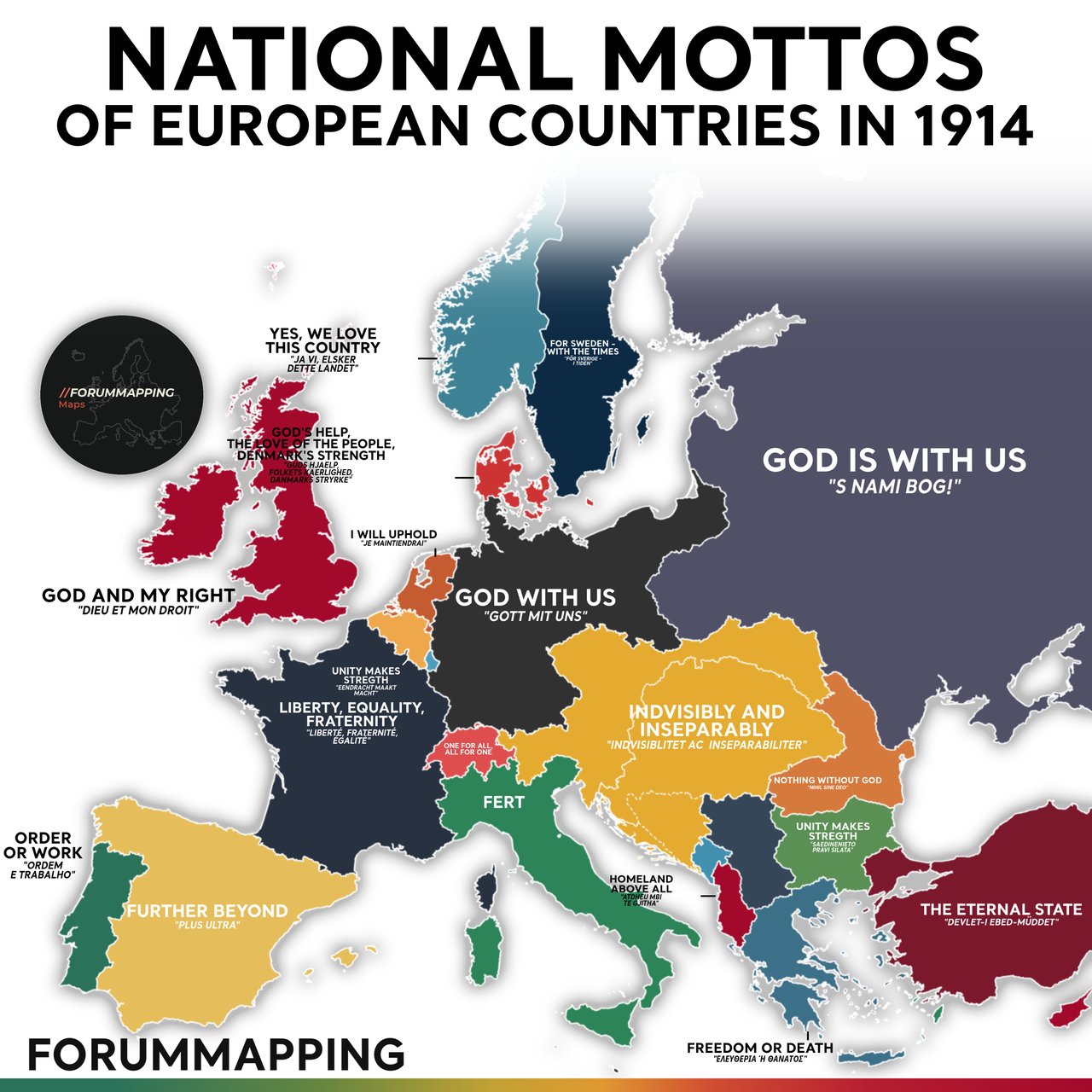
The first is probably Germany and Russia both having mottos that mean “God is with us” (or “God with Us”). Deeply ironic because Germany would lose the war, and Russia would become an atheistic state following the Russian Revolution.
The second is Austria-Hungary’s motto “Indivisibly and inseparably”, again deeply ironic given what happened to the country following the War.
Third, The Ottoman Empire’s The Eternal State is another deeply ironic motto.
And fourth WTF is FERT?
UK: “Dieu et mon droit” (God and my right). This is the royal motto, in French because of the Anglo-Norman court. It’s traditionally credited to Richard I, and Henry V made it standard.
Norway: “Ja, vi elsker dette landet” (Yes, we love this country). This is actually the opening line of the national anthem (Bjørnson, 1859), not a motto. King Haakon VII’s motto from 1905 was “Alt for Norge” (All for Norway).
Sweden: “För Sverige – i tiden” (For Sweden – with the times). This was the personal motto of Gustaf V, king from 1907 to 1950. Swedish monarchs each choose their own.
Denmark: “Guds hjælp, Folkets kærlighed, Danmarks styrke” (God’s help, the love of the people, Denmark’s strength). This was Christian X’s personal motto (king 1912–47). On the map the label sits over Britain, but it points to Denmark.
Netherlands: “Je maintiendrai” (I will maintain). This is the motto of the House of Orange-Nassau, inherited from William the Silent’s line.
Belgium: “L’union fait la force / Eendracht maakt macht” (Unity makes strength). It was adopted at independence in 1831 to bind Flemings and Walloons. The label is placed over northern France but means Belgium.
France: “Liberté, égalité, fraternité” (Liberty, equality, fraternity). It comes from the Revolution and was made official in 1848, then entrenched under the Third Republic in the 1880s.
Germany: “Gott mit uns” (God with us). This was the Prussian royal motto. It was famously stamped on soldiers’ belt buckles.
Russia: “С нами Бог” (God is with us). It’s from Isaiah (“Immanuel”) and was used on imperial banners and Orthodox hymns.
Austria-Hungary: “Indivisibiliter ac inseparabiliter” (Indivisibly and inseparably). It comes from the 1713 Pragmatic Sanction guaranteeing the Habsburg lands stay united. The map misspells it. Franz Joseph’s personal motto was “Viribus Unitis”.
Switzerland: “Unus pro omnibus, omnes pro uno” (One for all, all for one). It’s a traditional unofficial motto that was popularised in the 19th century, notably in an 1868 flood-relief appeal.
Spain: “Plus Ultra” (Further beyond). It was Charles V’s motto, flipping the “Non plus ultra” of the Pillars of Hercules to celebrate the New World.
Portugal: “Ordem e Trabalho” (Order and work). This one is doubtful. The 1910 Republic had no clear official motto, and the phrase echoes Brazil’s “Ordem e Progresso”.
Romania: “Nihil sine Deo” (Nothing without God). This was the motto of the Hohenzollern-Sigmaringen dynasty under Carol I.
Bulgaria: “Съединението прави силата” (Unity makes strength). It’s borrowed from Belgium and tied to the 1885 unification with Eastern Rumelia.
Albania: “Atdheu mbi të gjitha” (Homeland above all). It’s a nationalist slogan of the newly independent state of 1912.
Greece: “Ελευθερία ή θάνατος” (Freedom or death). It was the rallying cry of the 1821 War of Independence.
Ottoman Empire: “Devlet-i Ebed-müddet” (The eternal state). This was the empire’s traditional self-description of its permanence.
And finally:
Italy: “FERT”. This is the motto of the House of Savoy, and its meaning is disputed.
It dates to at least the 14th century and appears on the collar of the Order of the Annunciation (founded by Amadeus VI as the Order of the Collar, 1362–64), woven between love knots. The main theories:
Not an acronym at all. “Fert” is simply Latin for “he bears” or “he endures” (from ferre). This is probably the likeliest original sense: a terse chivalric device, like many medieval mottos.
“Foedere Et Religione Tenemur” (We are held by treaty and religion). This is the most widely repeated backronym, suggesting loyalty to alliances and the Church.
“Fortitudo Eius Rhodum Tenuit” (His strength held Rhodes). It’s tied to a legend that Amadeus V helped defend Rhodes for the Knights Hospitaller around 1310. There’s no good evidence he did, so it’s considered a later invention to give the motto a heroic origin.
“Fides Est Regni Tutela” (Faith is the safeguard of the kingdom). This is another pious later reading.
Joke readings. “Foemina Erit Ruina Tua” (Woman will be your ruin) and the French “Frappez, Entrez, Rompez Tout” (Strike, enter, smash everything) are satirical or folk inventions.
The motto followed the Savoys from Savoy and Piedmont to Sardinia and then all of Italy in 1861. It appeared on the royal arms, coins and the Annunziata collar until the monarchy fell in 1946.




Leave a Reply