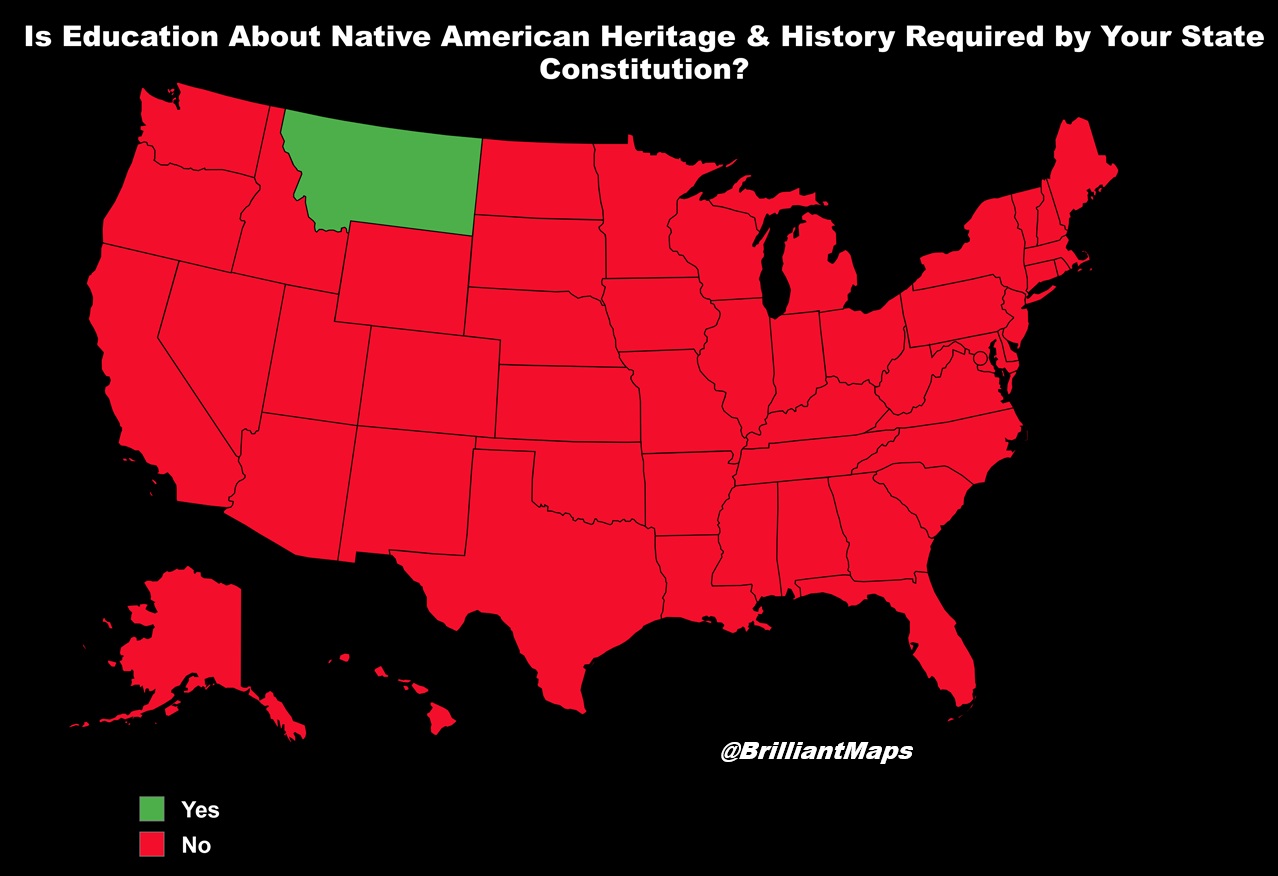
Montana’s Indian Education for All, commonly shortened to IEFA, is unusual because it rests on both the state constitution and ordinary legislation.
Article X, Section 1(2) of Montana’s 1972 Constitution states:
“The state recognizes the distinct and unique cultural heritage of the American Indians and is committed in its educational goals to the preservation of their cultural integrity.”
The wording does not itself prescribe particular lessons or grades. Instead, it establishes recognition of Indigenous culture as a permanent constitutional objective of Montana’s education system.
In 1999, the legislature passed House Bill 528, now generally called the Indian Education for All Act, to turn that broad constitutional promise into educational policy.
The law declares that every Montanan, “whether Indian or non-Indian,” should learn about American Indian heritage, with particular attention to Montana’s tribal nations, governments and contemporary contributions.
It also requires educational agencies to consult with Montana tribes when developing relevant instruction and policy.
What schools must now do
Following amendments in 2023 and 2025, Montana law is considerably stronger than the original 1999 version.
Public school districts must:
- Ensure that all students and certified school personnel receive instruction in American Indian studies.
- Include Montana Indian heritage within mandatory state content and performance standards.
- Use Indian language and culture specialists where possible.
- Include tribal representatives when relevant educational standards are written or revised.
- Report on implementation, spending and schools that fail to comply satisfactorily.
“American Indian studies” includes history, traditions, values, beliefs, languages, governments and contemporary affairs, not simply historical events such as westward expansion or the Indian Wars.
The idea is that Native history should not be confined to schools on reservations or treated as material solely for Native students. It is meant to be part of the basic civic education of every Montana student.
Why putting it in the constitution matters
Montana is generally regarded as the only state with an explicit constitutional educational commitment of this kind concerning American Indians. Other state constitutions discuss tribal land, taxation, gaming, voting, Native languages or cultural rights, but they do not establish the same statewide educational goal for all students.
The constitutional foundation matters in three ways:
It is more permanent. An ordinary legislature could amend or repeal a curriculum statute relatively easily. Removing the constitutional commitment would require a constitutional amendment.
It creates a legal obligation. Courts can judge education funding and policy against the constitutional promise, rather than treating Indigenous education as an optional programme.
It defines Native education as part of a “quality” education. IEFA is not merely a diversity initiative or a programme designed to raise Native student attainment. It says that non-Native students are also receiving an incomplete education when they are not taught about Montana’s tribal nations.
However, constitutional wording does not automatically produce classroom teaching.
Although the clause was adopted in 1972 and the implementing law passed in 1999, significant funding only followed school-funding litigation in 2005. Questions about uneven teaching, spending and accountability continued afterward.
How Montana compares with other states
| State | Legal basis | Main approach |
|---|---|---|
| Montana | Constitution plus statutes | All students and certified personnel must receive American Indian studies instruction; tribal heritage must be incorporated into accreditation standards. |
| Wisconsin | Statute and administrative standards | “Act 31,” adopted in 1989, requires social-studies instruction concerning the history, culture and sovereignty of Wisconsin’s federally recognized tribes and bands. |
| Washington | Statute | Districts must use the Since Time Immemorial curriculum and teach the history, culture and government of nearby federally recognized tribes, collaborating with tribal governments. |
| Oregon | Statute | The 2017 Tribal History/Shared History law directed the state to develop K–12 curriculum, teacher training and individual place-based materials with each of Oregon’s nine federally recognized tribes. |
| North Dakota | Statute, standards and state resources | A 2021 law prioritised Native American history instruction, supported by the state’s Native American Essential Understandings. |
Some state constitutions provide other important protections.
Hawaii’s constitution broadly protects traditional Native Hawaiian cultural and religious practices, while Oklahoma and Arizona expressly protect the use or preservation of Native languages from their English-language provisions.
Those are constitutionally significant, but they are not equivalent to Montana’s universal Indigenous-education commitment.
The important distinction
Montana is not the only state that requires schools to teach Indigenous history. Washington, Wisconsin, Oregon and several others have substantial statutory requirements, and some may be more detailed in particular areas.
What makes Montana exceptional is the hierarchy:
Constitutional promise → implementing legislation → curriculum standards, funding, consultation and accountability.
That gives Indigenous education a higher legal status than in states where it exists only through legislation or education-department standards.
Nevertheless, implementation has remained uneven.
A 2025 settlement with the Montana Board of Public Education required stronger accreditation, teacher preparation, tribal collaboration and reporting measures, showing that even a constitutional mandate still needs enforcement and oversight to become a consistent classroom reality.
What do you think about the idea?



Leave a Reply