
It was included in an excellent article by Nick Danforth in the Atlantic a decade ago titled: The Middle East That Might Have Been.
Here’s how the it looked in comparison to other plans at the time and things unfolded:
The King–Crane Commission was an American fact-finding mission commissioned in 1919 by U.S. President Woodrow Wilson to investigate the wishes of the peoples of the former Ottoman Empire territories after World War I, aiming to guide post-war decisions aligned with Wilson’s principle of self-determination.
Here is a concise but detailed overview of the commission, its recommendations, and contrasts with other key post-Ottoman arrangements:
The King-Crane Commission (1919)
Context & Purpose:
- President Woodrow Wilson, advocating “self-determination,” sought impartial insights on the Middle East after the collapse of the Ottoman Empire.
- The commission, headed by Henry King and Charles Crane, travelled through Ottoman-controlled Syria, Lebanon, Palestine, and Anatolia, meeting local populations and collecting extensive data on their aspirations.
Key Recommendations:
- Recommended against establishing a Jewish state in Palestine due to overwhelming local Arab opposition and fear of conflict.
- Advocated unified administration for Greater Syria (including modern-day Syria, Lebanon, Jordan, and Palestine) under a temporary U.S. mandate rather than British or French mandates, believing the U.S. was viewed favourably as less imperialist.
- Highlighted local preference for independence rather than colonial administration.
Impact:
- The commission’s recommendations were largely ignored by European powers and the League of Nations.
- Its findings, though insightful, had minimal immediate political influence but remain historically significant for revealing early opposition to externally imposed borders.
Sykes-Picot Agreement (1916)
Nature & Objectives:
- Secret wartime agreement between Britain and France (with assent from Tsarist Russia) to divide the Ottoman territories into spheres of influence.
- France would control Lebanon, coastal Syria, and areas in Anatolia; Britain would dominate Palestine, Transjordan, and Iraq.
Contrast with King-Crane Commission:
- Sykes-Picot was secretive, imperialist, and ignored local self-determination.
- In contrast, King-Crane advocated transparency, self-governance, and independence guided by local aspirations.
Paris Peace Conference & San Remo Conference (1919-1920)
Nature & Outcomes:
- At Paris (1919), and later San Remo (1920), Allies formalized division into mandates administered primarily by Britain (Iraq, Palestine) and France (Syria, Lebanon).
- Mandates were supposed to prepare territories for eventual independence, but essentially institutionalized European colonial oversight.
Contrast with King-Crane:
- King-Crane called explicitly for direct local input and self-determination; Paris and San Remo emphasized European strategic interests and control under the guise of temporary mandates.
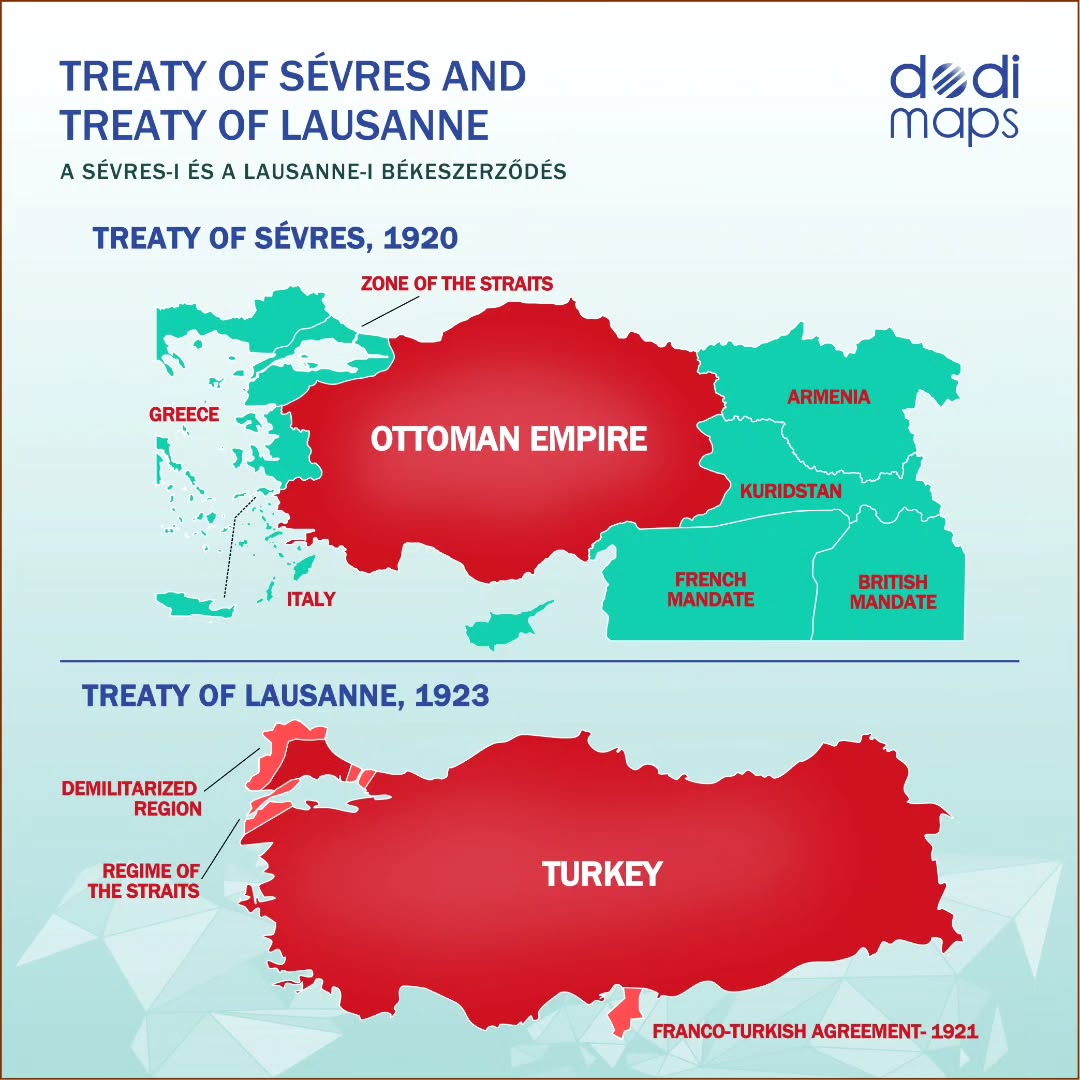
Treaty of Sèvres (1920)
Context & Objectives:
- Signed on August 10, 1920, between the defeated Ottoman Empire and the victorious Allies (Britain, France, Italy, Greece, etc.).
- Intended to dismantle the Ottoman Empire entirely, imposing harsh terms that greatly diminished Ottoman sovereignty and territory.
Main Provisions:
- Partitioned Anatolia among European powers, Greece, Armenia, and established an autonomous Kurdish region.
- Created mandates for Arab territories under British and French control, consistent with earlier decisions at Paris and San Remo.
- Reduced the Ottoman state to a small area around Constantinople (Istanbul) and parts of northern Anatolia, limiting its sovereignty with significant foreign oversight and military restrictions.
Reaction & Outcome:
- Widely rejected by Turkish nationalists led by Mustafa Kemal Atatürk, who organized resistance to foreign occupation.
- Fueled the Turkish War of Independence (1919–1923), causing the treaty never to be ratified or fully enforced.
Contrast with King–Crane Commission:
- King–Crane: Advocated self-determination and unified administration of former Ottoman territories based on local preferences.
- Treaty of Sèvres: Imposed external colonial partitions without genuine consideration of local nationalistic aspirations or realities, provoking intense local resistance.
Contrast with Sykes–Picot and Paris 1919 Settlements:
- Sykes–Picot & Paris/San Remo: Set a colonial pattern for mandates in Arab territories.
- Sèvres: Extended colonial logic into Anatolia itself, proposing direct partitions—thus even more severe and imperialist.
Creation of the Turkish Republic under Mustafa Kemal Atatürk (1923)
Nature & Significance:
- After a successful nationalist struggle against Greek invasion and allied occupation post-WWI, Mustafa Kemal (Atatürk) established the secular Republic of Turkey in 1923.
- Turkey rejected foreign partition (Treaty of Sèvres, 1920), establishing full sovereignty through the Treaty of Lausanne (1923).
Contrast with King-Crane:
- King-Crane did not significantly address Turkish nationalist aspirations explicitly; rather, it focused on Arabic-speaking provinces.
- Turkey’s creation under Atatürk starkly contrasted with the externally determined settlements, demonstrating a successful nationalist alternative to colonial mandates.
Treaty of Lausanne (1923)
Context & Objectives:
- Negotiated after the successful Turkish nationalist resistance under Mustafa Kemal Atatürk, marking a radical shift from the Sèvres treaty.
- Replaced Sèvres entirely, establishing modern Turkish sovereignty.
Main Provisions:
- Fully recognized Turkish independence and established the modern boundaries of the Republic of Turkey.
- Abandoned earlier proposals of partitioning Anatolia; mandated extensive population exchanges between Greece and Turkey.
- Revoked the establishment of Armenian and Kurdish states envisaged by the Treaty of Sèvres.
- Settled the issue of Turkish sovereignty over Istanbul and the Straits (Bosporus and Dardanelles), which remained internationalized but under Turkish sovereignty.
Significance & Legacy:
- Symbolized the first successful overturning of post-World War I treaties by nationalist resistance.
- Marked the beginning of secular, nationalist modernization under Atatürk, who abolished the Ottoman Sultanate (1922) and the Caliphate (1924).
Contrast with King–Crane Commission:
- King–Crane: Largely Arab-focused and limited influence on Anatolia; emphasized independence but not Turkish nationalist specifics.
- Lausanne: Embodied full realization of nationalist ideals and rejection of externally imposed borders, strongly contrasting the limited influence and moderate approach of the King-Crane recommendations.
Contrast with Treaty of Sèvres and earlier settlements (Sykes-Picot, Paris 1919):
- Sèvres, Sykes–Picot, Paris/San Remo: Embodied imperialist interests, arbitrary borders, colonial control.
- Lausanne: Represented nationalist self-determination, rejecting earlier imperialist frameworks and successfully asserting national sovereignty.
Finally Map from Dodi Maps
You can read the full story of King-Crane plan here and also buy a copy of Nick’s book: The Remaking of Republican Turkey: Memory and Modernity since the Fall of the Ottoman Empire here.





Leave a Reply