
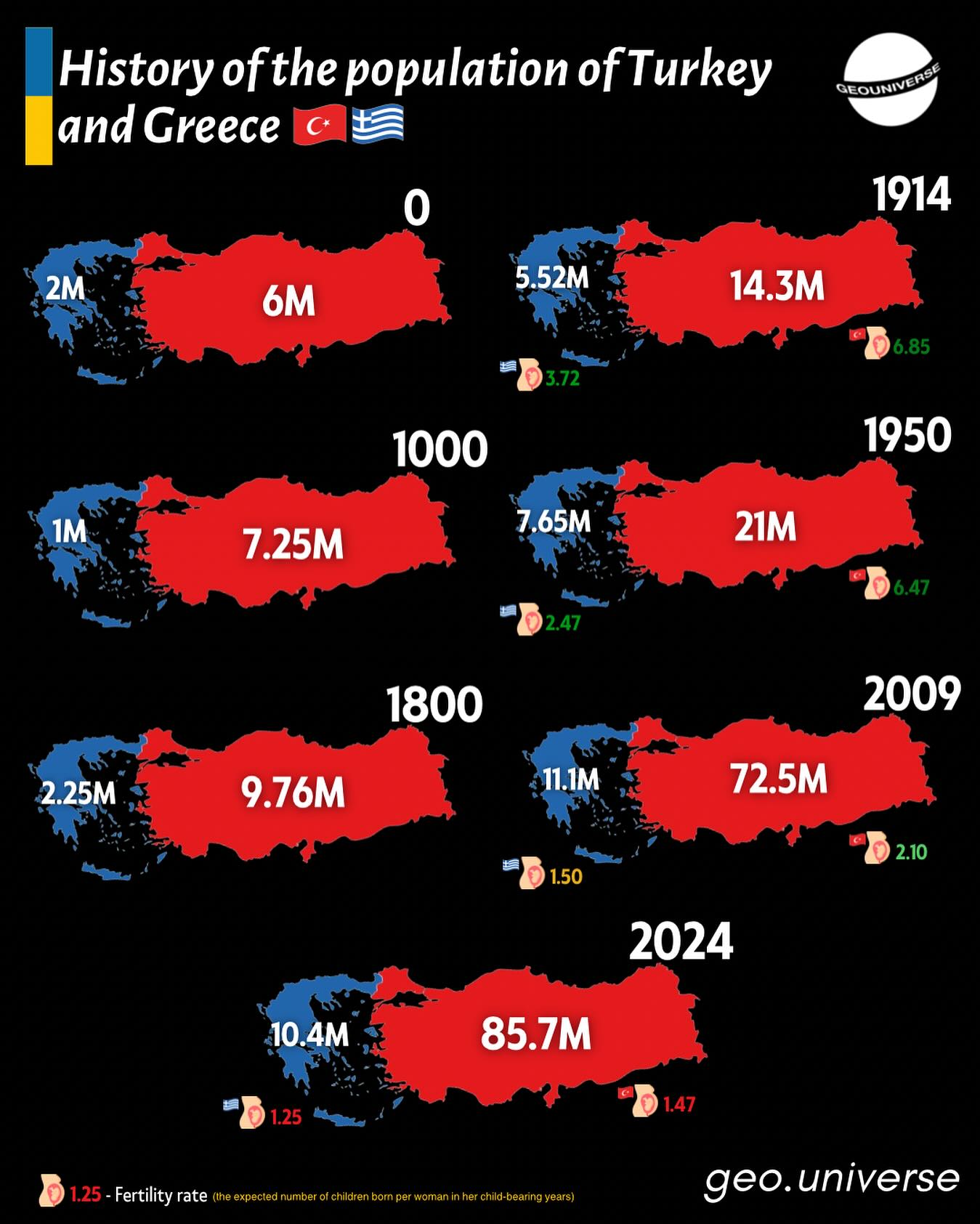
The map above looks at the population of Greece compared to Turkey between 1927 and 2024. Turkey went from having just over double the population of Greece in 1927 to being more than 8 times larger than Greece today.
You can see the numbers for the 4 years shown in the map below:
| Year | Greece | Trukey | How Much Bigger Is Turkey vs Greece |
|---|---|---|---|
| 1927 | 6,127,000 | 13,648,270 | 123% |
| 1960 | 8,304,698 | 27,754,820 | 234% |
| 2000 | 10,775,693 | 67,803,927 | 529% |
| 2024 | 10,491,922 | 85,664,944 | 716% |
The data for the two tables come from Wikipedia pages for the demographics of Greece and Turkey.
Here’s a short demographic history of Greece and Turkey, starting from the post-WWI population exchanges to the present, highlighting key demographic factors:
Greece
Population Exchange and Interwar Period (1920s–1940)
- 1923 Population Exchange: Following the Greco-Turkish War (1919–1922) and Treaty of Lausanne (1923), approximately 1.2 million Greeks were expelled or migrated from Asia Minor (Turkey) to Greece, and around 400,000 Muslims moved from Greece to Turkey.
- Result: Dramatic demographic shift; the sudden influx of refugees increased Greece’s population significantly (~25% increase).
Post-WWII to 1970s
- Strong population growth post-WWII with fertility rates around 2.5–3.0 children per woman.
- 1960s–1970s: Significant emigration, primarily to Germany, the U.S., Australia, and Canada, due to economic hardships.
Demographic Transition (1980s–2000)
- Rapid demographic transition: fertility rates dropped sharply from 2.2 in 1980 to 1.3 by 2000, among the lowest in Europe.
- Population aging accelerated due to low birth rates and higher life expectancy.
21st Century Trends
- Fertility rates remain very low: about 1.3–1.4 children per woman.
- Population growth has stagnated and begun declining; the population peaked around 2010 (~11 million), declining slightly since then.
- Greece has seen significant immigration since the 1990s, initially from Albania and Eastern Europe, and more recently from Middle Eastern and African refugees (especially post-2015 migration crisis).
Current Demographic Snapshot (2025)
- Population: 10.4 million; -0.4% annually.
- Fertility rate: ~1.3.
- Significant aging: median age ~45 years.
- Immigration partially offsets natural decline but not entirely.
Turkey
Population Exchange and Early Republic (1920s–1950)
- 1923 Treaty of Lausanne exchange: About 400,000 Muslims migrated to Turkey from Greece, complementing the outflow of Greek Orthodox minorities.
- Early Republic (1923–1950): High birth rates (over 6 children per woman) and rapidly increasing population.
Rapid Growth Period (1950–1990)
- Turkey’s population growth remained very high through mid-20th century, averaging 2–3% annually, with fertility rates around 5–6 children per woman in the 1950s–1970s.
- Rural-to-urban migration accelerated significantly from the 1960s onward, fueling rapid urbanization.
Demographic Transition (1980–2000)
- Fertility rates dropped significantly from about 4.5 in 1980 to 2.5 in 2000, driven by urbanization, increased education, and female employment.
- Emigration peaked in the 1960s–1980s, with millions moving primarily to Western Europe (Germany, Netherlands, France).
21st Century Trends
- Continued urbanization: more than 75% of the population urbanized today, primarily around Istanbul, Ankara, İzmir.
- Fertility rates continued declining steadily: approximately 2.0–2.1 children per woman today.
- Immigration became notable since 2011, largely due to Syrian refugee influx (3.6+ million Syrian refugees currently reside in Turkey).
Current Demographic Snapshot (2025)
- Population: ~86 million, still slowly growing (~0.7% annually).
- Fertility rate: ~2.0, nearing replacement level.
- Median age rising steadily: currently about 34 years, younger than Europe but rapidly aging.
- Large refugee and immigrant communities (primarily Syrians), making up around 4–5% of the population.
| Aspect | Greece | Turkey |
|---|---|---|
| 1923 Population Exchange | +1.2 million Greeks | +400,000 Muslims |
| Mid-20th century growth | Moderate, emigration high | Rapid growth, significant emigration |
| Late 20th century shift | Sharp fertility decline | Gradual fertility decline |
| 21st century fertility | ~1.3 (very low, declining) | ~2.0 (moderate, stabilizing) |
| Population growth today | Slight decline (~-0.4%) | Slow growth (~+0.7%) |
| Median Age (2025) | ~45 (highly aged) | ~34 (young, aging rapidly) |
| Immigration (current) | Mainly Eastern European, Middle Eastern, and African migrants/refugees | Mainly Syrian refugees (~4% of population) |
And geo.universe has created a map going back even further:
What do you think?
Also see: Map Of The Territorial Expansion of Greece From 1832 To 1947



TricoPat says
This article was a great reminder of why I love your blog.