
The Right to Roam is a legal principle that allows the public to access and walk across certain private land or countryside without needing the landowner’s permission, as long as they follow specific rules.
More about it below:
Right to Roam in England & Wales
In England and Wales, the Right to Roam was created by the Countryside and Rights of Way Act 2000 (CRoW Act).
What it allows:
People can walk on designated “open access land”, including:
- Mountains
- Moors
- Heaths
- Downland
- Registered common land
Activities allowed:
- Walking
- Sightseeing
- Birdwatching
- Climbing (in some areas)
What it does NOT allow
The right is limited, meaning you cannot:
- Camp without permission
- Light fires
- Ride bikes or horses
- Drive vehicles
- Hunt or fish
- Bring dogs in restricted seasons (like around livestock)
Most access land is for walking only.
Scotland
In Scotland, the right is much broader under the Land Reform (Scotland) Act 2003.
People can access most land and inland water for:
- Walking
- Cycling
- Horse riding
- Wild camping
- Canoeing
The rule is that access must be “responsible”, following the Scottish Outdoor Access Code.
Other European Countries
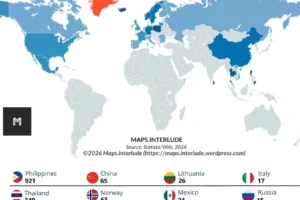
The other green countries on the map (besides Scotland) mostly follow versions of a Nordic-style public access tradition, often called “everyman’s right”, the right for anyone to access nature responsibly even on privately owned land.
Here’s how it works in each of the other green countries:
Norway
- Known as “allemannsretten” (everyman’s right).
- Allows people to:
- Walk, ski, and cycle on uncultivated land
- Camp in the wild for up to two nights
- Swim and use lakes and rivers
- Restrictions:
- Must stay 150 m away from houses
- No damage to crops or farmland.
This is one of the most extensive right-to-roam systems in the world.
Sweden
- Called “Allemansrätten.”
- Similar to Norway but even more culturally embedded.
- People can:
- Hike, cycle, ski
- Camp temporarily
- Pick berries and mushrooms
- The guiding principle is “Do not disturb, do not destroy.”
Finland
- Known as “Jokamiehenoikeudet.”
- Allows:
- Walking, skiing, cycling
- Wild camping
- Fishing with simple gear
- Picking berries and mushrooms
- Restrictions mainly protect farmland and private yards.
Denmark
- More limited than Norway/Sweden.
- Public can:
- Walk in most forests and beaches
- Camp only in designated areas
- Access to private forests may be restricted at night.
Iceland
- Public access is traditionally very open.
- People can:
- Hike across uncultivated land
- Camp temporarily in remote areas
- Increasing tourism has led to more restrictions in fragile environments.
Baltic States (Estonia, Latvia, Lithuania)
These countries allow relatively broad public access:
- People can generally:
- Walk through forests and countryside
- Forage for mushrooms and berries
- Camping may be allowed but often regulated in protected areas.
Their systems were influenced by Nordic traditions and Soviet-era public land access.
Germany
- Public access laws allow:
- Walking and cycling in forests and countryside
- However:
- You usually must stay on paths or designated routes
- Camping on private land usually requires permission.
Czech Republic
- Very open forest access laws.
- People may:
- Walk and cycle in forests
- Pick berries and mushrooms
- Camping is generally restricted to designated places.
Austria
- Public can enter forests for recreation.
- However:
- Camping and cycling are more regulated.
- Mountain areas may have freer access depending on the region.
Switzerland
- Swiss civil law explicitly guarantees public access to forests and pastures.
- Hiking and mountain walking are widely permitted.
- Camping is sometimes allowed above the tree line but varies by canton.
What do you think about the Right to Roam?




Leave a Reply