On May 12th, 2026 X user Ramin Nasibov tweeted the following fairly innocuous question: “What historical fact sounds fake but is true?”

Turns out he really hit nerve, because 1 week later over 91 million people had seen his tweet had over 2,000 replies. Here are a few of the related to Poltics:
1. Lincoln & The Samurai
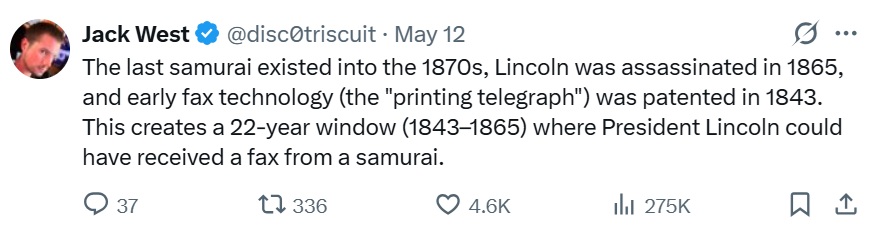
“The last samurai existed into the 1870s, Lincoln was assassinated in 1865, and early fax technology (the “printing telegraph”) was patented in 1843. This creates a 22-year window (1843–1865) where President Lincoln could have received a fax from a samurai.”
2. Stable Countries
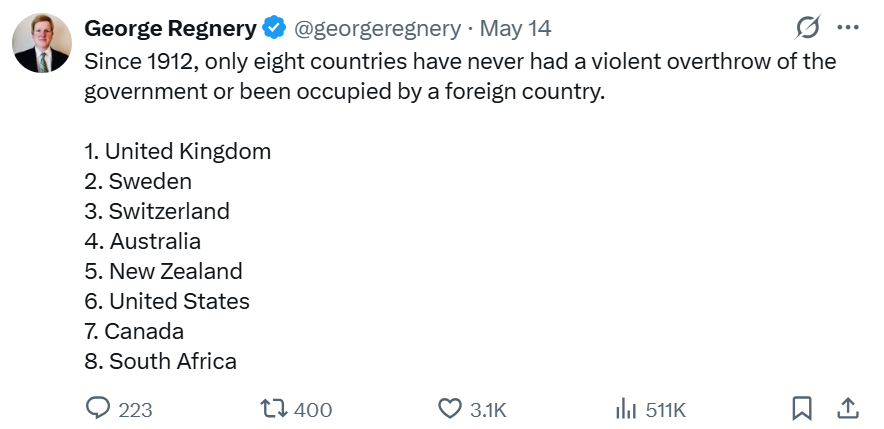
Since 1912, only eight countries have never had a violent overthrow of the government or been occupied by a foreign country.
1. United Kingdom
2. Sweden
3. Switzerland
4. Australia
5. New Zealand
6. United States
7. Canada
8. South Africa
3. Obama & Biden
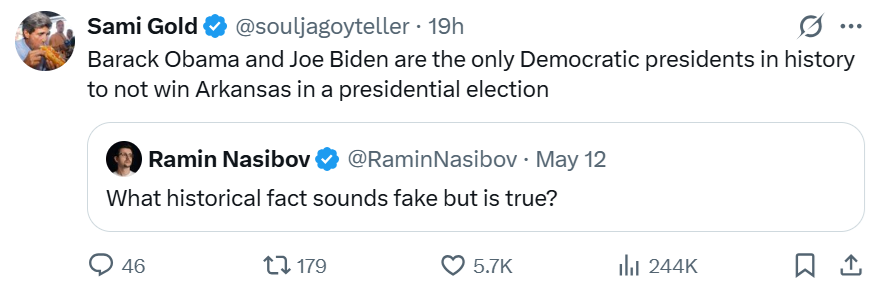
Barack Obama and Joe Biden are the only Democratic presidents in history to not win Arkansas in a presidential election.
4. 2016 Florida
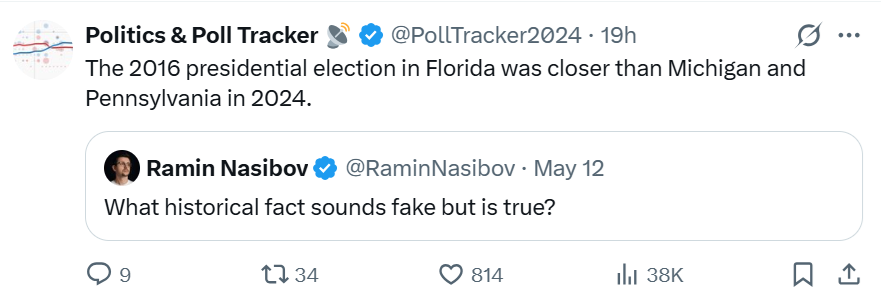
The 2016 presidential election in Florida was closer than Michigan and Pennsylvania in 2024.
Trump had a 1.2% Margin in Florida in 2016, but won Michigan with a 1.42% margin and Pennsylvania with a 1.71% margin in 2024. He also won Florida with a 13.1% margin in 2024.
5. John Wilkes Booth’s brother saved Abraham Lincoln’s son’s life.
The story: Edwin Booth, the famous actor and brother of John Wilkes Booth, once saved Robert Todd Lincoln (Abraham Lincoln’s son) from being seriously injured or killed by pulling him away from an oncoming train platform accident just months before John Wilkes Booth assassinated President Lincoln.
6. British Royal Family
Since 1066, not a single English dynasty of English origin has ruled England again. Every royal house since William the Conqueror has had Norman, French, Welsh, Scottish, Dutch, or German roots.
7. No 50s President
We haven’t had—and might not ever have—a president who was born in the 1950s.
8. Obama & Cleveland’s Widow
Barack Obama is the only president in American history born after Grover Cleveland’s widow died.
I had to check on this one, Frances Cleveland was born in 1864 and lived until 1947. This means she was still alive when Clinton, Bush and Trump were all born in 1946.
9. First JFK Speech
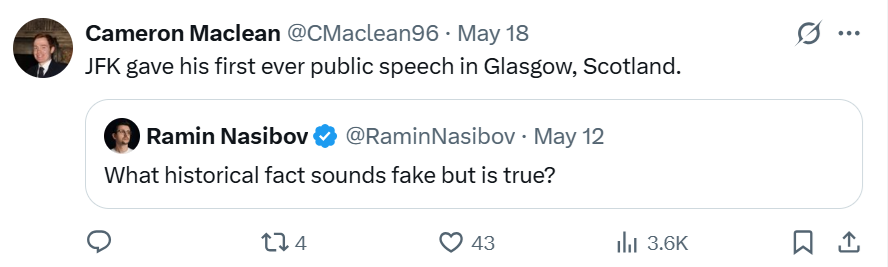
“JFK gave his first ever public speech in Glasgow, Scotland.”
You can read more about it here.
10. The Tyler’s
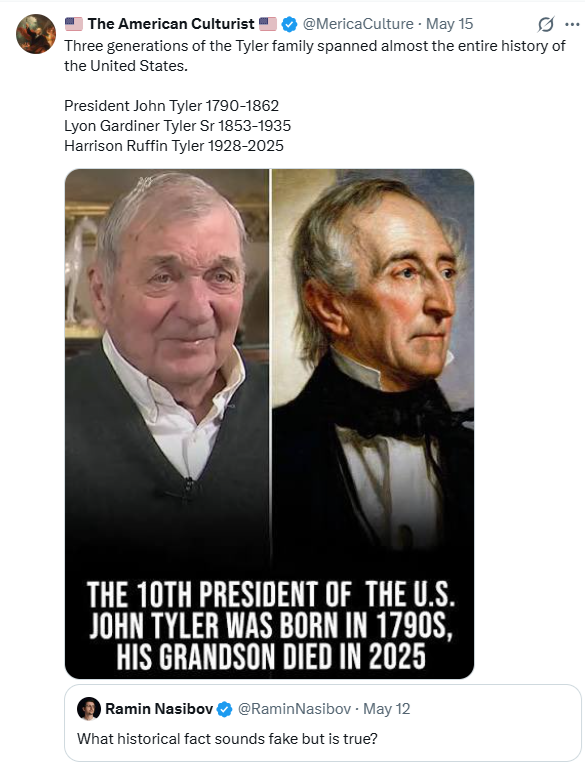
Three generations of the Tyler family spanned almost the entire history of the United States.
President John Tyler 1790-1862
Lyon Gardiner Tyler Sr 1853-1935
Harrison Ruffin Tyler 1928-2025
11. Capital Just For One Day
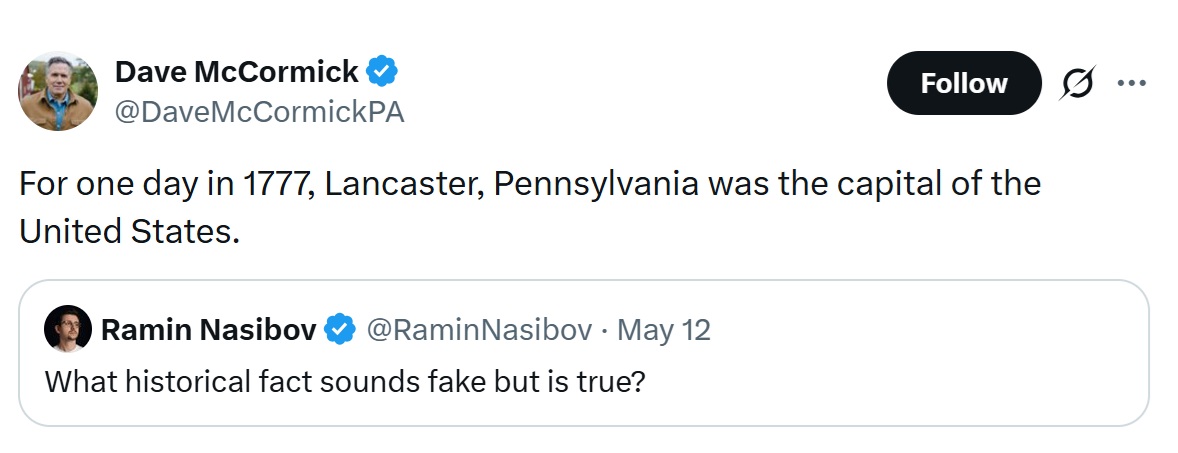
“For one day in 1777, Lancaster, Pennsylvania was the capital of the United States.”
During the American Revolutionary War, the Continental Congress fled Philadelphia in September 1777 as British forces advanced after the Battle of Brandywine. Congress briefly met in Lancaster for on September 27, 1777 before moving farther west to York, making Lancaster the capital of the United States for just one day.
12. Clinton in West Virginia
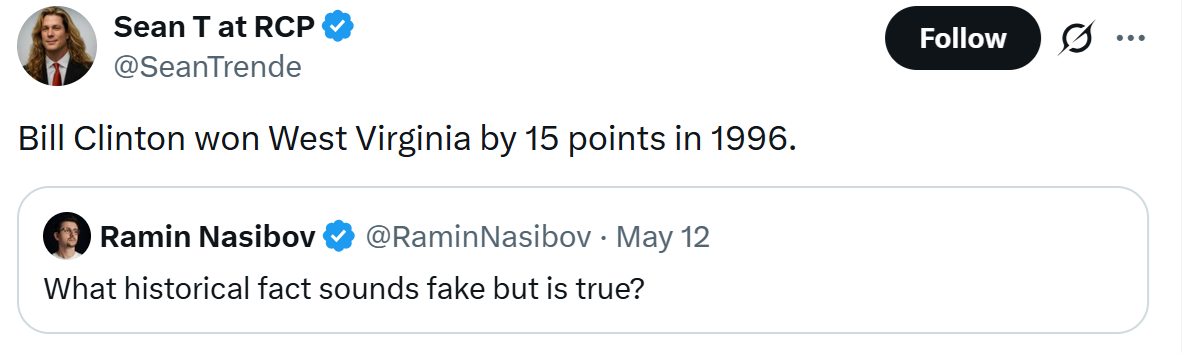
“Bill Clinton won West Virginia by 15 points in 1996.”
Looking at the 1996 US Presidential election results, Bill Clinton won West Virginia with 51.51% of the vote vs 36.76% for Dole (Perot got 11.26%). Fast Forward to 2024 and Trump won 69.97% of the vote vs just 28.10% for Harris.
13. Kingdom of Canada
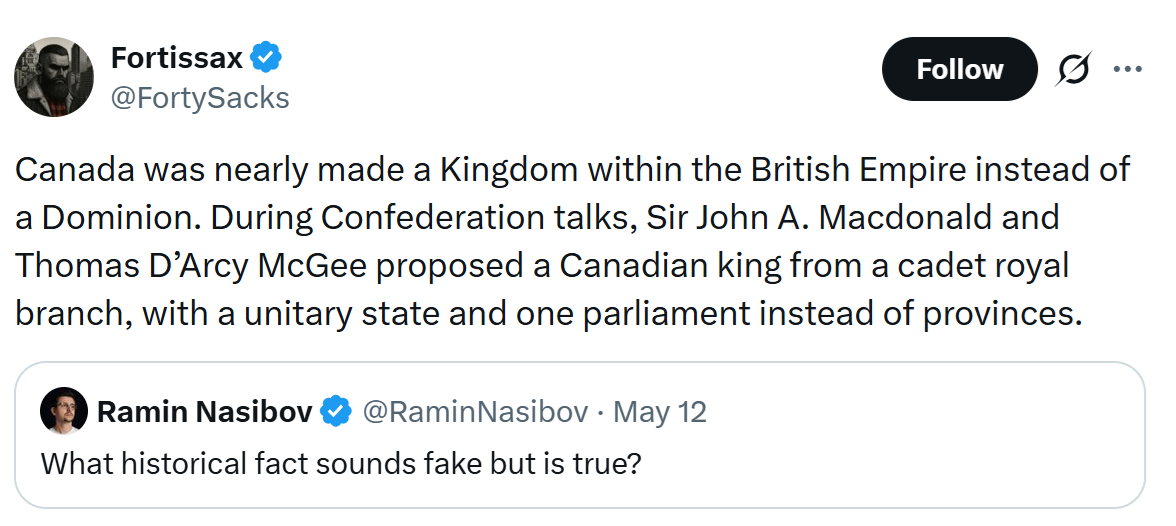
“Canada was nearly made a Kingdom within the British Empire instead of a Dominion. During Confederation talks, Sir John A. Macdonald and Thomas D’Arcy McGee proposed a Canadian king from a cadet royal branch, with a unitary state and one parliament instead of provinces.”
Explanation:
In the 1860s, British North America was politically fragmented:
- the Province of Canada (modern Ontario and Quebec),
- Nova Scotia,
- New Brunswick,
- Newfoundland,
- Prince Edward Island,
- and western territories controlled by the Hudson’s Bay Company.
Several pressures pushed these colonies toward union:
- fear of American expansion after the American Civil War,
- concern about U.S. republicanism spreading north,
- economic instability,
- and Britain’s desire to reduce the cost of colonial defense.
Many Confederation leaders therefore wanted a political structure that would be:
- explicitly monarchical,
- strongly centralized,
- and clearly distinct from the federal republic model of the United States.
Macdonald’s Vision: A Strong Central Kingdom
John A. Macdonald, later Canada’s first prime minister, strongly disliked the American federal model.
He believed the U.S. system had contributed to sectional division and ultimately civil war.
His preference was for:
- a unitary government,
- a powerful central parliament,
- weak local governments,
- and a constitutional monarchy tied closely to Britain.
At the Charlottetown Conference and Quebec Conference, Macdonald argued for something closer to a legislative union, essentially one sovereign parliament for all British North America, somewhat analogous to the United Kingdom itself.
The provinces were retained largely as a compromise because:
- French Canadians wanted protection for Quebec’s institutions,
- and the Maritime colonies feared domination by central Canada.
So the federation that emerged was actually more decentralized than Macdonald originally hoped.
Thomas D’Arcy McGee and the “Canadian Kingdom” Idea
Thomas D’Arcy McGee was one of the strongest advocates for a distinct Canadian nationality rooted in monarchy rather than republicanism.
McGee openly argued that Canada should avoid becoming:
“a mere copy of the American republic.”
Some Confederation-era thinkers proposed:
- formally calling the new country the “Kingdom of Canada,”
- and even potentially establishing a junior or cadet branch of the British royal family resident in Canada.
This would have created a semi-autonomous monarchy under the broader British imperial system, somewhat analogous to how European royal houses often established junior dynasties in related states.
The idea was not fully developed into a concrete succession plan, but it circulated seriously enough in elite political discussion to alarm American observers.
Why “Kingdom” Was Dropped
The proposed title “Kingdom of Canada” was considered during drafting of the Canadian Confederation arrangements.
But the British government became nervous about provoking the United States, especially:
- shortly after the Civil War,
- during the tense Fenian Raids period,
- and amid fears that Americans would interpret “Kingdom” as a hostile imperial statement on their border.
According to later accounts, British officials preferred the softer biblical term “Dominion,” drawn from Psalm 72:8:
“He shall have dominion also from sea to sea.”
So when the British North America Act 1867 created the country, the official title became:
- “The Dominion of Canada,”
not - “The Kingdom of Canada.”
The Cadet Royal Branch Proposal
The idea of installing a Canadian-based royal line was never close to implementation, but it reflected broader imperial thinking of the era.
Possible candidates discussed informally included:
- younger sons or relatives of the British royal family,
- who could reign locally while remaining tied to the Crown in London.
Supporters believed this would:
- strengthen Canadian identity,
- reduce republican sentiment,
- reinforce loyalty to the Empire,
- and symbolize that Canada was not merely a colony.
But there were major obstacles:
- Britain had little appetite for creating a separate North American monarchy,
- many colonists preferred responsible self-government without aristocratic institutions,
- and the practical constitutional implications were unclear.
The idea gradually faded as Canada evolved into a self-governing dominion sharing the same monarch as Britain rather than developing its own royal house.
The Irony
Ironically, although Macdonald wanted a highly centralized system, Canada evolved over time into one of the world’s more decentralized federations, with provinces gaining substantial power.
And although the “Kingdom of Canada” idea disappeared, Canada still retained:
- the British monarch as sovereign,
- the Westminster parliamentary system,
- and constitutional monarchy itself.
Today, Charles III is legally King of Canada in a distinct Canadian constitutional role, even though the country was never formally styled a kingdom.
14. Slavery Loans
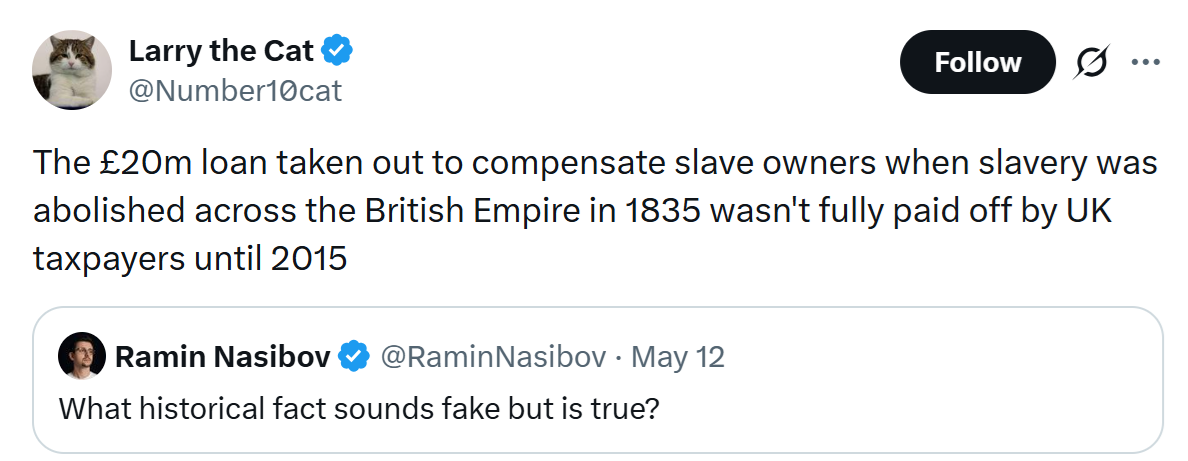
“The £20m loan taken out to compensate slave owners when slavery was abolished across the British Empire in 1835 wasn’t fully paid off by UK taxpayers until 2015”
When the Slavery Abolition Act 1833 abolished slavery across most of the British Empire, the British government chose to compensate slave owners rather than the formerly enslaved people.
To finance this, Parliament authorized a massive £20 million loan in 1835 — about 40% of the government’s annual budget at the time and equivalent to billions of pounds today.
The money was paid to plantation owners, merchants, clergy, and investors who claimed the loss of enslaved people as “property.” Meanwhile, formerly enslaved people received no financial compensation and were often forced into a period of unpaid “apprenticeship” labor before full emancipation.
The loan was arranged through bankers including Nathan Mayer Rothschild and Moses Montefiore. Rather than being repaid quickly, the debt was absorbed into long-term government borrowing. Over generations, interest payments became part of the UK national debt structure managed by the Treasury.
In 2018, HM Treasury noted publicly that taxpayers had only finished paying off this inherited debt in 2015.
The revelation sparked renewed debate about the enduring economic legacy of slavery and the fact that British taxpayers effectively spent nearly two centuries financing compensation for slave owners, not enslaved victims.
15. California Governors
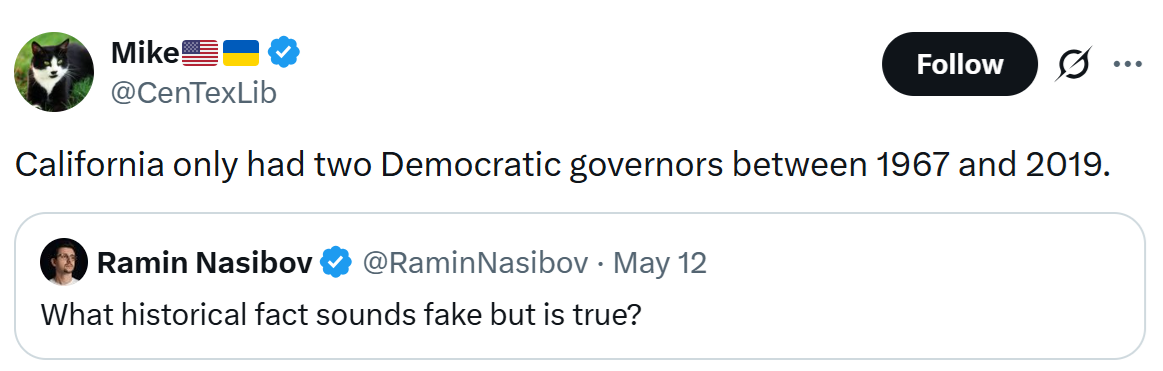
“California only had two Democratic governors between 1967 and 2019.”
Amazingly, it’s true! Jerry Brown was the state’s 34th governor from 1975 to 1983 and its 39th governor from 2011 to 2019 and the only other Democrat elected during this time was its 37th Governor Gray Davis who served from 1999 to 2003.
16. Harriet Tubman Lived A Long Time
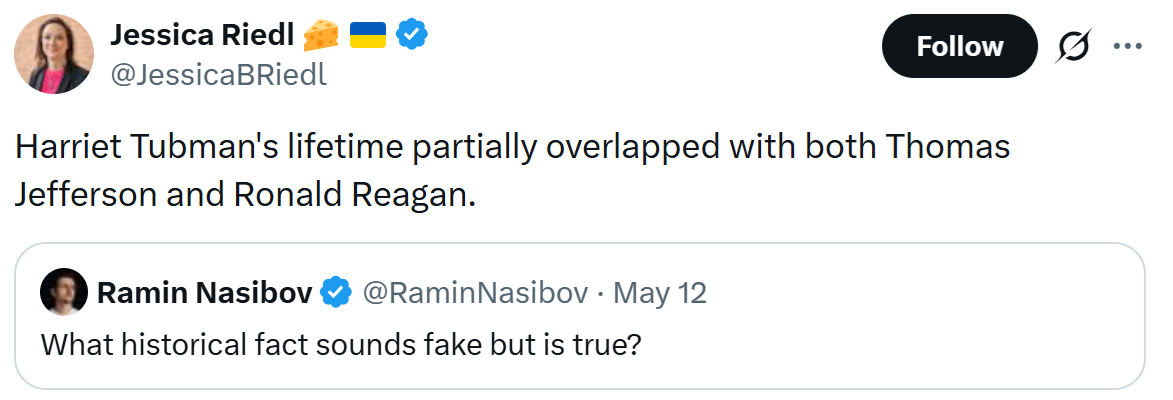
“Harriet Tubman’s lifetime partially overlapped with both Thomas Jefferson and Ronald Reagan.”
It’s true.
Harriet Tubman was born in March 1822 and lived until March 10, 1913. Jefferson died on July 4th, 1826 when Tubman was 4 and Ronald Reagan was born on February 6th, 1911 and so overlapped for the last two years of her life.
17. Ok so how is this possible?
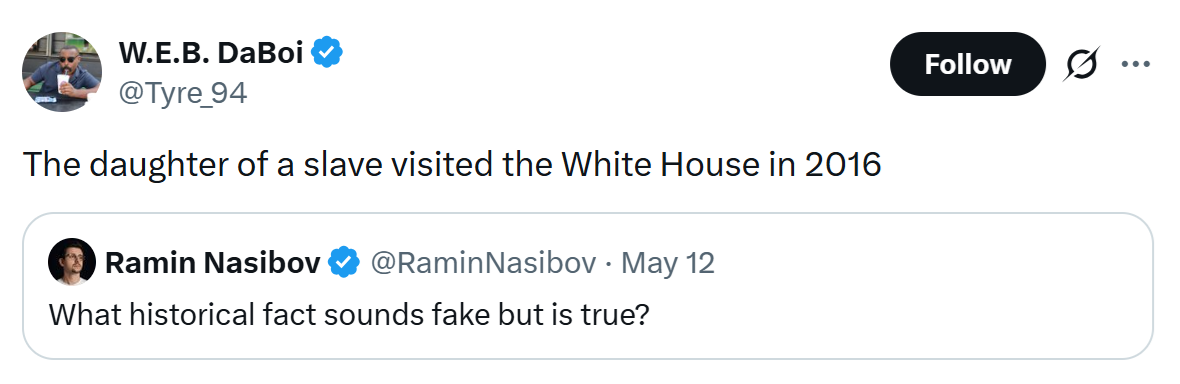
“The daughter of a slave visited the White House in 2016”
Explanation:
Elijah B. Odom was born in 10 October 1859 and spent the first few years of his life as a slave. He
had 8 children, including Ruth Bonner (born 1917), who on September 24, 2016, at the age of 99, joined President Barack Obama and four generations of her own family, including her 7-year-old great-granddaughter Christine, in ringing a bell dating back to the 1880s from First Baptist Church in Williamsburg, Virginia, to dedicate the opening of the National Museum of African American History and Culture on the National Mall in Washington, DC.
18. Weird UK PMs
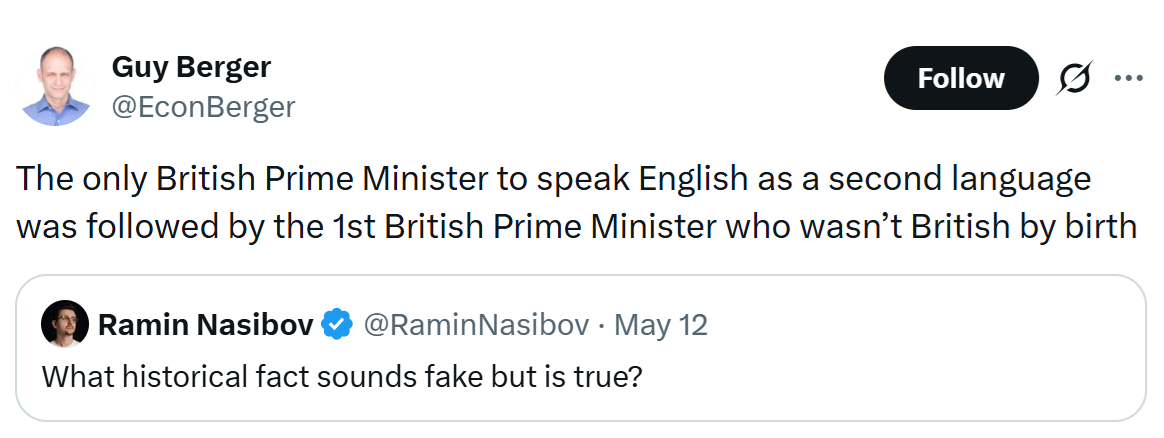
“The only British Prime Minister to speak English as a second language was followed by the 1st British Prime Minister who wasn’t British by birth”
David Lloyd George (PM: 6 December 1916 – 19 October 1922) grew up speaking Welsh, and was followed by Andrew Bonar Law (Canadian) (PM: 23 October 1922 – 20 May 1923).
And a fun bonus fact: Boris Johnson is American by birth!
19. Well done Michigan
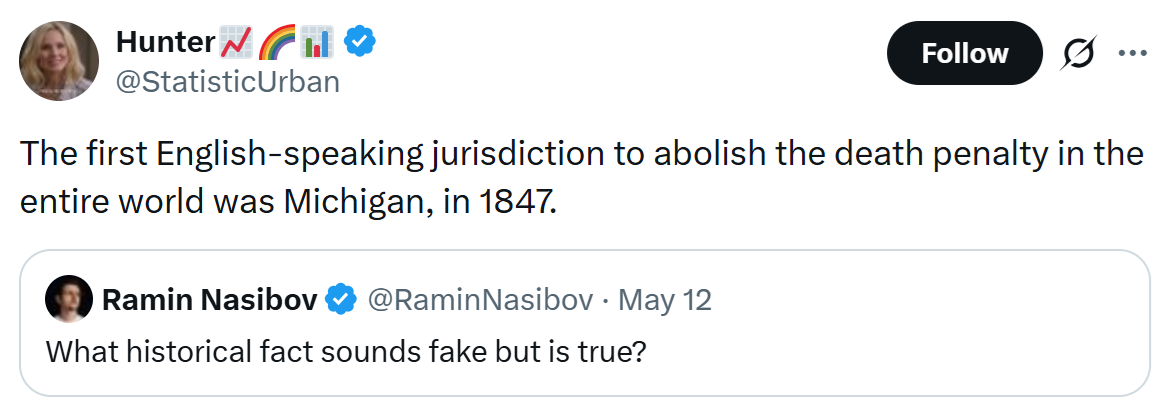
“The first English-speaking jurisdiction to abolish the death penalty in the entire world was Michigan, in 1847.”
Explanation:
The claim is broadly true if phrased carefully:
Michigan became the first English-speaking government/jurisdiction in the world to abolish the death penalty for ordinary crimes, with the law passed in 1846 and taking effect in 1847.
A few clarifications historians usually add:
- The Michigan legislature voted for abolition in 1846.
- The law officially took effect in 1847, which is why both dates appear in sources.
- Michigan still technically retained the death penalty for treason until 1963, though nobody was executed for it.
- Other places in the world had already abolished capital punishment earlier, but they were not English-speaking jurisdictions.
So the most precise version would be:
“Michigan was the first English-speaking jurisdiction in the world to abolish the death penalty for ordinary crimes, doing so in 1846–47.”
20. Napoleon’s great nephew
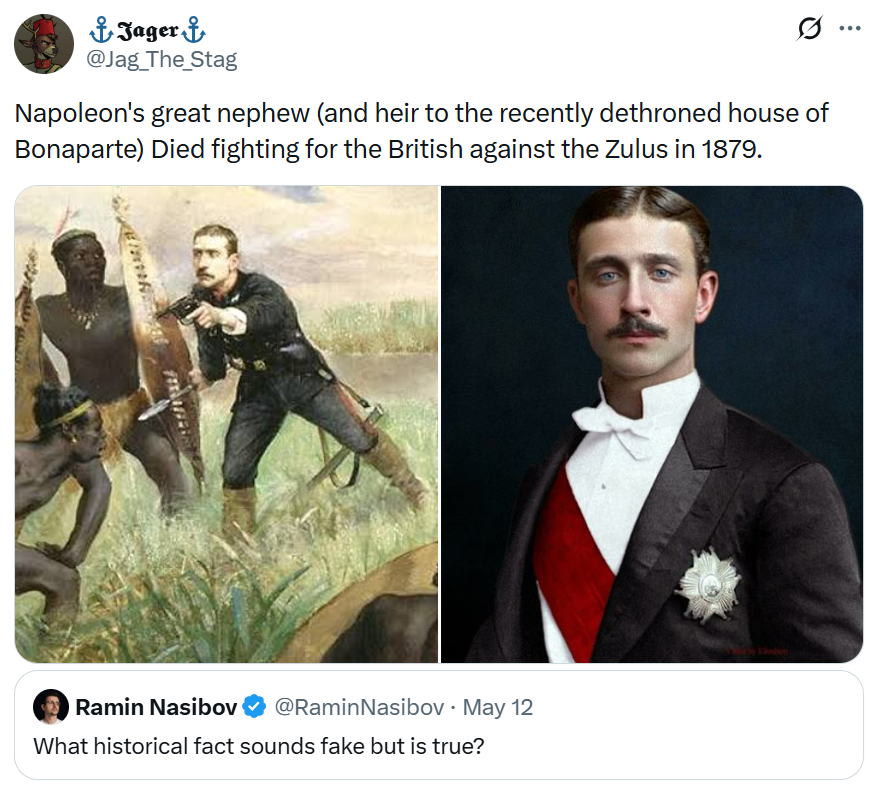
“Napoleon’s great nephew (and heir to the recently dethroned house of Bonaparte) Died fighting for the British against the Zulus in 1879.”
The Story:
The person was Napoléon Eugène, Prince Imperial, often called the Prince Imperial.
He was the only son of Napoleon III and the great-nephew of Napoleon Bonaparte.
Here’s how he ended up dying in South Africa while serving with the British army.
The Bonaparte dynasty had just collapsed
In 1870, France lost the Franco-Prussian War to Prussia.
As a result:
- Napoleon III was overthrown
- The Second French Empire collapsed
- France became a republic again
- The imperial family fled into exile in England
When Napoleon III died in 1873, the Prince Imperial became the Bonapartist claimant to the French throne. To Bonapartists, he was effectively “Napoleon IV.”
So by the late 1870s, he was:
- exiled,
- politically important,
- and symbolically the heir to the Napoleonic legacy.
Why was he with the British army?
The Prince Imperial desperately wanted military glory.
That mattered because the Bonaparte name was tied to:
- battlefield heroism,
- command,
- and martial prestige.
Since he was living in Britain, and Britain was fighting the Anglo-Zulu War against the Zulu Kingdom, he persuaded the British government to let him accompany the army in South Africa as an observer.
He was not officially a British officer commanding troops, but he was attached to British forces and participated in reconnaissance patrols.
His presence caused huge excitement across Europe because he was one of the most famous royal exiles alive.
His death
On June 1, 1879, during a scouting mission near Itelezi in present-day South Africa:
- the patrol stopped at an abandoned kraal (village),
- Zulu warriors suddenly appeared,
- the horses panicked,
- the Prince Imperial struggled to mount his horse,
- and he was overtaken.
He was killed with multiple assegai (Zulu spear) wounds.
Several British soldiers escaped; he did not.
His body was later recovered by British troops.
Why this shocked Europe
The symbolism was extraordinary:
- the heir of Napoleon,
- descendant of Europe’s greatest military dynasty,
- dying not in a European war,
- but in a colonial conflict thousands of miles away,
- while wearing a British uniform.
It stunned both Britain and France.
His death also effectively ended the serious political future of the Bonapartist movement, because he had no children and no direct heir.
The irony
There’s an especially striking historical irony:
- Napoleon Bonaparte had been Britain’s greatest enemy.
- Yet his dynastic heir died serving alongside the British Empire.
- And he died fighting the Zulus, not Europeans.
Victorian Britain treated him with enormous respect after his death. Even Queen Victoria personally mourned him because the imperial family had become close to the British royal family during exile.
His body was eventually buried in England at St Michael’s Abbey in Farnborough.
21. Progress
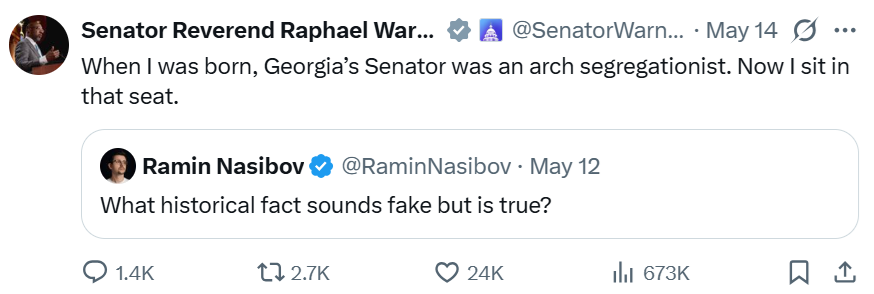
Senator Reverend Raphael Warnock: “When I was born, Georgia’s Senator was an arch segregationist. Now I sit in that seat.”
The Senator in question was Herman Eugene Talmadge::
He began his political career as a strong segregationist who opposed civil rights and supported efforts to keep public schools segregated, even backing legislation that would have closed schools rather than allow integration.
Later in his career, after the Voting Rights Act expanded African American political participation, Talmadge—like many Southern politicians of the era—moderated his views on race.
His life came to reflect Georgia’s broader transformation from a system rooted in white supremacy to a more diverse political culture in which white voters increasingly elected Black and other non-white candidates to state and national office.
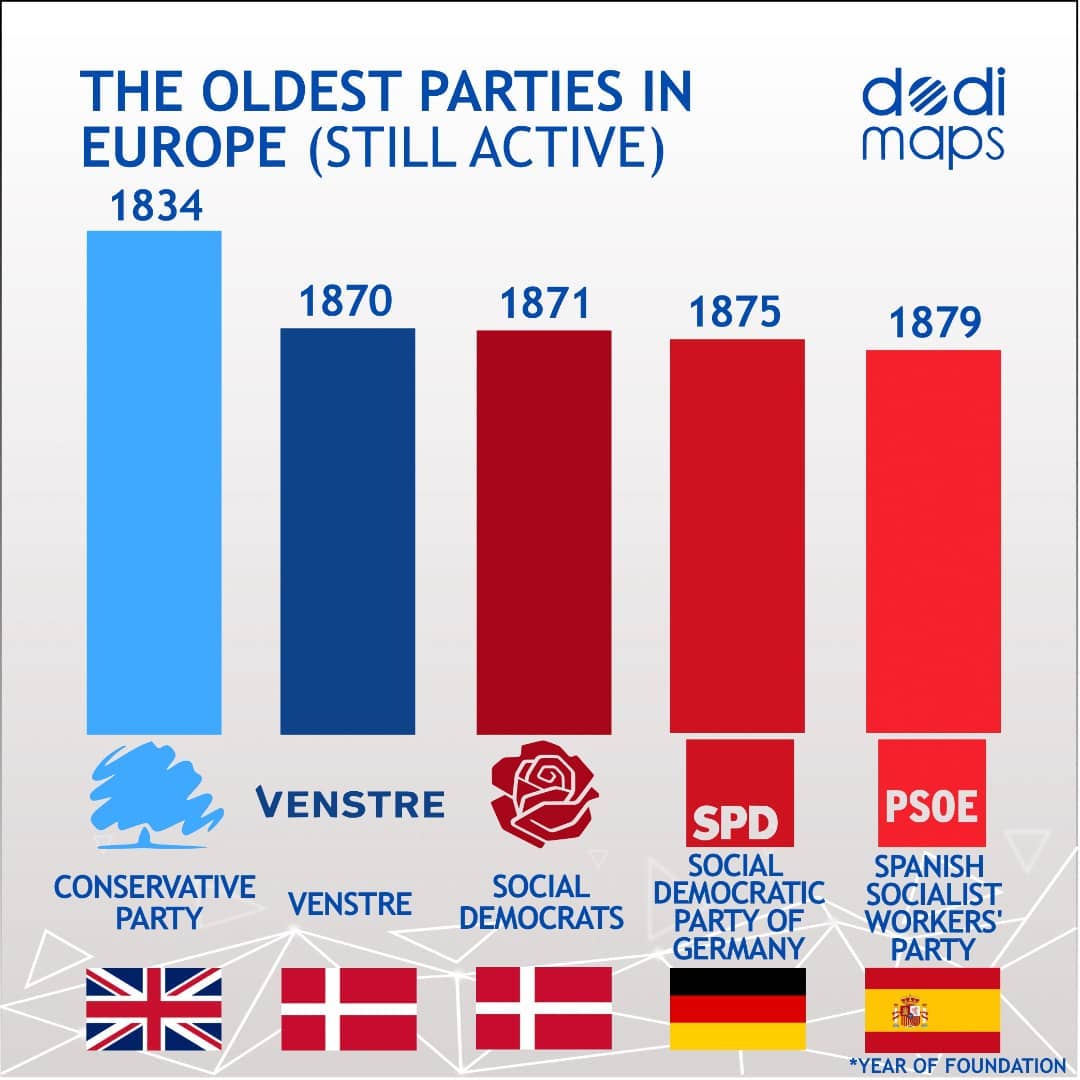
And finally this fact about the oldest European Political Parties



Leave a Reply