
The 20 maps here are work of reddit user PepperBlues show the various similarities and differences between the countries of the former Yugoslavia in 2023, 32 years after the country began to breakup.
And in case you’re too familiar with your Balkan geography these maps should help:
Countries Of The Former Yugoslavia

Breakup Timeline of The Former Yugoslavia

Claims Nikola Tesla vs Doesn’t Claim Nikola Tesla

For more on this debate see: Nationality Of Nikola Tesla According To Each Country’s Wikipedia Page
Member of the EU vs Not a Member of The EU

Member of NATO vs Not a Member of NATO

Has 10 Michelin Star Restaurants vs Doesn’t Have Michelin Star Restaurants

Find out what they are here.
Catholic vs Muslim vs Orthodox

Latin Alphabet vs Latin & Cyrillic Alphabets

Human Development Index

FIFA World Cup

Average Wage

Adoption By Same-Sex Couples

Euro Zone vs National Currency

Olympic Medals at Summer & Winter Olympics

Nobel Laurates

Number of Official Languages

Number of UNESCO World Heritage Sites

See them here.
Claims of Ancient Pyramids

An explanation can found here.
Has or Doesn’t Have McDonalds

Press Freedom

Here are some key facts about each of the countries that emerged from the former Yugoslavia:
- Capital: Sarajevo
- Population: Approximately 3.43 million (2022 estimate)
- GDP (Nominal): $29.078 billion (2024 estimate)
- GDP per Capita (Nominal): $8,317 (2024 estimate)
- Major Religions: Islam, Serbian Orthodoxy, Roman Catholicism
- Official Languages: Bosnian, Croatian, Serbian
- Currency: Convertible Mark (BAM)
- Area: 51,209 km²
- Population Density: 69 people per km²
- Human Development Index (HDI): 0.779 (2022)
- Gini Coefficient: 32.7 (2015)
- Time Zone: Central European Time (CET)
- Calling Code: +387
- Internet TLD: .ba
2. Croatia
- Capital: Zagreb
- Population: Approximately 3.85 million (2023 estimate)
- GDP (Nominal): $60.702 billion (2019)
- GDP per Capita (Nominal): $14,950 (2019)
- Major Religion: Roman Catholicism
- Official Language: Croatian
- Currency: Euro (€)
- Area: 56,594 km²
- Population Density: 74 people per km²
- Human Development Index (HDI): 0.837 (2018)
- Gini Coefficient: 29.7 (2018)
- Time Zone: Central European Time (CET)
- Calling Code: +385
- Internet TLD: .hr
3. Montenegro
- Capital: Podgorica
- Population: Approximately 623,633 (2023 census)
- GDP (Nominal): $7.058 billion (2023 estimate)
- GDP per Capita (Nominal): $11,338 (2023 estimate)
- Major Religions: Serbian Orthodoxy, Islam, Roman Catholicism
- Official Language: Montenegrin
- Currency: Euro (€)
- Area: 13,812 km²
- Population Density: 43.6 people per km²
- Human Development Index (HDI): 0.844 (2022)
- Gini Coefficient: 32.9 (2020)
- Time Zone: Central European Time (CET)
- Calling Code: +382
- Internet TLD: .me
- Capital: Skopje
- Population: Approximately 1.83 million (2023 estimate)
- GDP (Nominal): Data not available
- GDP per Capita (Nominal): Data not available
- Major Religions: Macedonian Orthodoxy, Islam
- Official Language: Macedonian
- Currency: Macedonian Denar (MKD)
- Area: 25,713 km²
- Population Density: 81 people per km²
- Human Development Index (HDI): 0.759 (2018)
- Gini Coefficient: 31.9 (2018)
- Time Zone: Central European Time (CET)
- Calling Code: +389
- Internet TLD: .mk
5. Serbia
- Capital: Belgrade
- Population: Approximately 6.65 million (January 2024 estimate, excluding Kosovo)
- GDP (Nominal): $82.550 billion (2024 estimate)
- GDP per Capita (Nominal): $12,513 (2024 estimate)
- Major Religion: Serbian Orthodoxy
- Official Language: Serbian
- Currency: Serbian Dinar (RSD)
- Area: 88,499 km² (including Kosovo); 77,612 km² (excluding Kosovo)
- Population Density: 85 people per km²
- Human Development Index (HDI): 0.805 (2022)
- Gini Coefficient: 33.3 (2019)
- Time Zone: Central European Time (CET)
- Calling Code: +381
- Internet TLD: .rs
6. Slovenia
- Capital: Ljubljana
- Population: Approximately 2.08 million (2018)
- GDP (Nominal): $54.154 billion (2019)
- GDP per Capita (Nominal): $26,170 (2019)
- Major Religion: Roman Catholicism
- Official Language: Slovene
- Currency: Euro (€)
- Area: 20,273 km²
- Population Density: 102 people per km²
- Human Development Index (HDI): 0.902 (2018)
- Gini Coefficient: 23.4 (2018)
- Time Zone: Central European Time (CET)
- Calling Code: +386
- Internet TLD: .si
7. Kosovo
- Capital: Pristina
- Population: Approximately 1.8 million (2023 estimate)
- GDP (Nominal): Data not available
- GDP per Capita (Nominal): Data not available
- Major Religions: Islam, Serbian Orthodoxy
- Official Languages: Albanian, Serbian
- Currency: Euro (€)
- Area: 10,908 km²
- Population Density: 159 people per km²
You can also watch the two following short videos:
and
Here’s one more joke:
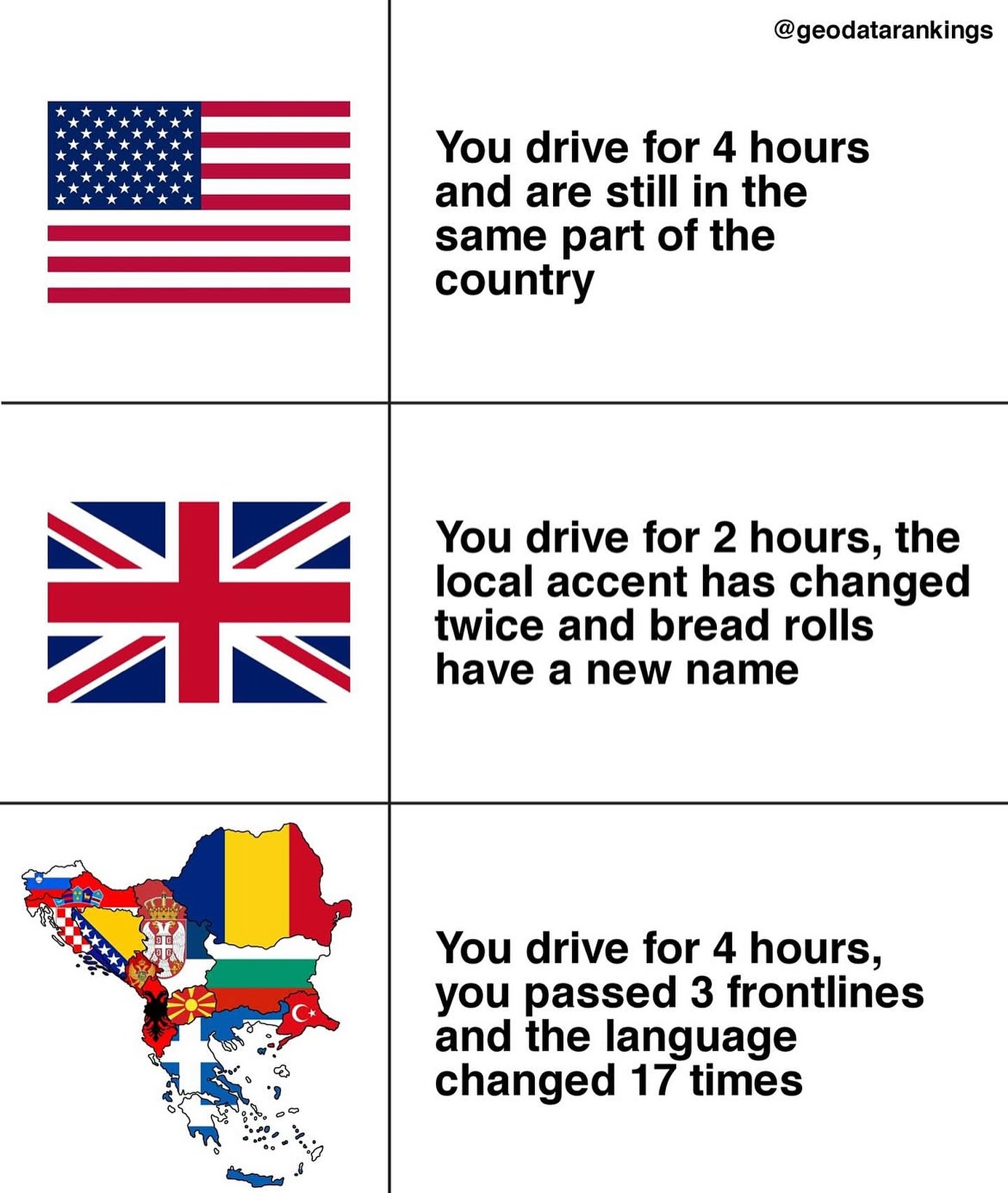
Can you think of any other ways the countries of the former Yugoslavia are the same or different?



Casper says
Croatian GDP nominal for 2023 is 82,69 billion US$
GDP nominal per capita for 2023 is 21.459,78 US$
Bro Knows says
All 3 are the same. It’s like British English and American English and Australian English. Same language.
Bro Knows says
Wow so many wrong things, really better just delete this.
Y.D. Robinson says
I’m surprised to see Slovenia among the countries having a problematic press freedom index. That leaves only Croatia, which overall is a bit less developed, having a satisfactory press freedom index!
Nancy says
SLOVENIA 🇸🇮: United Nations, Council Of Europe, NATO, European Union, European Economic Area, Eurozone, Schengen Area, OECD
CROATIA 🇭🇷: United Nations, Council Of Europe, NATO, European Union, European Economic Area, Eurozone, Schengen Area
MONTENEGRO 🇲🇪: United Nations, Council Of Europe, CEFTA, NATO
NORTH MACEDONIA 🇲🇰: United Nations, Council Of Europe, CEFTA, NATO
SERBIA 🇷🇸: United Nations, Council Of Europe, CEFTA
BOSNIA AND HERZEGOVINA 🇧🇦: United Nations, Council Of Europe, CEFTA
KOSOVO: –
S says
Alphabet: Cyrillic is not official in Kosovo only Latin for Serbian.