
The map above shows which countries are currently meeting their Paris 2016 climate goals (hint it’s none of them).
Instead the map below shows how close various countries are doing to meet their goals:
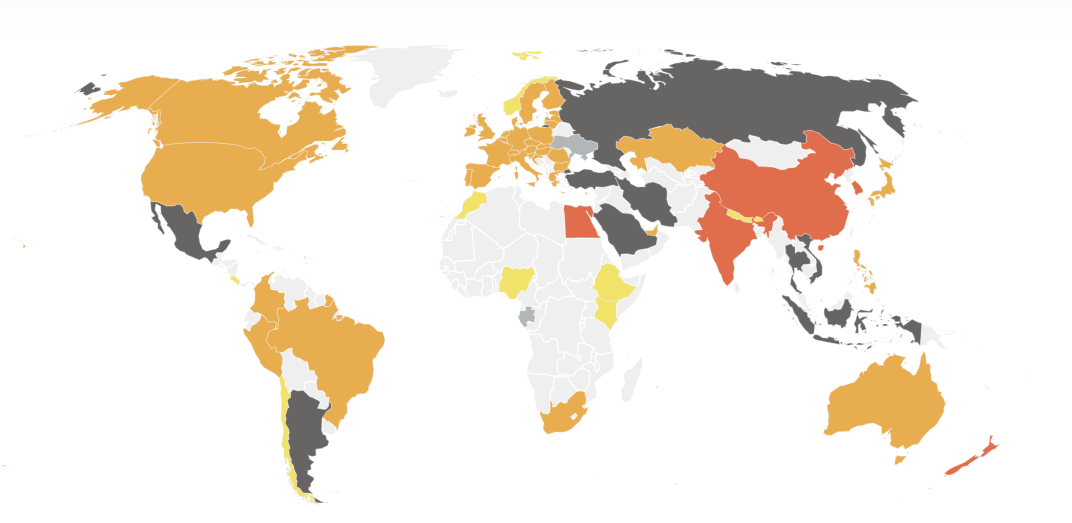
The map above comes from Climate Action Tracker, and tracks how certain countries are doing relative to their Paris Climate Agreements.
⚫ – Critically Insufficient
🔴 – Highly Insufficient
🟠 – Insufficient
🟡 – Almost Sufficient
🟢 – 1.5°C Paris Agreement Compatible
List of countries:
- Critically Insufficient
-
Highly Insufficient
- China
- Egypt
- India
- New Zealand
- Singapore
- South Korea
-
Insufficient
- Australia
- Brazil
- Canada
- Colombia
- EU
- Germany
- Japan
- Kazakhstan
- Peru
- Philippines
- South Africa
- Switzerland
- UAE
- USA
- United Kingdom
-
Almost Sufficient
- Bhutan
- Chile
- Costa Rica
- Ethiopia
- Kenya
- Morocco
- Nepal
- Nigeria
- Norway
- The Gambia
-
1.5°C Paris Agreement Compatible
- None
What did countries agree to?
The Paris Climate Agreement, adopted in December 2015 and entering into force in November 2016, is a landmark accord under the United Nations Framework Convention on Climate Change (UNFCCC).
It aims to strengthen the global response to the threat of climate change. Below are the key commitments and objectives that countries agreed to:
Main Goals
- Limit global temperature rise: Countries committed to keeping the global average temperature increase below 2°C above pre-industrial levels, while pursuing efforts to limit it to 1.5°C.
- Peak global emissions as soon as possible: Nations agreed to work towards rapidly peaking greenhouse gas emissions, recognizing that this will take longer for developing nations.
- Achieve net-zero emissions: Parties aim to balance anthropogenic emissions by sources and removals by sinks of greenhouse gases in the second half of this century. In simpler terms, the goal is to reach net-zero emissions around or after mid-century.
Nationally Determined Contributions (NDCs)
- Individual country plans: Each country submitted its own climate action plan, called a Nationally Determined Contribution, outlining how it intends to reduce greenhouse gas emissions.
- Review and update cycle: Countries agreed to review and update their NDCs every five years, aiming for progressively stronger targets.
- Transparency: A transparency framework was established to ensure accurate tracking and reporting of progress, allowing comparisons and assessments of collective efforts.
Financial and Technical Support
- Climate finance: Developed countries reaffirmed their intention to provide financial resources to assist developing nations in mitigation and adaptation. The initial goal was to mobilize USD 100 billion per year by 2020, with plans to extend and enhance this beyond 2025.
- Capacity building: The agreement emphasizes support for training and technical cooperation, particularly for countries with limited resources to tackle climate change.
- Technology development and transfer: Mechanisms were set up to promote clean technology development and facilitate transfer of climate-friendly technologies to countries in need.
Global Stocktake
Every five years, starting in 2023, there is a collective assessment of global progress (known as the “Global Stocktake”) to determine whether the world is on track to meet the Paris Agreement goals. The results are intended to inform countries as they update their climate targets and policies.
Long-Term Impact
The Paris Agreement marked the first time virtually all nations committed to a specific climate goal. Though the pledges vary in ambition, the structure encourages a gradual ratcheting up of commitments over time, with the ultimate aim of avoiding the worst impacts of climate change.
However as the maps above show, there is still a lot of work to be done.
What do you think about the US pulling out of the agreement for a second time?



Leave a Reply