
The difference between using US Letter and A4 paper sizes mainly stems from historical developments, standardization processes, and regional preferences that date back to the early 20th century.
1. Historical Context and Standardization
- US Letter Size: In the United States, the 8.5 x 11 inch size became popular due to early 20th-century industrial practices and legal standards set by the American National Standards Institute (ANSI). US Letter became the norm in part because it fit with existing printing and filing systems and was widely accepted in legal and commercial documents.
- A4 Size: A4 belongs to the ISO 216 standard, established in 1975 by the International Organization for Standardization (ISO). This standard is based on a mathematical formula: all paper sizes in the A-series have the same 1:√2 aspect ratio, allowing the paper to be resized or cut down easily. ISO 216 was widely adopted, especially in Europe and countries following the metric system, due to its efficient, universal dimensions.
2. Regional Preferences and Influence
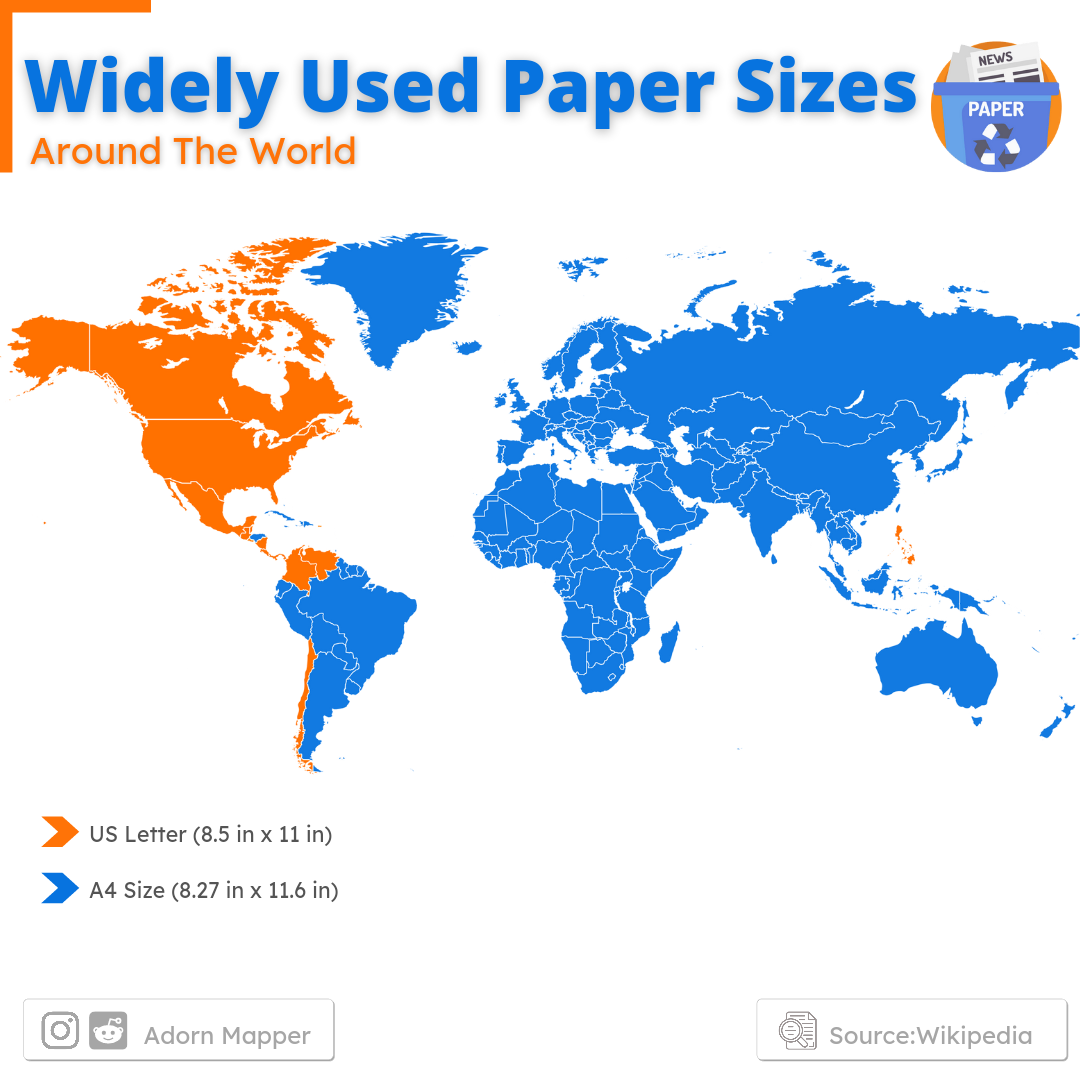
- The United States, Canada, Mexico, Philippines, and several Latin American countries having already adopted the US Letter size in industry, education, and government, saw no strong need to change to the ISO 216 standard, even as other countries standardized around A4.
- Most other countries, particularly those using the metric system, adopted A4 due to the ease of resizing documents and widespread interoperability across regions.
3. Practical Implications
- Interchangeability: The A4 format’s aspect ratio means that it can be scaled down to other sizes (A3, A5) without changing its proportions, a useful feature for technical drawings, printed materials, and publications.
- Local Usage: In the US, Canada and others, US Letter remains the norm, and the paper industry has geared production around it. In contrast, the rest of the world has embraced A4, which is now the standard for most international documentation and printing equipment.
Here’s another version of the map from Adorn Mapper:


Leave a Reply