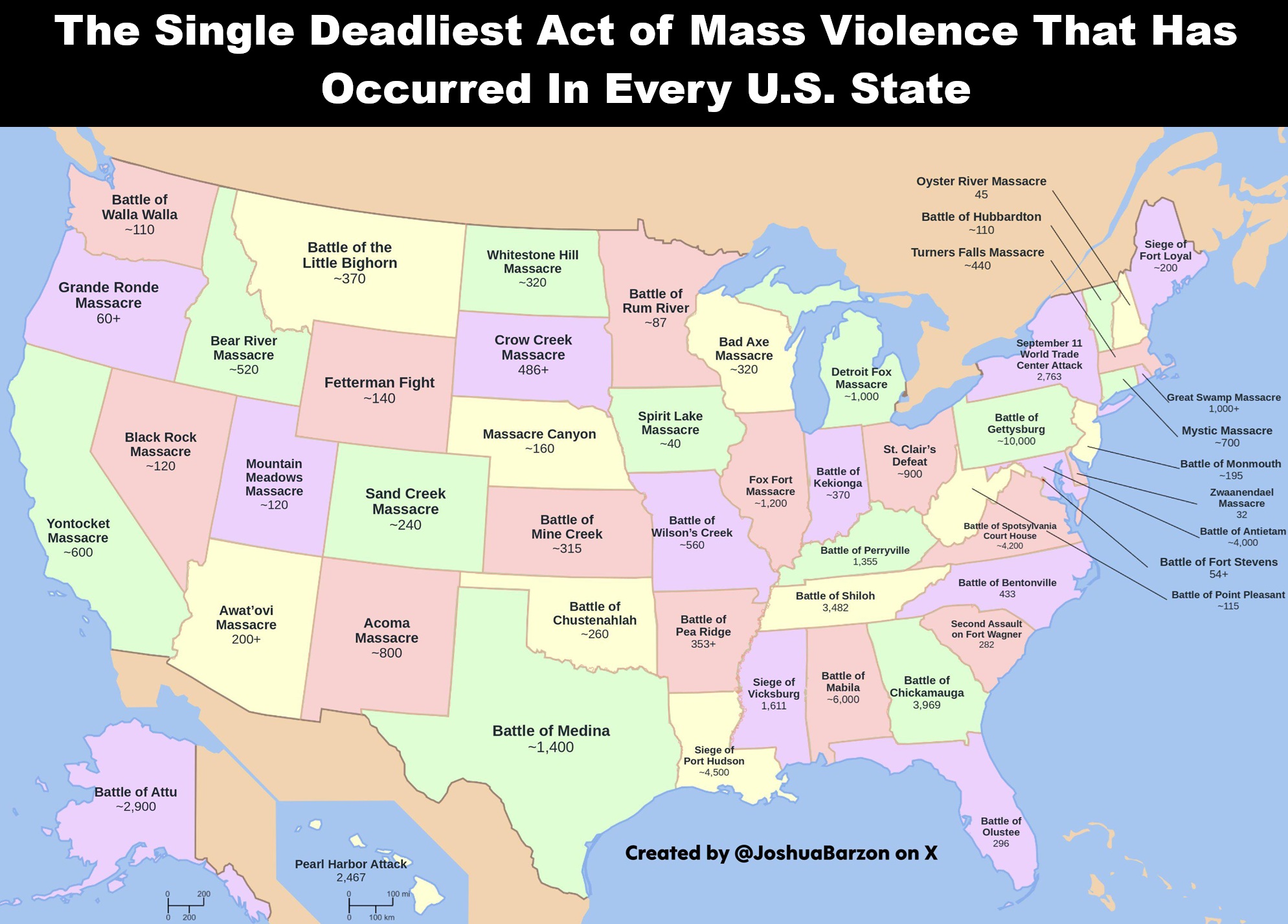
The map above shows the single deadliest act of mass violence that has occurred in each US state. Combined they resulted in 62,200 deaths.
Below is a full list with a short explanation and link to learn more about it:
1. Battle of Gettysburg, Pennsylvania (~10,000 deaths)
Three-day Civil War battle (1-3 July 1863). The Union victory ended Lee’s second invasion of the North. Read more on Wikipedia
2. Battle of Mabila, Alabama (~6,000 deaths)
1540 clash between Hernando de Soto’s expedition and Chief Tuskaloosa’s warriors at a fortified Mississippian town. Death estimates vary widely. Read more on Wikipedia
3. Siege of Port Hudson, Louisiana (~4,500 deaths)
48-day Union siege (May-July 1863). Its fall, days after Vicksburg, gave the Union control of the whole Mississippi. Read more on Wikipedia
4. Battle of Spotsylvania Court House, Virginia (~4,200 deaths)
Two weeks of fighting between Grant and Lee in May 1864, including the hand-to-hand combat at the Bloody Angle. Read more on Wikipedia
5. Battle of Antietam, Maryland (~4,000 deaths)
Fought on 17 September 1862, the bloodiest single day in American history. It halted Lee’s first invasion of the North. Read more on Wikipedia
6. Battle of Chickamauga, Georgia (3,969 deaths)
Confederate victory in north-west Georgia in September 1863, and one of the costliest battles of the Civil War. Read more on Wikipedia
7. Battle of Shiloh, Tennessee (3,482 deaths)
A Confederate surprise attack on Grant’s army in April 1862 was beaten back on the second day. Read more on Wikipedia
8. Battle of Attu, Alaska (~2,900 deaths)
US forces retook the Aleutian island from Japan in May 1943. It ended with one of the largest banzai charges of the Pacific War. Read more on Wikipedia
9. September 11 World Trade Center Attack, New York (2,763 deaths)
Al-Qaeda hijackers flew two airliners into the Twin Towers on 11 September 2001, causing both to collapse. Read more on Wikipedia
10. Pearl Harbor Attack, Hawaii (2,467 deaths)
Japan’s surprise air attack on the US Pacific Fleet on 7 December 1941, which brought the United States into the Second World War. Read more on Wikipedia
11. Siege of Vicksburg, Mississippi (1,611 deaths)
Grant besieged the river fortress from May to July 1863. Its surrender on 4 July split the Confederacy in two. Read more on Wikipedia
12. Battle of Medina, Texas (~1,400 deaths)
Spanish royalists crushed the Republican Army of the North south of San Antonio on 18 August 1813. The bloodiest battle fought on Texas soil. Read more on Wikipedia
13. Battle of Perryville, Kentucky (1,355 deaths)
The largest Civil War battle in Kentucky (8 October 1862). The Confederates withdrew afterwards, leaving the state in Union hands. Read more on Wikipedia
14. Fox Fort Massacre, Illinois (~1,200 deaths)
In 1730 French troops and allied Native nations besieged a Meskwaki (Fox) fort on the Illinois prairie, then killed those who tried to escape. Read more on Wikipedia
15=. Great Swamp Massacre, Rhode Island (1,000+ deaths)
In December 1675 New England militia stormed and burned a fortified Narragansett village during King Philip’s War. Read more on Wikipedia
15=. Detroit Fox Massacre, Michigan (~1,000 deaths)
In 1712 the French and their Native allies besieged Meskwaki and Mascouten encamped at Fort Pontchartrain, then cut them down as they fled. Read more on Wikipedia
17. St. Clair’s Defeat, Ohio (~900 deaths)
A Native confederacy led by Little Turtle and Blue Jacket routed the US Army on 4 November 1791, its worst ever defeat by Native Americans. Read more on Wikipedia
18. Acoma Massacre, New Mexico (~800 deaths)
In January 1599 Spanish soldiers sent by Juan de Onate stormed Acoma Pueblo in reprisal for the killing of a Spanish party. Read more on Wikipedia
19. Mystic Massacre, Connecticut (~700 deaths)
In May 1637 English colonists and their Mohegan and Narragansett allies set fire to a fortified Pequot village during the Pequot War. Read more on Wikipedia
20. Yontocket Massacre, California (~600 deaths)
In 1853 settlers attacked Tolowa people gathered for a religious ceremony at the village of Yontocket and burned it. Estimates of the dead vary widely. Read more on Wikipedia
21. Battle of Wilson’s Creek, Missouri (~560 deaths)
The first major Civil War battle west of the Mississippi (10 August 1861). Union general Nathaniel Lyon was killed. Read more on Wikipedia
22. Bear River Massacre, Idaho (~520 deaths)
On 29 January 1863 US volunteers under Colonel Patrick Connor attacked a Shoshone winter camp. Read more on Wikipedia
23. Crow Creek Massacre, South Dakota (486+ deaths)
A pre-Columbian massacre (around 1325) of the inhabitants of a fortified village on the Missouri River, known only from archaeology. Read more on Wikipedia
24. Turners Falls Massacre, Massachusetts (~440 deaths)
In May 1676 colonial militia made a dawn attack on a Native fishing encampment at Peskeompscut during King Philip’s War. Read more on Wikipedia
25. Battle of Bentonville, North Carolina (433 deaths)
The last major Confederate attempt to stop Sherman’s march through the Carolinas, in March 1865. Read more on Wikipedia
26=. Battle of the Little Bighorn, Montana (~370 deaths)
Lakota, Northern Cheyenne and Arapaho warriors wiped out Custer’s battalion of the 7th Cavalry in June 1876. Read more on Wikipedia
26=. Battle of Kekionga, Indiana (~370 deaths)
In October 1790 Miami-led warriors under Little Turtle defeated General Harmar’s expedition near present-day Fort Wayne. Read more on Wikipedia
28. Battle of Pea Ridge, Arkansas (353+ deaths)
A Union victory in March 1862 that secured Missouri for the North. Read more on Wikipedia
29=. Whitestone Hill Massacre, North Dakota (~320 deaths)
In September 1863 General Alfred Sully’s troops attacked a large Sioux encampment during the reprisals that followed the Dakota War. Read more on Wikipedia
29=. Bad Axe Massacre, Wisconsin (~320 deaths)
The end of the Black Hawk War (August 1832). Militia and a gunboat killed Sauk and Fox men, women and children trying to cross the Mississippi. Read more on Wikipedia
31. Battle of Mine Creek, Kansas (~315 deaths)
One of the largest cavalry battles of the Civil War (25 October 1864). Union horsemen routed Sterling Price’s retreating army. Read more on Wikipedia
32. Battle of Olustee, Florida (296 deaths)
The largest Civil War battle in Florida (February 1864), and a Confederate victory. Read more on Wikipedia
33. Second Assault on Fort Wagner, South Carolina (282 deaths)
A failed Union assault on Morris Island on 18 July 1863, led by the Black soldiers of the 54th Massachusetts. Read more on Wikipedia
34. Battle of Chustenahlah, Oklahoma (~260 deaths)
On 26 December 1861 Confederate troops attacked Opothleyahola’s pro-Union Creeks and Seminoles, driving the survivors to Kansas. Read more on Wikipedia
35. Sand Creek Massacre, Colorado (~240 deaths)
On 29 November 1864 Colonel John Chivington’s Colorado volunteers attacked a peaceful Cheyenne and Arapaho camp. Read more on Wikipedia
36=. Awat’ovi Massacre, Arizona (200+ deaths)
Around 1700 Hopi from neighbouring villages destroyed Awat’ovi and killed most of its men after it readmitted Spanish missionaries. Read more on Wikipedia
36=. Siege of Fort Loyal, Maine (~200 deaths)
In May 1690 French and Wabanaki forces besieged the English fort at Falmouth (now Portland) and killed most of the garrison and settlers after they surrendered. Read more on Wikipedia
38. Battle of Monmouth, New Jersey (~195 deaths)
Washington’s Continental Army fought the British army as it withdrew across New Jersey on 28 June 1778. Read more on Wikipedia
39. Massacre Canyon, Nebraska (~160 deaths)
On 5 August 1873 a large Lakota war party attacked Pawnee on their summer buffalo hunt. One of the last big battles between Native nations. Read more on Wikipedia
40. Fetterman Fight, Wyoming (~140 deaths)
On 21 December 1866 Lakota, Cheyenne and Arapaho warriors lured Captain Fetterman’s 81 men into an ambush near Fort Phil Kearny and killed them all. Read more on Wikipedia
41=. Black Rock Massacre, Nevada (~120 deaths)
Killing of Northern Paiute by US and Nevada cavalry in the Black Rock Desert region during the Snake War of the mid-1860s. No dedicated article; link goes to the Snake War. Read more on Wikipedia
41=. Mountain Meadows Massacre, Utah (~120 deaths)
In September 1857 a Mormon militia killed the men, women and older children of the Baker-Fancher emigrant wagon train. Read more on Wikipedia
43. Battle of Point Pleasant, West Virginia (~115 deaths)
Virginia militia fought Shawnee and Mingo warriors under Cornstalk on 10 October 1774, the only major battle of Lord Dunmore’s War. Read more on Wikipedia
44=. Battle of Walla Walla, Washington (~110 deaths)
A four-day running battle in December 1855 between Oregon volunteers and Walla Walla, Cayuse and allied warriors. Read more on Wikipedia
44=. Battle of Hubbardton, Vermont (~110 deaths)
A rearguard action on 7 July 1777 after the American retreat from Fort Ticonderoga. The only Revolutionary War battle fought in Vermont. Read more on Wikipedia
46. Battle of Rum River, Minnesota (~87 deaths)
In July 1839 Dakota warriors attacked Ojibwe returning home from Fort Snelling near the mouth of the Rum River. No dedicated article; link goes to the Dakota-Ojibwe War. Read more on Wikipedia
47. Grande Ronde Massacre, Oregon (60+ deaths)
In July 1856 Washington territorial volunteers attacked a Cayuse, Walla Walla and Umatilla camp in the Grande Ronde Valley. No dedicated article; link goes to the Yakima War. Read more on Wikipedia
48. Battle of Fort Stevens, District of Columbia (54+ deaths)
Jubal Early’s Confederate raid reached the defences of Washington in July 1864. Abraham Lincoln came under fire while watching. Read more on Wikipedia
49. Oyster River Massacre, New Hampshire (45 deaths)
In July 1694 a French and Abenaki force raided the English settlement at Oyster River (now Durham). Read more on Wikipedia
50. Spirit Lake Massacre, Iowa (~40 deaths)
In March 1857 Inkpaduta’s band of Wahpekute Dakota attacked settler cabins around the Okoboji lakes and Spirit Lake. Read more on Wikipedia
51. Zwaanendael Massacre, Delaware (32 deaths)
The Dutch colonists of Zwaanendael (now Lewes) were killed by local Lenape after a dispute, in about 1631-32. Read more on Wikipedia




Leave a Reply