
Below is the translation of the Italian terms into English:
- Venezia e il Dogado: Venice and the Dogado (Doge’s territory)
- Territori ad inizio Sec. XV: Territories at the beginning of the 15th century
- Acquisti successivi: Subsequent acquisitions
- Acquisti temporanei: Temporary acquisitions
- Tratto di mare dominato dalle flotte venete ad inizio Secolo XVI: Sea areas dominated by Venetian fleets at the beginning of the 16th century
- Principali rotte veneziane: Main Venetian routes
- Grandi empori e colonie commerciali: Major trading emporiums and colonies
Key Locations and Trade Routes:
- Adriatico: Adriatic Sea
- Ionio: Ionian Sea
- Egeo: Aegean Sea
- Mar Nero: Black Sea
- Albania Durazzo: Durres in Albania
- Tessalonica: Thessaloniki
- Costantinopoli: Constantinople
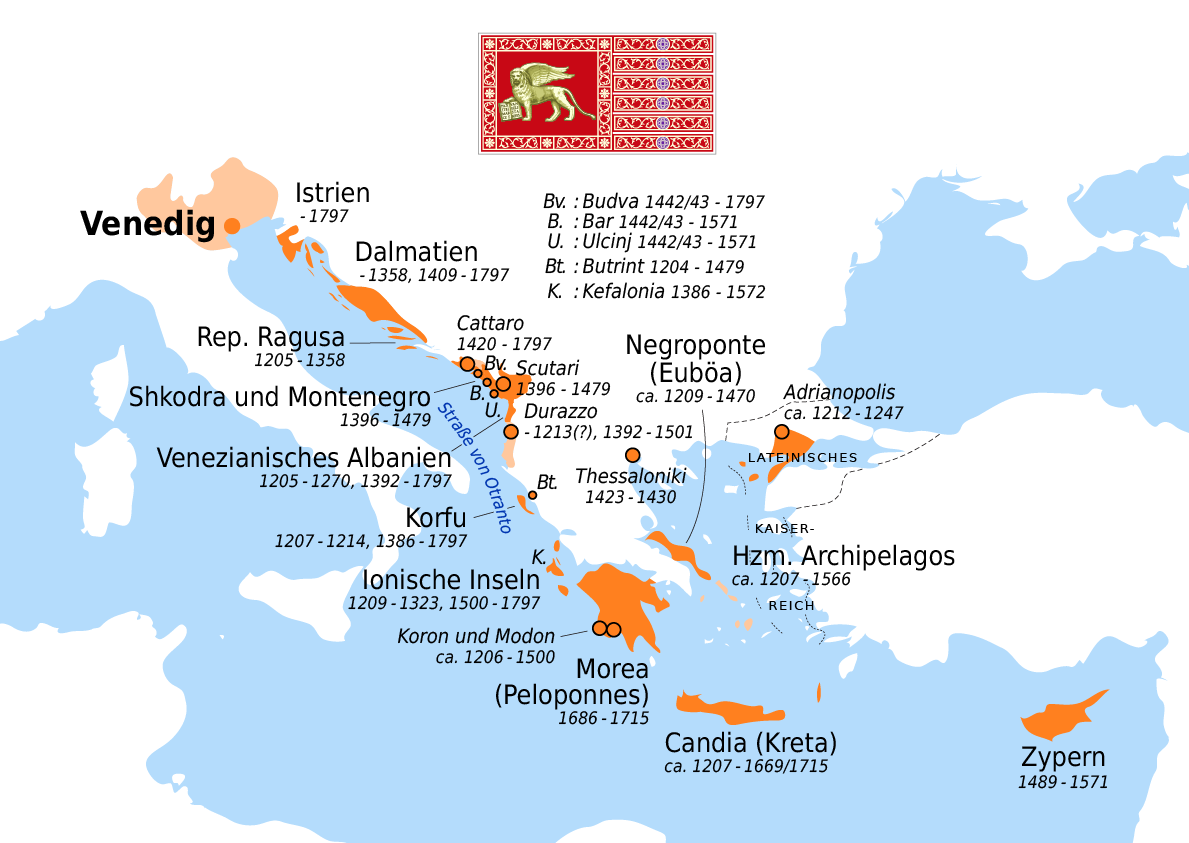
- Candia (1204-1669): Crete
- Arcipelago (1204-1714): The Aegean Islands
- Cipro (1489-1571): Cyprus
- Morea (1685-1715): Morea (Peloponnese)
- Antiochia: Antioch
- Tripoli: Tripoli
- Tunisi: Tunis
- Malta: Malta
- Alessandria: Alexandria in Egypt
- Impero Ottomano: Ottoman Empire at the beginning of the 16th century (in Green)
Time of the Rise of The Republic of Venice
Here is a timeline detailing the rise of the Republic of Venice until the 16th century:
Early Beginnings
- 5th Century: The origins of Venice date back to the 5th century, when people fled the mainland to escape barbarian invasions, seeking refuge in the islands of the Venetian Lagoon.
Establishment and Growth
- 726: Venice becomes an autonomous region under the leadership of the first Doge, Paolo Lucio Anafesto.
- 810: Venice defeats the Franks and secures its independence from the Byzantine Empire.
- 828: The relics of St. Mark are brought to Venice from Alexandria, establishing St. Mark as the patron saint and symbol of Venice.
Expansion of Influence
- 9th-10th Century: Venice begins to establish itself as a powerful maritime and trading city-state. It develops commercial networks throughout the Mediterranean.
- 1000: Doge Pietro II Orseolo launches a successful military campaign against the Dalmatian pirates, securing Venetian control over the Adriatic Sea.
Golden Age
- 1082: Venice gains significant trading privileges in the Byzantine Empire through the Golden Bull of Alexios I Komnenos.
- 1204: During the Fourth Crusade, Venice plays a crucial role in the capture of Constantinople, leading to the establishment of the Latin Empire. Venice gains control of valuable territories and trading routes in the eastern Mediterranean.
- 13th Century: Venice expands its influence and control over the Aegean Islands, Crete, and parts of the Greek mainland.
Consolidation and Conflict
- 1297: The Serrata del Maggior Consiglio (“Closing of the Great Council”) effectively transforms Venice into an oligarchic republic, consolidating power within a small group of noble families.
- 1381: The War of Chioggia against Genoa ends in Venetian victory, securing Venice’s dominance in the Adriatic Sea and affirming its maritime supremacy.
Height of Power
- 1405: Venice conquers Padua, consolidating its control over the Venetian mainland (Terraferma).
- 1489: Venice acquires Cyprus, further extending its reach in the eastern Mediterranean.
16th Century
- 1508: The League of Cambrai, an alliance of European powers including France, the Papal States, and the Holy Roman Empire, is formed against Venice. Despite initial losses, Venice manages to recover much of its territory.
- 1571: The Battle of Lepanto, where the Holy League (including Venice) defeats the Ottoman fleet, marking a significant moment in the struggle for control over Mediterranean trade routes.
Decline & Fall
Here’s a timeline of key events in the history of the Republic of Venice from 1571 onwards:
Late 16th Century
- 1573: Venice signs the Treaty of Constantinople, ending hostilities with the Ottoman Empire and ceding Cyprus to the Ottomans. Despite the victory at Lepanto, the war had strained Venice’s resources.
- 1595-1603: The Long War (also known as the Fifteen Years’ War) between the Habsburgs and the Ottoman Empire indirectly affects Venice, which tries to maintain its neutrality while protecting its trade interests.
17th Century
- 1615-1617: The War of Gradisca (part of the Uskok War) between Venice and Austria. Venice successfully defends its territory but gains no significant advantage.
- 1645-1669: The Cretan War (Fifth Ottoman-Venetian War), where Venice battles the Ottoman Empire for control of Crete. Despite prolonged resistance, Venice eventually loses Crete to the Ottomans after the fall of Candia in 1669.
- 1684-1699: The Morean War (Sixth Ottoman-Venetian War), part of the larger conflict known as the Great Turkish War. Venice allies with the Holy League and manages to capture the Peloponnese (Morea) and parts of Dalmatia from the Ottomans. The Treaty of Karlowitz (1699) solidifies these gains.
18th Century
- 1714-1718: The Seventh Ottoman-Venetian War, also known as the Second Morean War. The Ottomans retake the Peloponnese and other territories, with Venice suffering significant losses. The Treaty of Passarowitz (1718) ends the war, marking the decline of Venice as a major Mediterranean power.
- 1797: The Treaty of Campo Formio marks the end of the Republic of Venice. Napoleon Bonaparte conquers Venice and subsequently cedes its territories to the Austrian Empire. This event ends over a millennium of Venetian independence.
Anachronistic map of Venetian colonies (c.1000-1797)


Leave a Reply