
The map above shows one history’s forgotten economic geography facts. Today we tend to think of South Korea as a economic miracle and North Korea as an economic basket case.
However, from the division of the Korean peninsula in 1948 up until the early 1970s, the North was actually richer than the South in per capita terms.
According to data from the UN, the North’s GDP in 1970 was $4,927 million USD, compared to that of the South of $8,936 million USD.
But, the South had more than twice the population of the North: 32.2 million vs 15.2 million.
This meant that on a Nominal GDP per capita basis the North was around 25% richer than the South $325 vs $260.
Fast forward to today and the situation is unrecognizable.
Nominal GDP per capita in North Korea is estimated by the UN at just $640 per person in 2023.
South Korea on the other hand has a nominal GDP per capita of $35,538 per person. This is 56x that of the North or put the other way GDP per capita in the North is 1.8% that of the South.
How did South Korea get so much richer than the North?
1. Economic Policies and Reforms:
South Korea: Adopted market-oriented reforms, emphasizing capitalism, export-led industrialization, and integration into the global economy. Policies encouraged innovation, foreign investment, and private enterprise.
North Korea: Pursued centrally-planned socialism, isolationist policies, and self-reliance ideology (“Juche“), restricting private enterprise and foreign trade.
2. Political Stability and Governance:
South Korea: After initial authoritarianism, transitioned to democracy in the 1980s, creating stability, accountability, and rule of law, boosting investor confidence and economic growth.
North Korea: Remained under authoritarian dynastic leadership, marked by strict political control, human rights abuses, and military spending that diverted resources away from economic development.
3. International Support and Investment:
South Korea: Benefited substantially from international aid (particularly from the U.S. after the Korean War), investments, technological transfers, and trade access to global markets.
North Korea: Relied heavily on Soviet Union and China until the 1990s, but economic support drastically declined following the Soviet collapse, leading to severe economic hardship and isolation.
4. Education and Human Capital:
South Korea: Invested heavily in education, skills training, and human capital development, creating a highly educated workforce suited for technology, manufacturing, and service industries.
North Korea: Education emphasized ideological indoctrination rather than practical, market-relevant skills, limiting productivity and innovation.
5. Industrialization and Innovation:
South Korea: Focused heavily on industrialization, technology, electronics, automotive industries, and global brands (Samsung, LG, Hyundai, etc.), which propelled rapid economic growth.
North Korea: Prioritized heavy industry and military production at the expense of consumer goods and services, hindering growth and development.
6. Openness to Global Trade:
South Korea: Aggressively pursued open markets, free trade agreements, and export-oriented growth strategies.
North Korea: Severely restricted international trade, largely isolated from global economic networks.
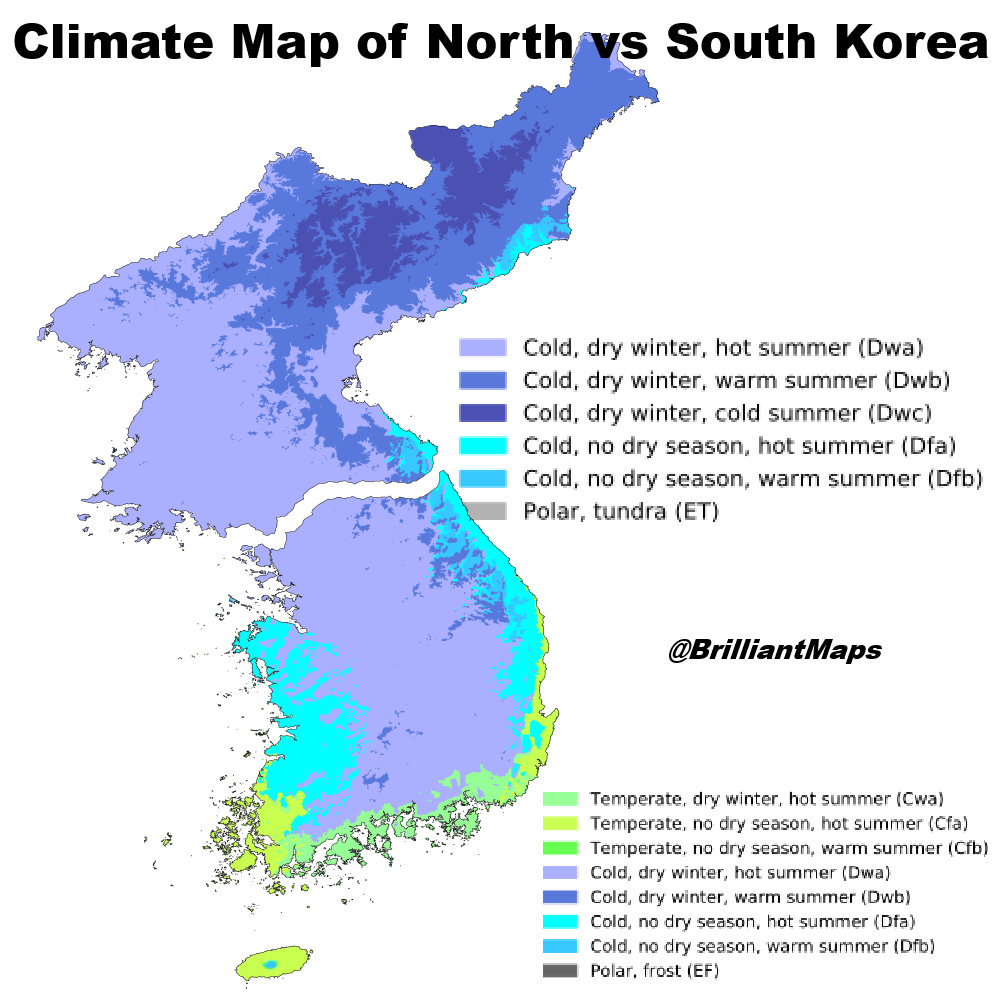
Also here’s a climate differecne:
Flag map credits:
What do you think?


Leave a Reply