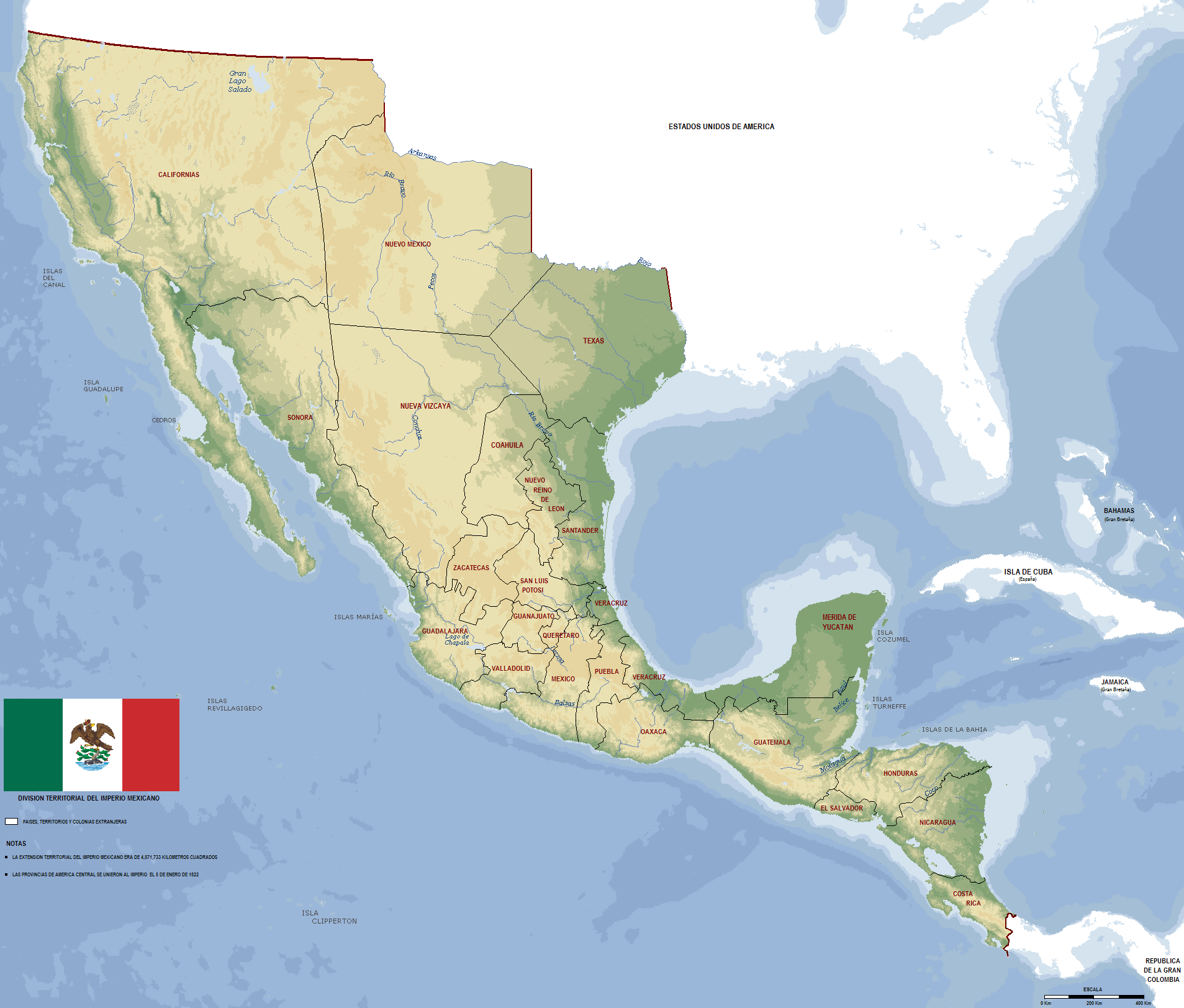
The map above shows the short lived First Mexican Empire [Imperio Mexicano (Spanish) / Imperium Mexicanum (Latin)] at its greatest extent between 1821 and 1823.
Not only did it include modern day Mexico, but also the area now occupied by some or all of California, Texas, Nevada, Utah, Arizona, New Mexico, Colorado, Wyoming, Oklahoma and Kansas.
And the following Central American countries: Guatemala, El Salvador, Honduras, Nicaragua and Costa Rica.
Here’s a breif history of the First Mexican Empire (1821–1823):
1. Formation:
- Origins: The First Mexican Empire emerged from Mexico’s independence movement against Spanish colonial rule. After years of conflict, the Plan of Iguala (1821) outlined a constitutional monarchy for the newly independent nation, emphasizing unity among social classes, Catholicism as the state religion, and the monarchy as a stabilizing force.
- Treaty of Córdoba: Signed in 1821 between Mexican leaders (notably Agustín de Iturbide) and Spain, this treaty officially recognized Mexico’s independence.
- Monarchy Declared: In 1822, military leader Agustín de Iturbide was crowned Emperor Agustín I, formalizing the establishment of the empire.
2. Geographical Features:
- Territory: The empire covered a vast area, including:
- All of modern-day Mexico.
- Central America (Guatemala, El Salvador, Honduras, Nicaragua, and Costa Rica).
- Parts of the present-day United States (California, Nevada, Utah, Arizona, New Mexico, Texas, and portions of Colorado, Wyoming, Kansas, and Oklahoma).
- Geographic Highlights:
- Mountain ranges (Sierra Madre), arid deserts (Sonoran and Chihuahuan), tropical rainforests in the south, and volcanic highlands in Central America.
- Extensive coastline along the Pacific Ocean and Gulf of Mexico.
3. Government:
- System: Constitutional monarchy.
- Leader: Emperor Agustín I served as the head of state.
- Constitution: The empire lacked a formal constitution but was guided by the Plan of Iguala, emphasizing unity under monarchy, Catholicism, and equality among social classes.
- Subdivisions: The empire retained the administrative divisions from the colonial era, with provinces governed by officials loyal to the emperor.
4. Population:
- Demographics: Estimated at 6–8 million people, including:
- Indigenous peoples: Formed the majority, living in rural areas with traditional communal practices.
- Mestizos (mixed heritage): The largest social group, often laborers or artisans.
- Criollos (Mexican-born Spaniards): Elite landowners, military leaders, and clergy.
- Afro-Mexicans and other minorities.
- Ethnic Diversity: Included a mix of Indigenous, European, African, and mixed-heritage populations.
5. Downfall:
- Economic Struggles: Years of war left the empire financially unstable. The government failed to manage debt, inflation, and taxation effectively.
- Political Discontent: Factions opposed the monarchy. Many preferred a republican system, while others opposed Iturbide’s autocratic tendencies.
- Rebellion: Central American provinces sought autonomy and withdrew from the empire. Mexican military leaders, like Antonio López de Santa Anna, rebelled against Iturbide’s rule.
- Abdication: In 1823, facing increasing opposition, Agustín I abdicated and went into exile. The empire collapsed soon after.
6. Successor States:
- In Mexico: The First Mexican Empire was replaced by the United Mexican States, a federal republic established in 1824 under a new constitution.
- In Central America: The provinces formed the Federal Republic of Central America (1823–1841), which eventually fragmented into independent countries (Guatemala, El Salvador, Honduras, Nicaragua, and Costa Rica).
Here is a flag map of the modern day states that made up parts of First Mexican Empire


- 447 that used to be entirely part of Mexico and now 87.2 million people
- 16 partially in Mexico which have 742k
Compare that to Mexico’s current population of 132 million.


Leave a Reply