
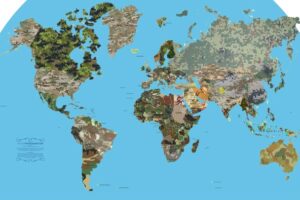
The map above supposedly shows the prevalence of blond hair in the population around the world.
The map doesn’t list its sources and the definition used.
Moreover, what counts as blond varies from country to country and even throughout a person’s lifetime (When I was a kid I had very blond hair, which then turned brown and is now rapidly turning grey).
But here’s a bit more on blond hair:
From the map itself:
Natural lighter hair colors occur most often in Europe and less frequently in other areas.
In Northern European populations, the occurrence of blond hair is very frequent.
The hair color gene MCR1 has at least seven variants in Europe giving the continent a wide range of hair and eye shades.
Based on recent genetic research carried out at three Japanese universities, the date of the genetic mutation that resulted in blond hair in Europe has been slated to about 11,000 years ago during the Last Ice Age.
A typical explanation found in the scientific literature for the evolution of light hair is related to the requirement for vitamin D synthesis and northern Europe’s seasonal deficiency of sunlight.
Lighter skin is due to low concentration in pigmentation, thus allowing more sunlight to trigger the production of vitamin D.
In this way, high frequencies of light hair in northern latitudes are a result of the light skin adaptation to lower levels of sunlight, which reduces the prevalence of rickets caused by vitamin D deficiency.
The darker pigmentation at higher latitudes in certain ethnic groups such as the Inuit is explained by a greater proportion of seafood in their diet.
As seafood is high in vitamin D, vitamin D deficiency would not create a selective pressure for lighter pigmentation in that population.
Blond Hair Facts
“Blond or blonde, or fair hair, is a hair color characterized by low levels of the dark pigment eumelanin.
The resultant visible hue depends on various factors, but always has some sort of yellowish color.
The color can be from the very pale blond (caused by a patchy, scarce distribution of pigment) to reddish (‘strawberry blond’) colors or golden-brownish (‘sandy’) blond colors (the latter with more eumelanin).
On the Fischer-Saller scale, blond color ranges from A to J (blond to dark blond).”
How many people have blond hair worldwide?
The percentage of people with naturally blond hair varies significantly by region, largely due to genetic and environmental factors.
Here’s a summary based on genetic and anthropological data:
Northern Europe
- Scandinavia (Norway, Sweden, Denmark, Finland): 50%–80% of the population have blond hair, particularly light blond shades.
- Baltic countries (Estonia, Latvia, Lithuania): Around 40%–70% of the population have blond hair.
- Iceland: Approximately 50%–70%.
Western and Central Europe
- Germany, Netherlands, Belgium: Around 25%–50% of the population have blond hair.
- France: 20%–40% in northern regions, lower in southern France.
- United Kingdom: 10%–30%, with higher frequencies in northern areas (e.g., Scotland).
Eastern Europe
- Russia (European part): 30%–50% in regions like the Baltic coast, decreasing further south and east.
- Poland, Ukraine: Approximately 25%–50%.
Southern Europe
Asia
- Central Asia (Kazakhstan, parts of Siberia): Around 5%–15% in populations with mixed European ancestry.
- Rest of Asia: Less than 1% naturally have blond hair, except for specific isolated populations, like the Kalash people in Pakistan.
Africa
- Northern Africa: Less than 1%, except among Berber populations in Morocco or Algeria, where lighter hair is slightly more common.
- Sub-Saharan Africa: Blond hair is extremely rare.
Oceania
- Australia (Aboriginal population): Less than 1% naturally have blond hair.
- Melanesia (e.g., Solomon Islands, Vanuatu): 5%–10% have natural blond hair, unrelated to European ancestry.
Americas
- North America (European-descended populations): Around 20%–40%, depending on the region and ancestry.
- South America: 1%–10%, primarily in populations with European heritage (e.g., Argentina, Uruguay).
Global Average
Globally, it’s estimated that 2%–16% of people have naturally blond hair, with the higher estimates including lighter shades like dark blond. The highest concentrations are found in Northern and Central Europe.
Here’s an animation based on the original map above:



Alonso Strippoli says
That map is very, very wrong. The Latin American percentages, for instance, are extremely inflated. I’m from Latinamerica and can attest to the fact that the overwhelming majority of Latinos have dark to brown hair. Even for Argentines and Uruguayans, the purported “Europeans of South America”, light hair is extremely rare.
Like most Latin Americans, Argentines are the result of a mix between European and Indigenous peoples. The thing that makes them stand out from the rest of Latinos is that their European genetic stock is not just made up of Iberian DNA but also Italian and other European groups, but Argentines still have substantial Indigenous genetic component. Same goes for Colombia, Costa Rica, and Brazil. Therefore it is laughable to suggest that Argentina is as blond as the American South.
By the way, this map was made by white supremacists on 4chan’s /pol/, so it should be taken as propaganda, not fact.