
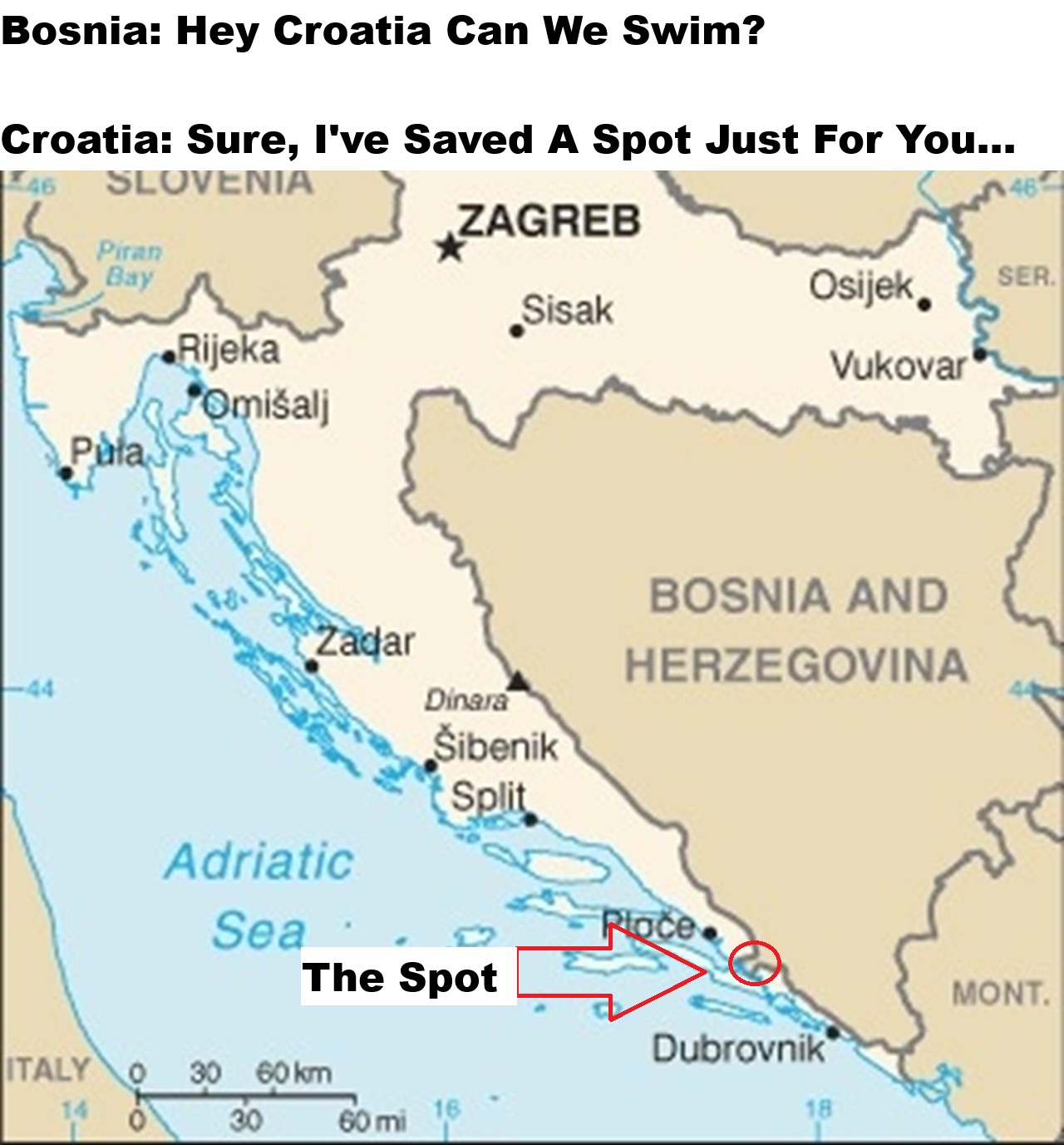
But it splits the Republic of Croatia into two parts, mainly the area around the city of Dubrovnik in the south from the rest of Croatia proper in the north.
Neum itself has a tiny population of just under 5,000 people, 97.64% of whom are Croats.
So why does it exist?
It exists due to historical territorial divisions and treaties dating back to the Ottoman Empire and the Republic of Ragusa (modern-day Dubrovnik).
Historical Background
- Ottoman and Ragusan Treaty: The origins of the Neum Strip trace back to a treaty in 1699, the Treaty of Karlowitz, and subsequent adjustments. During the period of the Ottoman Empire, the Republic of Ragusa, which was centered in Dubrovnik, sought to maintain its independence from the more powerful Republic of Venice. To create a buffer zone between itself and Venice, Ragusa ceded a small strip of coastal land to the Ottoman Empire. This land, now known as the Neum Strip, was part of that buffer.
- Austro-Hungarian Period: The area later became part of the Austro-Hungarian Empire, along with the rest of Bosnia and Herzegovina. When the empire dissolved after World War I, the land became part of the Kingdom of Yugoslavia, which later evolved into the Socialist Federal Republic of Yugoslavia.
- Yugoslav Federation and the Breakup: During Yugoslavia’s existence, the Neum Strip was administratively part of Bosnia and Herzegovina. After the breakup of Yugoslavia in the early 1990s, Bosnia and Herzegovina became an independent country and retained the Neum corridor as its only access to the sea.
Modern Significance
The Neum Strip gives Bosnia and Herzegovina its only coastline, although it is quite limited in terms of port access or economic use.
The strip divides the Croatian coastline into two parts, complicating transportation between the northern and southern parts of Croatia, particularly to the popular tourist destination of Dubrovnik.
To mitigate this issue, Croatia recently completed the construction of the Pelješac Bridge in 2022, which bypasses the Neum Strip, directly connecting the Croatian mainland with its southern territories, including Dubrovnik.
Why It Still Exists
The existence of the Neum Strip today is a result of complex historical circumstances involving shifting borders, regional power dynamics, and treaties designed to protect smaller states from larger rivals.
It remains as an artifact of centuries-old territorial arrangements, serving as a rare example of how historical treaties continue to influence modern borders and geopolitics.
And it also helps to create this meme:


Leave a Reply