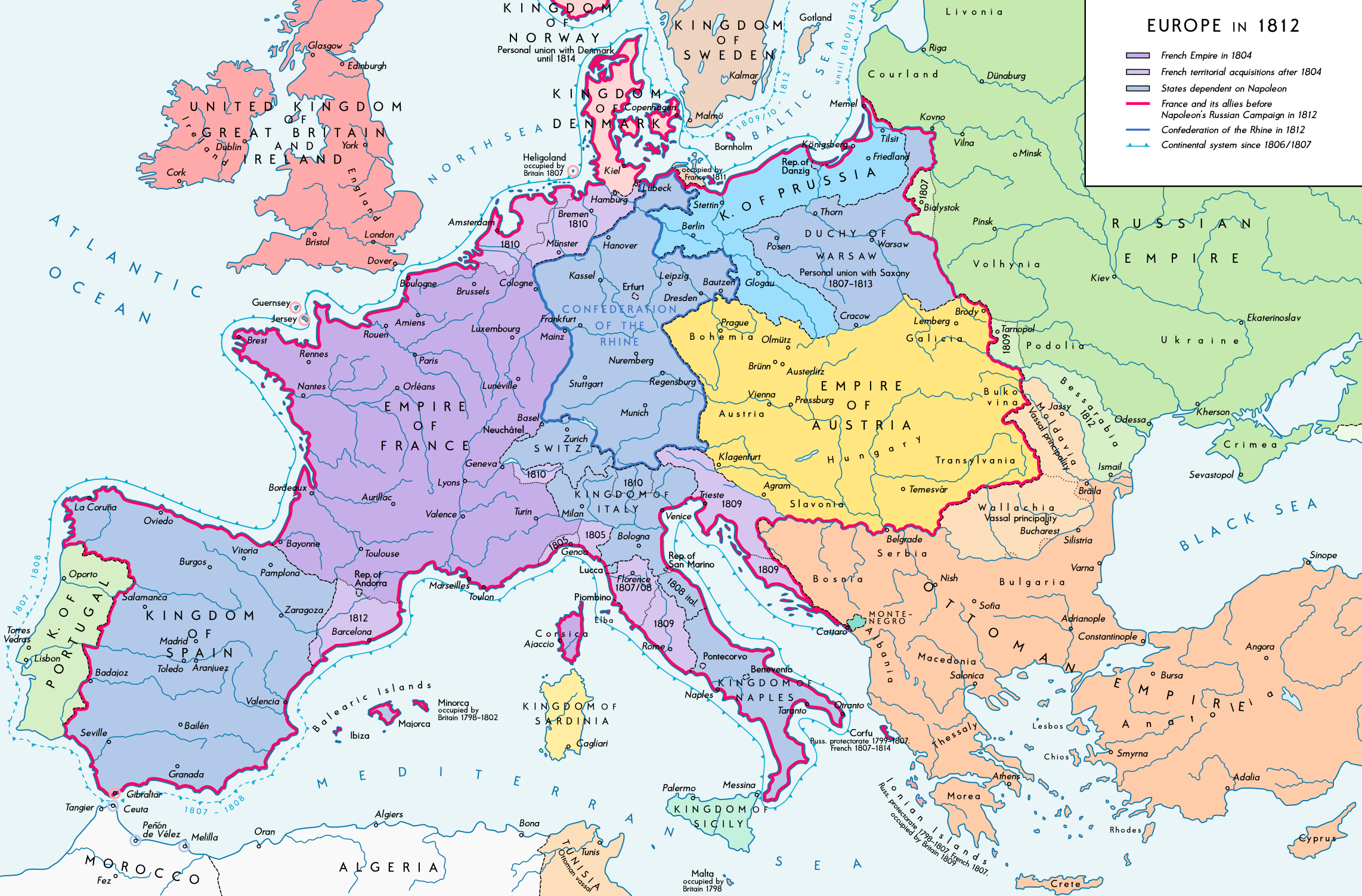
The boundaries and political entities shown are reflective of the territorial changes brought about by Napoleon Bonaparte’s conquests and alliances.
Here are some key details:
- French Empire: Central to the map is the Empire of France, which includes not only modern-day France but also extended territories that were annexed by France after 1804.
- French Territorial Acquisitions: Highlighted areas show territories acquired by France after 1804, demonstrating the expansion of Napoleon’s influence.
- Confederation of the Rhine: Formed in 1806, this confederation of German states was under the influence of France and served as a buffer zone against Austria and Prussia.
- Kingdom of Italy: Created by Napoleon, this kingdom encompasses northern and central Italy, including the key regions of Venice and Milan.
- Duchy of Warsaw: Established by Napoleon, this state existed from 1807 to 1813 and was intended to be a French client state.
- Kingdoms and States Dependent on Napoleon: Various kingdoms, such as Spain, Naples, and the Duchy of Warsaw, were either directly ruled by Napoleon’s family members or were French client states.
- Napoleon’s Allies: The map shows several states aligned with or dependent on Napoleon, reflecting his extensive influence across Europe.
- Empire of Austria: Shown in yellow, the Austrian Empire was one of the major powers opposing Napoleon.
- Kingdom of Prussia: Another significant adversary of Napoleon, marked in blue, which had lost substantial territory following its defeats.
- Continental System: The map also indicates the extent of the Continental System, an economic blockade against Britain initiated by Napoleon.
- Ottoman Empire: The southeastern part of Europe is under the control of the Ottoman Empire, a significant but waning power at the time.
- Russian Empire: Finally, the map highlights the Russian Empire in Green which Napoloen would invade in 1812, and would ultimately lead to his downfall.
Timeline of Napoleon’s Rise To Power Up Until 1812
Here is a timeline highlighting key events in the rise of Napoleon Bonaparte and France’s expansion of power up to 1812:
Early Life and Rise
- 1769: Napoleon Bonaparte is born on August 15th in Corsica.
- 1785: Napoleon graduates from the École Militaire in Paris and is commissioned as a second lieutenant in the French artillery.
- 1793: During the Siege of Toulon, Napoleon’s military prowess is recognized, leading to his promotion to brigadier general.
French Revolutionary Wars
- 1795: Napoleon suppresses the Royalist insurrection in Paris, known as the 13 Vendémiaire, and is promoted to major general.
- 1796-1797: Appointed commander of the Army of Italy, Napoleon leads successful campaigns against the Austrians, gaining significant territories for France.
Coup and Consulate
- 1799: Napoleon returns to France from the Egyptian campaign and participates in the Coup of 18 Brumaire, overthrowing the Directory. He establishes the Consulate and becomes First Consul.
- 1800: Wins the Battle of Marengo, solidifying his power in France.
- 1802: Napoleon becomes First Consul for Life following a plebiscite.
Empire and Expansion
- 1804: Napoleon crowns himself Emperor of the French on December 2nd.
- 1805: France defeats Austria and Russia at the Battle of Austerlitz, known as the Battle of the Three Emperors.
- 1806: The Holy Roman Empire is dissolved following the creation of the Confederation of the Rhine, a group of German states allied with France.
- 1807: France defeats Russia at the Battle of Friedland, leading to the Treaties of Tilsit, which establishes the Duchy of Warsaw and makes Russia an ally.
- 1808: Napoleon invades Spain, leading to the Peninsular War, and places his brother Joseph on the Spanish throne.
Consolidation and the Continental System
- 1809: Napoleon defeats Austria again at the Battle of Wagram. The Treaty of Schönbrunn results in significant territorial gains for France.
- 1810: At the height of his power, Napoleon controls most of continental Europe either directly or through allied states. He marries Marie Louise, Archduchess of Austria, strengthening ties with the Austrian Empire.
Campaigns and Challenges
- 1812: Napoleon launches the invasion of Russia, assembling the Grande Armée, one of the largest forces ever seen in Europe. The campaign initially sees some success but ends disastrously with a devastating retreat from Moscow during the harsh winter.
Napoleon’s Downfall
Here is a detailed timeline outlining the key events leading to Napoleon’s downfall from 1812 to 1815:
1812
- June 24: Napoleon begins his invasion of Russia with the Grande Armée. (see this graphic for how it went)
- September 7: The Battle of Borodino takes place, resulting in heavy casualties on both sides. Napoleon wins a costly victory.
- September 14: Napoleon’s army reaches Moscow, only to find the city abandoned and set on fire by the Russians.
- October 19: Facing supply shortages and harsh weather, Napoleon begins the retreat from Moscow.
- November-December: The retreat turns disastrous due to the severe winter and continuous Russian attacks. Only a fraction of the Grande Armée survives.
1813
- April-May: Napoleon raises a new army and wins initial victories at the battles of Lützen and Bautzen.
- June-September: Despite these victories, Napoleon’s forces are increasingly stretched, facing the Sixth Coalition comprising Austria, Prussia, Russia, the United Kingdom, Sweden, Spain, and Portugal.
- October 16-19: The Battle of Leipzig (Battle of Nations) results in a decisive defeat for Napoleon. The Coalition forces significantly outnumber and defeat the French army.
- November-December: Napoleon retreats back to France as the Coalition forces advance.
1814
- January-March: Despite several victories in the Six Days’ Campaign, Napoleon’s situation becomes untenable as Coalition forces press into France from multiple directions.
- March 31: Paris falls to the Coalition forces.
- April 6: Napoleon abdicates for the first time and is exiled to the island of Elba in the Mediterranean.
- May 4: Napoleon arrives in Elba and begins his rule over the small island.
1815 (The Hundred Days)
- February 26: Napoleon escapes from Elba and returns to France, landing on March 1.
- March 20: Napoleon enters Paris, having regained support and started his campaign to reclaim his empire.
- June 18: The Battle of Waterloo occurs in Belgium. Napoleon’s forces are decisively defeated by the Duke of Wellington’s British-led allied army and Gebhard Leberecht von Blücher’s Prussian army.
- June 22: Napoleon abdicates for the second time, in favor of his son Napoleon II.
- July 15: Napoleon surrenders to the British and is subsequently exiled to the remote island of Saint Helena in the South Atlantic Ocean.
Aftermath
- 1821: Napoleon dies on May 5 on Saint Helena, marking the end of an era.
Why did Napoleon invade Russia?
Napoleon’s decision to invade Russia in 1812 was driven by a combination of strategic, political, and personal motivations. Here are the main reasons:
Enforcement of the Continental System
- Economic Warfare: One of Napoleon’s primary goals was to enforce the Continental System, which was an economic blockade designed to cripple the British economy by prohibiting European nations from trading with Britain. Russia’s continued trade with Britain undermined this system.
Geopolitical Strategy
- Securing Dominance: By bringing Russia firmly under his influence, Napoleon aimed to secure his dominance over Europe and prevent the formation of any strong coalition against him.
- Buffer States: Napoleon wanted to create a buffer zone of friendly or compliant states around France to protect it from future invasions. Controlling Russia would help in securing the eastern front.
Political Reasons
- Deteriorating Relations: Relations between France and Russia had deteriorated after the 1807 Treaties of Tilsit. The marriage of Napoleon to Marie Louise of Austria in 1810, instead of a Russian princess, further strained relations.
- Polish Question: Napoleon’s support for the Duchy of Warsaw (a Polish state created from former Polish territories taken by Prussia and Austria) was seen as a direct threat to Russian interests in the region.
Personal Ambition
- Legacy and Glory: Napoleon sought to achieve a grand and lasting legacy by conquering new territories and expanding his empire. The conquest of Russia would have been a significant accomplishment.
- Overconfidence: Buoyed by his previous military successes, Napoleon believed that he could replicate his success in Russia despite the vast distances and logistical challenges.
Misjudgments and Miscalculations
- Underestimating Russia: Napoleon underestimated the size, resilience, and harsh climate of Russia, as well as the logistical difficulties of supplying a large army over such vast distances.
- Russian Strategy: The Russian strategy of scorched earth, where they retreated and destroyed supplies and resources that could be used by the French army, was not anticipated by Napoleon. This left his troops without necessary supplies as they advanced deeper into Russian territory.
Immediate Triggers
- Non-Compliance with Continental System: Czar Alexander I’s refusal to fully comply with the Continental System and his resumption of trade with Britain was a direct challenge to Napoleon’s authority, prompting the invasion as a means to enforce compliance.
How did the Continental System work?
The Continental System was an economic blockade implemented by Napoleon Bonaparte aimed at weakening the British economy by restricting its trade with Europe.
Here is how it functioned:
- Blockade Decree: Napoleon issued the Berlin Decree on November 21, 1806, which declared a blockade of the British Isles, forbidding any trade or correspondence with Britain.
- Expansion and Enforcement: The Milan Decree of December 17, 1807, extended the blockade by stating that any ship complying with British trade regulations or stopping at British ports could be seized. Napoleon pressured European countries to adhere to this blockade.
- Exclusion of British Goods: European countries under French influence were forced to exclude British goods from their markets. This included both direct imports from Britain and re-exports from other countries.
- Economic Warfare: The aim was to weaken Britain’s economy by cutting off its markets in continental Europe, thereby reducing its ability to fund the war against France.
- Impact on Europe: While the system was designed to harm Britain, it also had significant economic impacts on European countries, causing shortages, price increases, and economic hardship.
Why Russia Wanted to Leave the Continental System
- Economic Disadvantages:
- Trade Disruption: The Continental System severely disrupted Russia’s trade. Russia relied heavily on exporting raw materials like grain and timber, much of which had previously gone to Britain. The blockade hindered these exports, affecting the Russian economy.
- Imports: Russia also faced difficulties importing goods from Britain, which were often of higher quality or cheaper than those from other sources. The lack of British goods led to shortages and increased prices.
- Economic Hardship:
- Domestic Economy: The Russian economy suffered as it could not easily replace British markets or products. The blockade led to economic stagnation and hardship, which created domestic discontent.
- Geopolitical Considerations:
- Strategic Autonomy: Russia wanted to maintain strategic and economic autonomy rather than being subordinated to French interests. Being part of the Continental System made Russia overly dependent on France.
- Political Discontent: The aristocracy and the merchant class in Russia were particularly discontented with the blockade, which hurt their economic interests. This pressure influenced Tsar Alexander I’s decision-making.
- Strained Relations with France:
- Territorial Ambitions: Napoleon’s creation of the Duchy of Warsaw out of Polish territories, which were of interest to Russia, heightened tensions between the two powers.
- Marriage Politics: Napoleon’s marriage to Marie Louise of Austria instead of a Russian princess was perceived as a slight, further straining relations.
- French Hegemony: Russia was increasingly wary of French hegemony in Europe and sought to assert its independence from French dominance.
- Alternatives to British Trade:
- Search for New Markets: While complying with the Continental System, Russia explored alternative markets, but these did not compensate for the loss of British trade.
Enjoy this map? Please help us by sharing it:




Attila says
This map is absolutely biased and rubbish.
Austria, Prussa, Warsaw were never integrated parts of the Napoleonic Empire. Maybe they were more than allied powers, but they were defenitely less than dominions or dependent territories. On the map I do not agree with the Eastern part of the read straigt line at all. Please research more before publishing these kind of biasing maps.
lori los says
Napoleon Bonaparte’s Continental System was a result of Napoleon’s inflated ego and belief that he was the new Caesar, a belief shared by most working class French.
It also forced the European nations to adopt SI units like Km over miles and pass or drive on the right, overturning 2000 years of passing on the LEFT, which is still used at sea (thanks to the British Empire).
The Roman practice of passing on the left with the oncoming pedestrians, wagons or horses was logical for all right handed people in that any weapon held in the right hand Dexter would be visible, with shields held on the left arm.
Napoleon created this new law primarily to assert his authority but also so that approaching British troops or their allies could be easily identified from French and their allies at a distance. Napoleon was also left handed.
The European dominions of Napoleon’s empire continue this tradition to this day though they forget why.
The American colonists who allied with Napoleon followed suit to spite the British.