
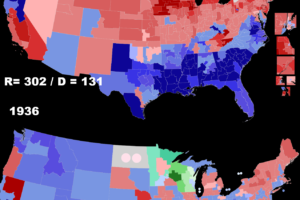
Areas in red require full-service. Areas in Blue require full-service but permit customers to self-serve.
More about them below:
New Jersey: Drivers are not permitted to refuel their own vehicles. This practice was prohibited in 1949 following pressure from service station owners.
As a result, fuel stations now provide either full service or limited “mini service.” Advocates of this restriction argue that it enhances safety and preserves employment opportunities.
Oregon: Oregon fully banned self-service fuelling in 1951, but in 2018, the practice was legalized in counties with 40,000 or fewer residents.
In 2020, in response to COVID, the state temporarily allowed self-service state-wide.
Then, in August 2023, Oregon permitted fuel stations to offer a self-serve option on up to half of their pumps.
Under the new rules, rural counties are not required to have attendants, while urban counties must maintain at least one attendant per station.
The rural counties specified under HB 2426 (2023) are Baker, Clatsop, Crook, Curry, Gilliam, Grant, Harney, Hood River, Jefferson, Klamath, Lake, Malheur, Morrow, Sherman, Tillamook, Umatilla, Union, Wallowa, Wasco, and Wheeler.
Others: In towns of Huntington, Long Island New York and Weymouth, Massachusetts, gas stations that let you pump your own gas are illegal, with all stations being full-service.
A little history
There’s actually a great history of self fuelling from the NACS which you should read here. But here is a brief summary of a few of their main points:
The article traces the evolution of self-service gasoline in the United States, highlighting the key moments, innovations, and individuals who helped shape this transformative change.
1. Early Attempts (1940s–1950s)
- 1947: Frank Urich opened one of the earliest modern self-service stations in Los Angeles, where customers pumped their own fuel, and attendants collected payment and reset mechanical pumps.
- Despite these experiments, most states and local fire codes restricted self-service, and major oil companies competed by offering full service, loyalty incentives, and branded gimmicks.
2. Breakthrough in 1964: John Roscoe’s Remote Self-Service
- June 10, 1964: John Roscoe introduced remote-access self-service pumps at his Big Top store in Westminster, Colorado, using an invention by Herb Timms.
- Sales began modestly, but Roscoe quickly expanded the system. Reduced labor costs and lower fuel prices proved attractive to both retailers and consumers.
3. Wider Acceptance and Regulatory Changes
- Over time, states gradually amended fire codes to allow self-service, dispelling safety concerns.
- Many retailers and major oil companies initially resisted, doubting that customers would want to pump their own gas. However, as vehicles and cost-conscious consumers multiplied, the economic advantages became more compelling.
4. Rise of Convenience Stores with Fuel (1970s–1980s)
- The 1973–74 Oil Crisis drove consumer demand for cheaper gas and led to rapid adoption of self-service and the convenience store model.
- By the mid-1980s, pay-at-the-pump technology emerged, allowing customers to pay directly at the fuel dispenser, further enhancing speed and convenience.
5. Consumer Embrace & Industry Transformation
- Lower prices and faster fueling drew customers to self-service stations, and concerns about losing in-store sales proved unfounded.
- Retailers integrated multiple payment systems and embraced the convenience trend, helping transform gas stations into the dominant fueling model nationwide.
What do you think should people be able to pump their own gas?





Jon says
Your coloring is off. Clatsop and Curry are counties on the Oregon coast and should be gray.