
This map visually represents the world divided into eight regions, each containing approximately one billion people. Here’s a breakdown of what each region covers:
- Pink (Americas):
- Includes all of North America, Central America, the Caribbean, and South America.
- This region represents the entire Western Hemisphere’s population distribution.
- Yellow (Europe and Russia):
- Covers parts Europe and Russia.
- Reflects a combination of relatively low population density areas in Russia and the higher population density regions of Western Europe.
- Brown (Middle East & North Africa):
- Encompasses Turkey, North Africa and the Middle East, and extends into Central Asia.
- Green (Sub-Saharan Africa):
- Africa’s population is rapidly growing and is diverse in terms of cultures and languages.
- Purple (Most of India):
- Encompasses some of India, and Sri Lanka.
- This is one of the most densely populated regions in the world.
- Red (China):
- Includes only part of China.
- China is the second most populous country in the world and hence makes up one of these billion-person regions on its own.
- Turquoise (Southeast Asia and parts of East Asia):
- Includes part of India and China and also includes, Thailand.
- This region includes several high population density areas with diverse cultures.
- Light Blue (East Asia and Oceania ):
- Includes Japan, Koreas, Vietnam, Indonesia, the Philippines Australia, New Zealand, Papua New Guinea, and parts of the Pacific islands.
- The population density is mixed.
Each of these regions has unique geographical, cultural, and demographic characteristics, reflecting the diverse distribution of the world’s population.
What’s the world’s current population?
As of June 2024, the world’s population is estimated to be approximately 8.1 billion people.
This estimate is based on data from the United Nations and other population tracking organizations. The world population continues to grow at a rate of about 0.9% per year (Worldometer) (Nations Geo | Population).
This population is distributed across various continents as follows:
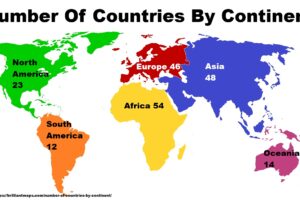
- Asia: Approximately 4.76 billion people
- Africa: Approximately 1.48 billion people
- Europe: Approximately 716 million people
- North America: Approximately 601 million people
- South America: Approximately 441 million people
- Oceania: Approximately 45 million people
These figures reflect the diverse and rapidly changing demographics of our world.
The population growth rates vary significantly by region, with Africa experiencing the highest growth rate and Europe experiencing a slight decline (Nations Geo | Population).
Which map region would have the biggest economy and which would have the smallest economy?
The Pink region has without a doubt the largest economy as it includes the US which is the world’s largest economy. The green region would have the smaller economy.
Based on the latest data, here are the estimated GDPs for each continent:
1. Asia
- Estimated GDP (Nominal): $40.02 trillion
- Estimated GDP (PPP): $90.98 trillion
- Sources: International Monetary Fund (IMF), United Nations (UN) (Statistics Times) (Wikipedia)
2. North America
- Estimated GDP (Nominal): $33.78 trillion
- Estimated GDP (PPP): $36.07 trillion
- Sources: IMF, UN (Statistics Times) (Wikipedia)
3. Europe
- Estimated GDP (Nominal): $26.45 trillion
- Estimated GDP (PPP): $38.28 trillion
- Sources: IMF, UN (Statistics Times) (Wikipedia)
4. South America
- Estimated GDP (Nominal): $4.37 trillion
- Estimated GDP (PPP): $8.68 trillion
- Sources: IMF, UN (Statistics Times) (Wikipedia)
5. Africa
- Estimated GDP (Nominal): $2.82 trillion
- Estimated GDP (PPP): $9.52 trillion
- Sources: IMF, UN (Statistics Times) (Visual Capitalist)
6. Oceania
- Estimated GDP (Nominal): $2.09 trillion
- Estimated GDP (PPP): $2.14 trillion
- Sources: IMF, UN (Statistics Times) (Wikipedia)
Summary
Here’s a summary of the estimated GDP for each continent in both nominal terms and purchasing power parity (PPP):
| Continent | GDP (Nominal, $ Trillion) | GDP (PPP, $ Trillion) |
|---|---|---|
| Asia | 40.02 | 90.98 |
| North America | 33.78 | 36.07 |
| Europe | 26.45 | 38.28 |
| South America | 4.37 | 8.68 |
| Africa | 2.82 | 9.52 |
| Oceania | 2.09 | 2.14 |
What regions of the world are growing the fastest and which regions are growing the slowest?
Based on current data, here are the regions of the world that are experiencing the fastest and slowest population growth:
Fastest Growing Regions:
- Africa:
- Africa has the highest population growth rate among all continents. The population growth rate is around 2.37% per year (Nations Geo | Population).
- The continent’s high fertility rate, which averages about 4.2 children per woman, significantly contributes to this rapid growth (Worldometer).
- Countries like Nigeria, Ethiopia, and Tanzania are among the fastest-growing nations in Africa (Nations Geo | Population).
- Asia (especially South Asia and parts of the Middle East):
- Asia’s overall growth rate is around 0.68%, but certain subregions like South Asia have higher growth rates due to high birth rates and relatively lower death rates (Nations Geo | Population).
- Countries such as India, Pakistan, and Bangladesh are notable for their significant population increases (Nations Geo | Population).
Slowest Growing Regions:
- Europe:
- Europe has a negative population growth rate of about -0.17%, making it the slowest-growing region (Nations Geo | Population).
- Several European countries are experiencing population declines due to low birth rates, aging populations, and higher death rates compared to birth rates (Worldometer) (Nations Geo | Population).
- North America:
- North America’s growth rate is modest at around 0.66%. While it is growing, the rate is significantly slower compared to regions like Africa (Nations Geo | Population).
- The United States, which has a relatively higher growth rate within the continent, benefits from immigration which partially offsets its lower natural increase rate.
Key Factors Influencing Growth Rates:
- High Fertility Rates: Regions with high fertility rates, like Africa, tend to have faster population growth.
- Aging Populations: Regions with aging populations and low birth rates, like Europe, tend to have slower or negative growth rates.
- Migration: Migration can significantly affect population growth. For instance, North America’s growth is positively influenced by immigration.
Will the earth’s population keep growing?
The Earth’s population is projected to continue growing for the foreseeable future, but the rate of growth is expected to slow down over time.
Here are some key projections and factors influencing future population growth:
Current Projections:
- United Nations Projections:
- The UN’s “World Population Prospects 2022” projects that the global population will reach around 9.7 billion by 2050 and could peak at approximately 10.4 billion by the 2080s before stabilizing or slightly declining by 2100 (Worldometer) (Nations Geo | Population).
- Factors Influencing Growth:
- Fertility Rates: Global fertility rates are declining. The average number of children per woman has dropped from about 5 in 1950 to around 2.4 today and is expected to continue declining to around 2.1 by 2050, which is the replacement level.
- Mortality Rates: Improvements in healthcare and living standards have reduced mortality rates, contributing to population growth, particularly in developing countries.
- Aging Population: Many regions, especially in Europe and East Asia, are experiencing aging populations, which will eventually lead to slower population growth and even decline in some areas.
- Regional Differences:
- Africa: Expected to be the main driver of global population growth, with its population projected to double by 2050.
- Asia: Growth will continue, but at a slower pace, with significant differences between regions (e.g., South Asia vs. East Asia).
- Europe: Expected to experience population decline due to low fertility rates and an aging population.
- Americas: Moderate growth is expected, with variations between North America and Latin America.
Long-Term Outlook:
- Peak and Stabilization:
- Some projections suggest that the global population could peak around the mid-21st century and then stabilize or decline slightly by 2100, depending on various factors such as fertility rates, policies, and socio-economic conditions.
- Sustainability and Resources:
- Continued population growth raises concerns about sustainability, resource management, and environmental impact. The ability to support a larger population depends on advancements in technology, agriculture, energy, and policies aimed at sustainable development.



Leave a Reply