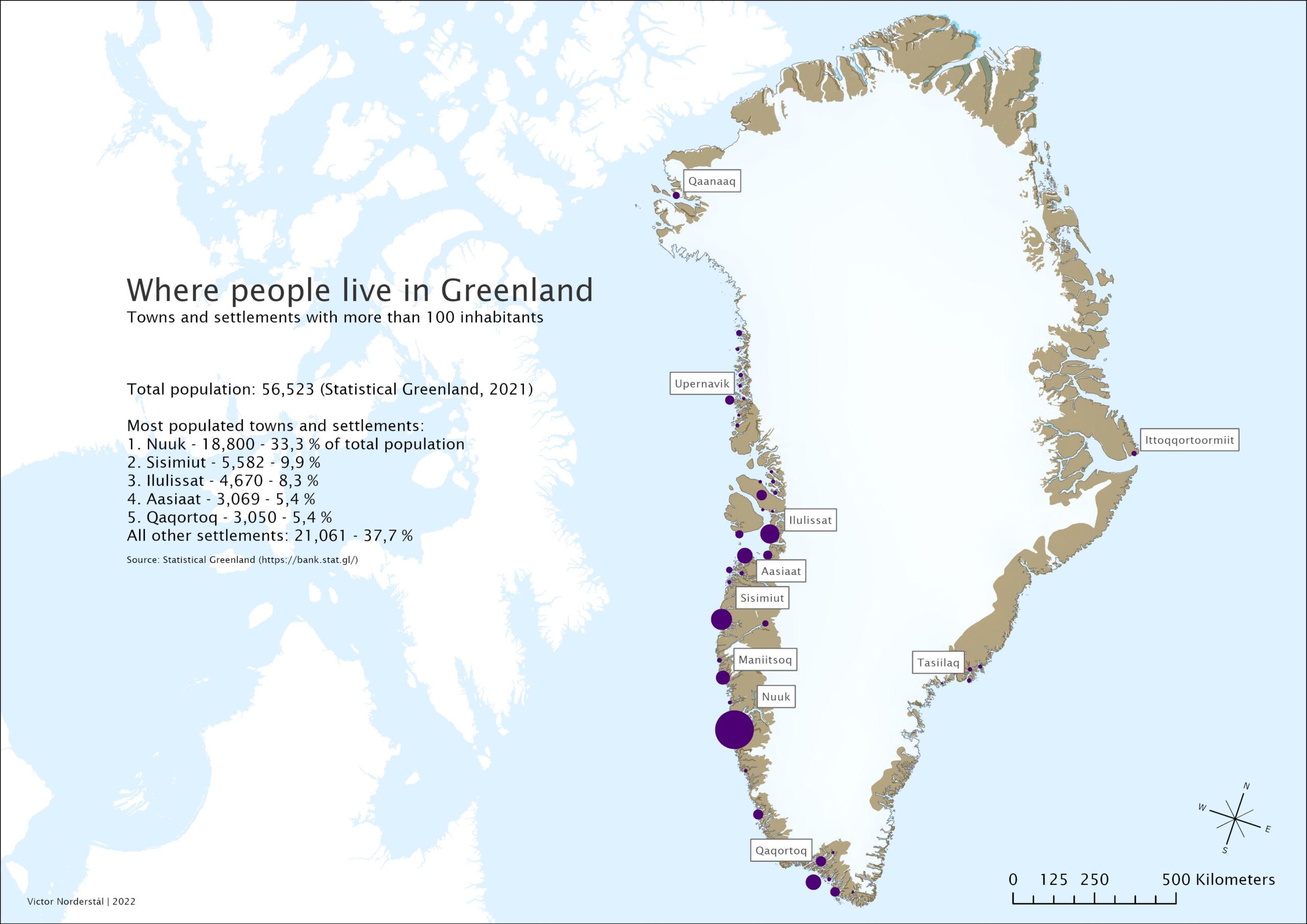
Here’s what you need to know:
Most populated towns and settlements:
- Nuuk (capital) – 18,800 – 33.3% of total population
- Sisimiut – 5,582 – 9.9%
- Ilulissat – 4,670 – 8.3%
- Aasiaat – 3,069 – 5.4%
- Qaqortoq – 3,050 – 5.4%
All other settlements: 21,061 – 37.7%
Source: Statistical Greenland (https://bank.stat.gl)
History of Settlement in Greenland:
Greenland’s history of settlement is closely tied to its geographic isolation, harsh climate, and strategic location in the Arctic. Here’s a brief overview:
- Paleo-Eskimo Cultures (ca. 2500 BCE – 1 CE):
The first known inhabitants were the Saqqaq culture, followed by the Independence I and II cultures. These were small, nomadic groups that relied on hunting marine mammals and caribou. - Thule Migration (ca. 13th Century):
The ancestors of modern Inuit, the Thule people, migrated from Alaska. They brought advanced hunting tools and techniques, which allowed them to thrive in the Arctic environment. The Thule became the dominant culture, displacing earlier groups. - Norse Settlements (10th – 15th Century):
Norse settlers from Iceland, led by Erik the Red, established colonies in southern Greenland around 985 CE. They created two main settlements: the Eastern Settlement near modern-day Qaqortoq and the Western Settlement near Nuuk. The Norse relied on farming, hunting, and trade with Europe. These settlements mysteriously disappeared in the 15th century, possibly due to climate changes during the Little Ice Age and isolation from Europe. - Modern Inuit Communities:
The Inuit have continuously inhabited Greenland since the Thule migration. They adapted to the extreme Arctic conditions, maintaining a subsistence economy based on hunting, fishing, and whaling. - Danish Colonization (18th Century):
In the 1700s, Denmark established control over Greenland, beginning with missionary activities led by Hans Egede. Greenland became a Danish colony in 1721, introducing Christianity and new trading systems. - 20th Century and Modern Era:
Greenland transitioned to being a part of the Kingdom of Denmark in 1953, with significant modernization efforts. In 1979, Greenland gained home rule, and in 2009, it achieved further autonomy, though it remains part of the Danish realm. Most of the population today is concentrated in towns along the west coast, reflecting the historic importance of maritime resources and trade.
Modern Demographics of Greenland (as of recent data):
Greenland’s modern demographics are shaped by its geographic isolation, small population, and strong ties to Inuit culture.
Here’s a breakdown:
Population:
- Total Population: Approximately 56,523 (2021).
- Greenland is one of the least densely populated areas in the world, with a density of just 0.03 people per square kilometer.
Ethnic Composition:
- Inuit (Greenlanders): Around 88% of the population are Inuit or Inuit-Danish mixed. Inuit culture dominates Greenland’s identity.
- Danes (Non-Indigenous): About 12% of the population are of Danish or other European descent, primarily concentrated in Nuuk and other larger towns.
See: Countries With At Least 10 Citizens Living In Greenland
Languages:
- Greenlandic (Kalaallisut): The official language and widely spoken by the Inuit population.
- Danish: Spoken fluently by many, especially in larger towns and by the Danish population.
- English: Gaining popularity as a second or third language, especially among younger generations.
Religion:
- The vast majority of Greenlanders are Lutheran Christians, reflecting the influence of Danish missionaries. The Greenlandic Lutheran Church is a branch of the Church of Denmark.
Urbanization:
- Highly urbanized: Around 85% of Greenland’s population live in towns and settlements along the western coast.
- Major towns include:
- Nuuk (Capital): Largest city with about 33% of the total population.
- Sisimiut: Second largest, with approximately 10% of the population.
- Other significant towns: Ilulissat, Aasiaat, and Qaqortoq.
- Major towns include:
- The east and north coasts are sparsely populated, with only a few small settlements like Ittoqqortoormiit and Qaanaaq.
Economy and Employment:
- Main industries: Fishing (particularly shrimp and halibut), hunting, tourism, and mining.
- Public sector: Provides significant employment, especially in Nuuk and other major towns.
- Unemployment: While unemployment varies by region, smaller settlements often face higher rates due to limited opportunities.
Age Structure:
- Youthful population: Around 20% of the population is under 15 years old.
- Median age: Approximately 34 years.
- Greenland faces challenges with youth migration to Denmark for education and better opportunities.
Education:
- Education is free and mandatory for children aged 6 to 16.
- Many Greenlandic students continue their higher education in Denmark, as Greenland has limited tertiary education facilities.
- Recent focus on integrating Greenlandic culture into the education system.
Health and Social Issues:
- Life expectancy: Around 71 years for men and 76 years for women, lower than Denmark due to harsher living conditions and lifestyle factors.
- Social challenges: Alcoholism, suicide rates, and domestic violence are significant concerns in some communities, reflecting historical disruptions and ongoing socio-economic issues.
Cultural Aspects:
- Greenland maintains a strong Inuit cultural identity, including traditional hunting practices, language, and crafts.
- Efforts are underway to preserve the Greenlandic language and heritage in the face of globalization.
6 Facts About Greenland’s Population
1. Over a Third of the Population Lives in Nuuk:
- The capital city, Nuuk, is home to around 18,800 people, making up 33.3% of Greenland’s total population. This concentration of people in Nuuk is unique for such a vast and sparsely populated landmass.
- Nuuk is Greenland’s political, economic, and cultural hub, featuring the country’s largest university, hospital, and a growing number of modern urban developments.
2. Most People Live Along the West Coast:
- Almost all of Greenland’s settlements are located on the ice-free coastal areas, with the vast majority along the west coast. This is because the interior is covered by the massive Greenland Ice Sheet, making it uninhabitable.
- Towns on the west coast, such as Sisimiut, Ilulissat, and Qaqortoq, thrive due to access to the sea for fishing and transportation.
3. No Roads Between Towns:
- There are no roads or railways connecting towns and settlements in Greenland. Travel between towns is possible only by boat, helicopter, plane, or snowmobiles in winter.
- This is due to the rugged terrain and the dominance of the ice sheet, making large-scale infrastructure projects unfeasible.
4. Greenland’s Tallest Building is a Shopping Center:
- The tallest building in Greenland is the Nuuk Center, a 2 story shopping mall with an 8-story office building on top.
- It is an iconic part of Nuuk’s skyline and represents the shift towards urbanization and vertical housing in a country where housing shortages are common in the larger towns.
5. One of the World’s Lowest Population Densities:
- With a total land area of 2.166 million square kilometers and a population of only around 56,500, Greenland has a population density of 0.03 people per square kilometer, making it one of the least densely populated places on Earth.
- Despite its vast size, Greenland’s population is comparable to that of a small town in many other countries.
6. Blok P – Greenland’s Most Famous (and Infamous) Building:
- Blok P, was located in Nuuk, and was once the largest residential building in Greenland and housed over 1% of the country’s population in a single building.
- Built in the 1960s as part of a modernization effort, it was designed to centralize Inuit populations moving from remote settlements to urban centers.
- The building became notorious for overcrowding and social issues, symbolizing both modernization and the challenges of rapid urbanization.
- Blok P was demolished in 2012, but it remains a key part of Greenland’s urban history and a reminder of the struggles of cultural and economic transition.
Why are most of the settlements in the West of the country?
The map below shows why most people live along the West coast. Quite simply, it’s the only part of Greenland that’s green.

and finally everyone’s favourite question:
Why is Greenland called Greenland when it’s less green than Iceland?
Short answer: marketing, politics, and a bit of Viking humor.
The name “Greenland” is usually credited to Erik the Red, a Norse explorer who settled there around 985 AD.
According to medieval Icelandic sources, he deliberately chose the name to make the land sound appealing:
“People would be more eager to go there if it had a favourable name.”
— The Saga of the Greenlanders
Key reasons behind the name
Medieval marketing
Erik the Red needed settlers. Calling the place Greenland made it sound fertile and inviting, even if much of it was icy. This was essentially 10th-century advertising.
Greenland actually was greener (then)
During the Medieval Warm Period (roughly 900–1300 CE), parts of southern Greenland were:
- Ice-free in summer
- Suitable for grazing sheep and cattle
- Covered in grass and low vegetation
So while not lush, it was greener than it is today, especially along the coasts.
Iceland’s name is misleading in the opposite way
Iceland has:
- Volcanic soil
- Mild ocean currents
- Large areas of green pasture
Ironically, Iceland is greener than Greenland today, while Greenland is mostly ice-covered (~80%).
Norse naming tradition
Viking names often emphasized:
- Aspirational qualities
- Settlement potential
- Symbolic meaning
Would you want to live in Greenland?




Y.D. Robinson says
On the eastern coast, there is another, much bigger settlement besides Ittoqqortoormiit (formerly Scoresbysund), one not mentioned in this article…I’m talking about Tasiilaq (formerly Ammassalik), which is further south.
Patrick malone says
I.U.D.s for the Inuits ? What a shitty culture .
Rockymountains says
I always thought the words “colonize” or “colony” are pejorative because it related to invision or conquest,even massacar.But now I had to admit that these words are neutral which ralated to developement or opening up either.