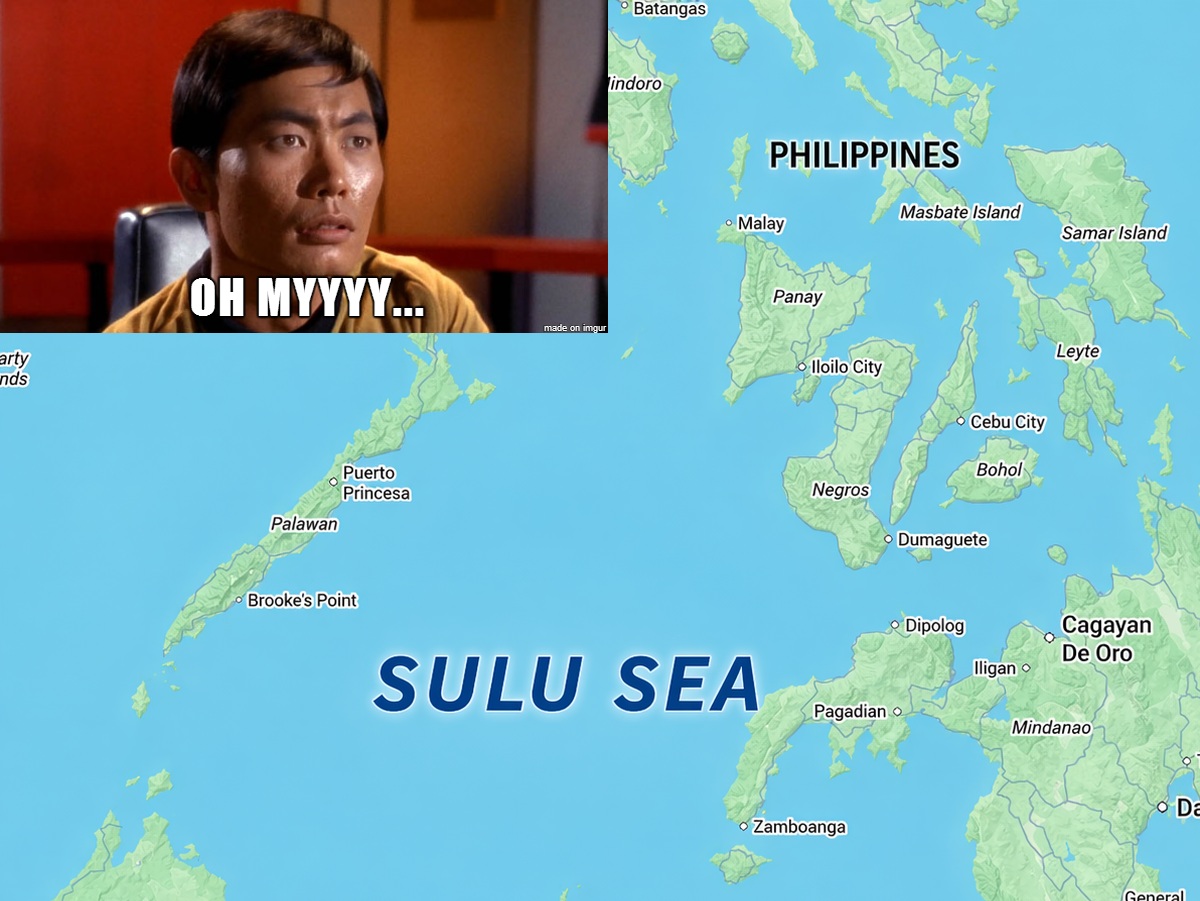
Above is a map the Sulu Sea between the Philippines and Borneo.
More about the Sea and its connection to Star Trek below:
The Sulu Sea is a deep, semi-enclosed sea in Philippines, bordered by Palawan to the northwest, the Visayas to the northeast, and Mindanao to the southeast.
To the southwest, it opens toward Borneo.
Geography
- Deep basin: Parts exceed 5,000 meters (16,400 ft), making it one of the deeper seas in Southeast Asia.
- Natural boundaries: Surrounded by island arcs like the Sulu Archipelago, which act like a partial barrier to ocean currents.
- Coral ecosystems: Home to the Tubbataha Reefs Natural Park, a UNESCO World Heritage Site and one of the most biodiverse reef systems on Earth.
- Limited water exchange: Narrow straits connect it to nearby seas (like the South China Sea), which creates distinct circulation patterns and high marine productivity.
This combination of depth, isolation, and reef systems makes the Sulu Sea a kind of “marine laboratory.”
Economic Importance
The Sulu Sea plays a major role in the regional economy:
Fisheries
- One of the Philippines’ most productive fishing grounds
- Supports tuna, sardines, and reef fish industries
- Provides livelihoods for millions of coastal residents
Shipping & Trade
- Serves as a regional maritime corridor between the Pacific and the South China Sea
- Important for domestic shipping between Philippine islands
Natural Resources
- Potential reserves of oil and natural gas (though not fully developed)
- Rich marine biodiversity also supports eco-tourism
Tourism
- Diving hotspots (especially Tubbataha) attract global visitors
- Coral reefs, clear waters, and marine life are major draws
However, the region also faces challenges:
- Overfishing
- Coral reef degradation
- Maritime security issues in parts of the Sulu Archipelago
🖖 Connection to Star Trek
At first glance, the Sulu Sea and Star Trek seem unrelated, but there’s a fun cultural link:
Hikaru Sulu
The character Hikaru Sulu from Star Trek was named “Sulu” deliberately.
- Creator Gene Roddenberry chose the name to reflect a pan-Asian identity, rather than tying the character to one specific nationality.
- The Sulu Sea was selected because it is a neutral, geographically broad reference in Asia.
- This aligned with Star Trek’s vision of a unified, multicultural future.
So while the sea itself doesn’t appear in the show, its name lives on in one of Starfleet’s most iconic officers.
Have you ever been?







Criss Criss says
The character Hikaru Sulu from Star Trek was named “Sulu” deliberately… HAHA