
The map above shows how many operation suspension railway systems each country has. Germany is the clear lead with 4 (the most famous of which is the Wuppertaler Schwebebahn, but Japan and China also have operating systems.
Here is the list:
| Name | Location | Country | Started operations | Status | Track length |
|---|---|---|---|---|---|
| Schwebebahn | Wuppertal | Germany | 1901 | Operating | 13.3 km (8.3 mi) |
| Schwebebahn | Dresden | Germany | 1901 | Operating | 0.274 km (0.170 mi) |
| H-Bahn | TU Dortmund | Germany | 1984 | Operating | 3.16 km (1.96 mi) |
| Sky train | Düsseldorf Airport | Germany | 2002 | Operating | 2.5 km (1.6 mi) |
| Shonan Monorail | Kanagawa Prefecture | Japan | 1970 | Operating | 6.6 km (4.1 mi) |
| Chiba Urban Monorail | Chiba | Japan | 1988 | Operating | 15.2 km (9.4 mi) |
| Optics Valley Suspended Monorail | Wuhan | China | 2023 | Operating | 10.5 km (6.5 mi) |
Suspension railway systems, also known as hanging railways or suspended monorails, are transportation systems where vehicles are suspended from tracks elevated above the ground, typically supported by overhead beams or structures.
Unlike conventional monorails or railways where vehicles rest atop the track, suspension systems have cars hanging beneath it.
Advantages of Suspension Railway Systems
- Reduced Ground Footprint:
- Tracks are elevated, freeing ground space for roads, buildings, and pedestrian areas.
- Minimal disruption at street level.
- Ability to Navigate Complex Terrain:
- Ideal for hilly or densely built urban environments.
- Easily crosses rivers, valleys, and obstacles without extensive tunneling or bridges.
- Safety and Collision Avoidance:
- Reduced risk of collisions with pedestrians or road vehicles due to elevated tracks.
- Less likely to be affected by road traffic accidents.
- Aesthetics and Tourism Potential:
- Can become iconic landmarks attracting tourism (e.g., Wuppertal).
- Offers unique views and experiences compared to ground-level transit.
- Quiet and Smooth Operation:
- Typically quieter due to minimal friction and vibration, especially compared to ground-level steel rails.
- Provides passengers with smooth rides.
Disadvantages of Suspension Railway Systems
- High Construction Costs:
- Infrastructure often expensive and complex to construct.
- Requires substantial initial investment in support structures and stations.
- Limited Capacity and Scalability:
- Vehicles often smaller, limiting passenger volumes compared to conventional metro or heavy-rail systems.
- Difficulties in scaling up operations, as adding extra tracks is costly and structurally complex.
- Infrastructure Complexity:
- Needs specialized support infrastructure, maintenance facilities, and emergency evacuation systems.
- Structural complexities pose engineering challenges, especially over existing infrastructure.
- Visual Intrusiveness and Environmental Impact:
- Elevated guideways might obstruct views or sunlight, causing visual clutter in urban landscapes.
- Can be controversial aesthetically, leading to resistance from communities.
- Limited Network Integration:
- Challenging to integrate with existing transportation networks.
- Potentially less flexible than conventional tram or metro systems in adapting to changing urban development patterns.
Comparison between various options:
| Aspect | Suspension Railways | Conventional Monorails | Ground-level Rail (Tram/Metro) |
|---|---|---|---|
| Footprint | Minimal (overhead structures) | Moderate (columns, stations) | Large (track, stations, street-level) |
| Construction Cost | High | Medium to High | Medium (tram), High (metro/subway) |
| Capacity | Low to Medium | Medium | High (metro), Medium (tram) |
| Scalability | Limited | Moderate | High |
| Terrain Flexibility | Excellent (over rivers, uneven areas) | Good | Limited |
| Safety | High (minimal collisions) | High (also elevated) | Medium (tram accidents, street traffic) |
| Visual Impact | High (overhead visual intrusion) | Moderate | Low (metro/subway), Medium to High (tram) |
| Maintenance | Complex (specialized infrastructure) | Moderate | Established, simpler (well-understood) |
Which US States Have Ever Had A Suspension Railway
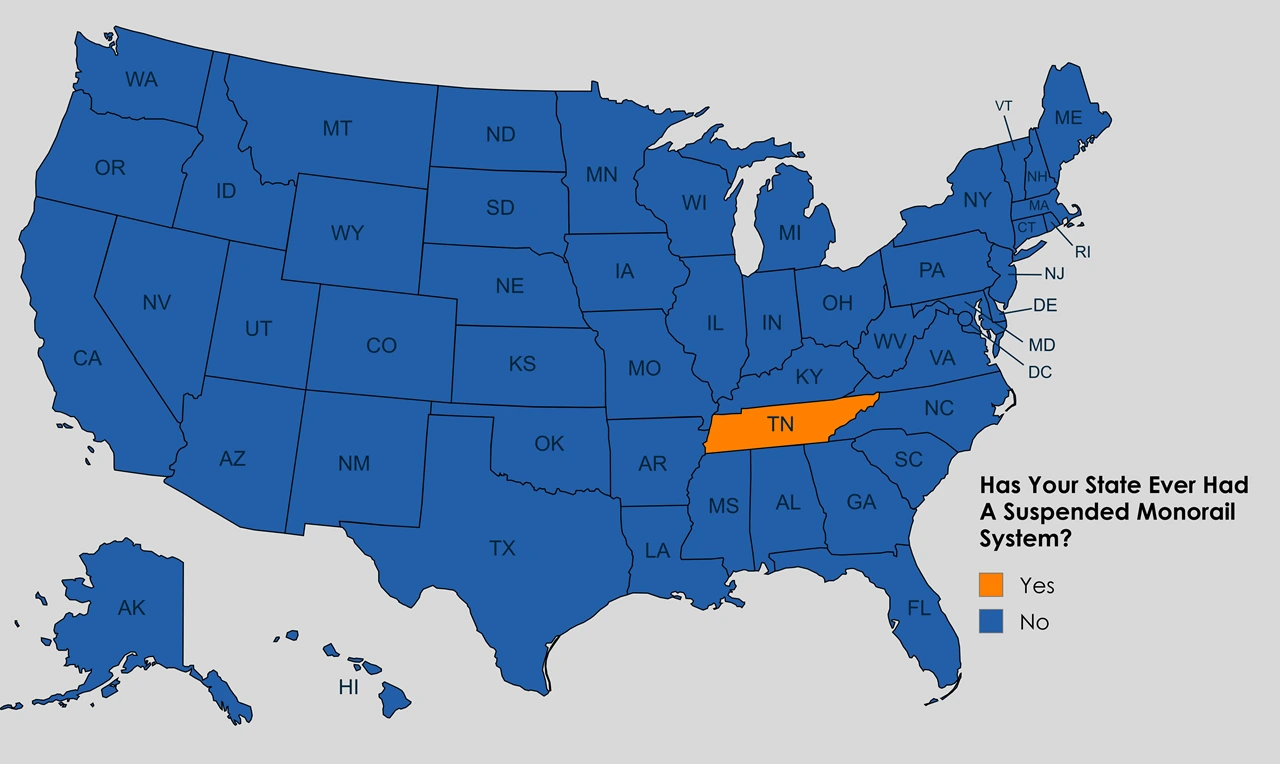
Memphis, Tennessee is the lone US state to have ever had a suspended monorail system, called the Memphis Suspension Railway. Unfortunately it closed in 2018 after passengers were stranded mid-ride, and hasn’t reopened since.
Part of the problem as reported by Action News 5 was that:
Paul Jordan, the engineer who built it, was the lone man who could fix it. Over the decades, he’d fly to Memphis, often in his own plane, land in the Wolf River Harbor, pull right up to the boat ramp at the park and stay a few days to make repairs.
The line opened in 1982 and only had 2 stations that the city center of Memphis with the entertainment park on Mud Island. The two stations were only about 1,700 ft (518 m) apart.
The trains would travel at gentle 7 mph (11 km/h).
What do you think of suspension railways?



Leave a Reply