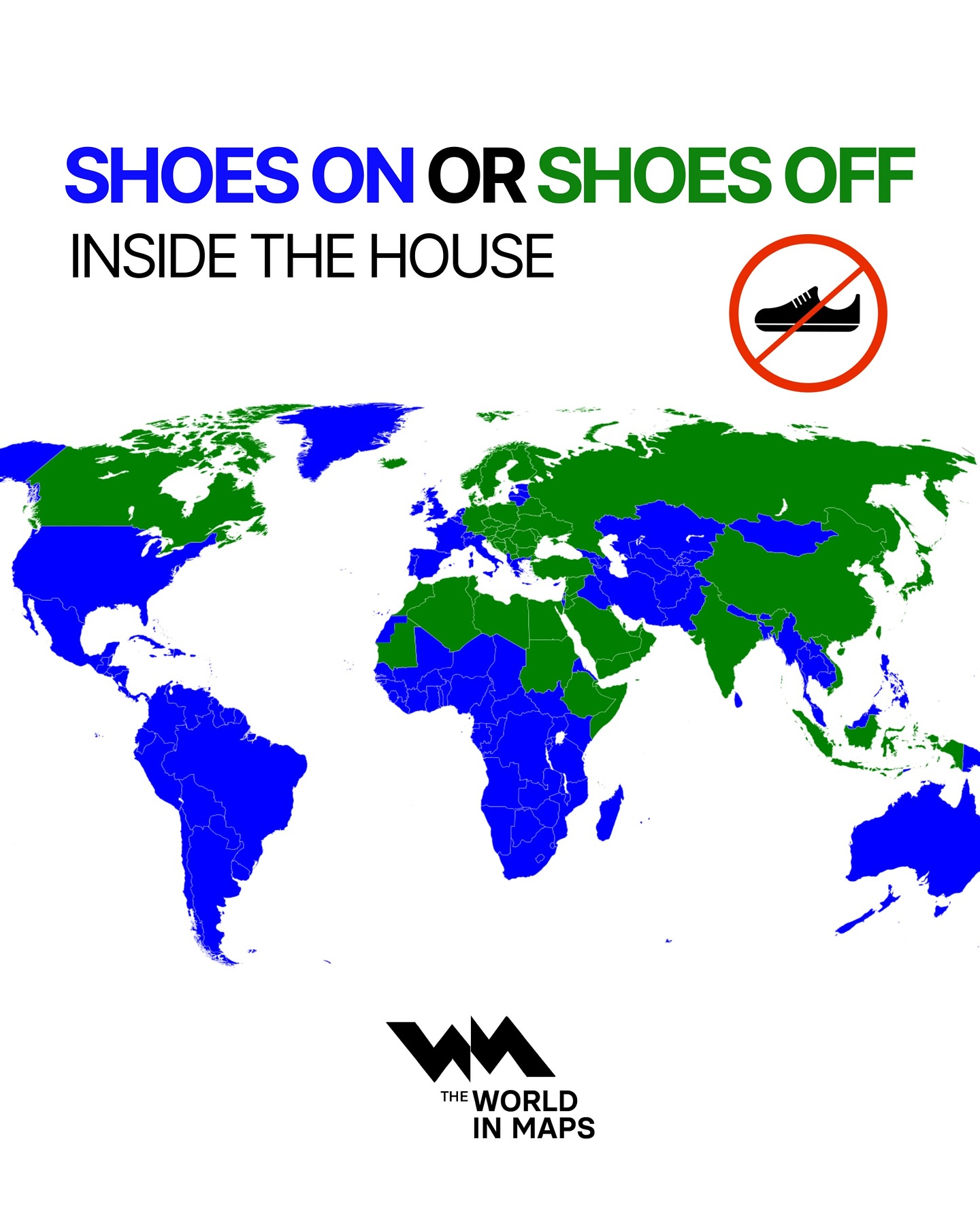
However, the reality is considerably more complicated.
While removing outdoor shoes is an almost universal expectation in countries such as Japan, in many other countries it comes down to personal preference, family traditions, regional customs and even the weather.
The map also fails to distinguish between people who remove their own shoes at home and those who expect their guests to do the same.
Arguments for taking your shoes off indoors
- Cleanliness: Shoes bring mud, dust, dirt, animal waste and other unpleasant substances into the house.
- Hygiene: Outdoor footwear can carry bacteria and other microorganisms. Removing shoes reduces the amount brought indoors, although finding bacteria on shoes does not necessarily mean they pose a significant risk of illness.
- Chemical contaminants: Shoes can track pesticides, lead and other pollutants into the home. This is particularly relevant for households with young children who spend time crawling on the floor.
- Protecting floors: Shoes can scratch wooden floors, damage carpets and generally increase wear and tear.
- Comfort: Many people simply find walking around barefoot, in socks or in slippers more comfortable.
- Cultural and religious traditions: In many cultures, removing shoes is considered a sign of respect and marks the separation between the outside world and the private space of the home.
- Less cleaning: Keeping outdoor dirt at the entrance means less vacuuming, sweeping and mopping.
Arguments for keeping your shoes on indoors
- Convenience: Taking shoes off and putting them back on every time you enter or leave the house can be inconvenient.
- Hospitality: In some cultures, asking guests to remove their shoes is considered overly demanding or even rude, particularly during formal gatherings.
- Foot support: People with certain foot problems may need supportive footwear or orthopaedic insoles throughout the day.
- Safety: Shoes can protect against broken glass, dropped objects and other household hazards. Suitable footwear is especially important for people with diabetes who are at risk of foot injuries.
- Warmth: Shoes can provide insulation in homes with cold stone, tiled or wooden floors.
- Embarrassment: Some guests may feel uncomfortable exposing their feet, smelly socks or holes in their socks.
- Limited health benefits: Although shoes can carry potentially harmful microorganisms, there is less evidence that wearing outdoor shoes in an ordinary household significantly increases the risk of infectious illness.
Of course, there is an obvious compromise: remove outdoor shoes and replace them with slippers or dedicated indoor shoes. This is already common practice in many parts of the world.
Why do shoe-wearing customs vary around the world?
Several factors help explain the geographical differences.
Climate: In countries with snowy or wet winters, such as Canada, Sweden and Finland, removing shoes prevents snow, mud and road salt from being brought inside. However, the custom is also widespread in tropical countries, so climate alone cannot explain it.
Traditional architecture: In Japan, homes traditionally have an entrance area called a genkan, where outdoor shoes are removed before stepping onto the raised interior floor. Traditional tatami mats would quickly become damaged and dirty if people wore outdoor shoes on them.
Religion: Removing shoes before entering mosques, Hindu temples and many Buddhist temples reinforces the association between removing footwear and cleanliness or respect. These traditions can also influence behaviour in the home.
Flooring and furniture: Cultures where people traditionally sit, eat or sleep on the floor have particularly strong reasons to keep outdoor footwear away from living areas.
Social etiquette: In some countries, removing your shoes demonstrates respect for your host. In others, allowing guests to keep their shoes on is seen as a sign of hospitality.
Regional variations within countries
United States
The United States is probably one of the best examples of why this map is misleading.
A 2023 CBS News/YouGov poll found that nearly two-thirds of Americans prefer to remove their shoes at home. However, most do not require visitors to do the same.
A 2018 YouGov survey also found noticeable regional differences.
Percentage of Americans who remove their shoes at home at least occasionally
- Midwest: 92%
- Northeast: 88%
- West: 86%
- South: 83%
Source: YouGov, January 2018. Includes people who rarely remove their shoes.
Southerners were also the least likely to ask visitors to remove their shoes, with 58% saying they never did so.
The colder and snowier winters of the Midwest and Northeast are one possible explanation for these differences.
United Kingdom
Despite being coloured blue on the map, Britain is largely a shoes-off country when it comes to people’s own homes.
A 2022 YouGov survey found:
| Behaviour | Percentage |
| Immediately remove shoes and expect guests to do likewise | 33% |
| Immediately remove shoes but don’t expect guests to | 36% |
| Don’t immediately remove shoes | 27% |
| Don’t know | 4% |
In other words, 69% of Britons immediately remove their shoes when entering their own home.
Germany
Germany has a strong tradition of wearing Hausschuhe (house shoes or slippers). However, there is still a distinction between residents and guests.
A 2022 YouGov survey found that 82% of Germans immediately remove their outdoor shoes at home, but only 34% also expect visitors to do so.
Other variations within countries
Geographical differences are only part of the story. Other factors that can influence shoe-wearing habits include:
- Urban vs rural areas: City residents may be more concerned about street dirt and pollution, while rural residents may be more concerned about mud or agricultural dirt.
- Ethnic and cultural background: Immigrant communities often retain the footwear customs of their countries of origin.
- Age: Younger Americans are more likely than older Americans to ask guests to remove their shoes.
- Season: Some households allow shoes indoors during summer but insist on removing them during winter.
- Rooms: Some families allow shoes in kitchens, hallways and living rooms but not in bedrooms or carpeted areas.
- Occasion: Close friends and family might be expected to remove their shoes, while guests attending a formal dinner party might not.
Which countries are incorrectly coloured on the map?
Several countries stand out as particularly questionable:
| Country | Problem with the map |
| United States | Most Americans prefer to remove their shoes at home. |
| United Kingdom | 69% immediately remove their shoes at home. |
| Thailand | Removing shoes when entering a home is traditional, as confirmed by the Thai government’s etiquette guidance. |
| Iran | Outdoor shoes are traditionally removed before entering domestic living spaces. |
| Kazakhstan | Removing shoes and changing into slippers is a widespread domestic custom. |
Conclusion
Ultimately, the biggest problem with the map is that it presents a complex cultural practice as a simple binary choice.
A more accurate map would distinguish between countries where removing shoes is expected, countries where keeping shoes on is normal, and countries where it varies from household to household.
Ideally, it would also distinguish between what residents do themselves and what they expect of guests.
There is a reasonable argument for removing outdoor footwear on cleanliness grounds, but whether people should be expected to do so is as much a question of culture and etiquette as it is of hygiene.
Sources
- YouGov – Most Americans take their shoes off at home, but don’t expect their guests to
- CBS News – Most Americans are shoes off at home
- YouGov – British shoe-wearing habits
- YouGov – German shoe-wearing habits
- University of Georgia – Reduce Indoor Contaminants: Leave Your Shoes at the Door
- Japan National Tourism Organization – Japanese Manners
- US Environmental Protection Agency – Reduce the Risk of Lead Exposure at Home



Leave a Reply