
Most of the countries refer to the 1968 Vienna Convention on Road Signs and Signals, except from Moldova🇲🇩, Spain🇪🇸 and Ireland🇮🇪.
This is why all of the signs look so similar, although if you check carefully they are almost all different!
Sweden 🇸🇪 is the only country in the whole continent that adopted both male and female characters in their signs, while countries like Austria 🇦🇹, Norway 🇳🇴 and Switzerland🇨🇭/ Liechtenstein 🇱🇮 are the only ones that adopted signs where the character is using a hat!
Iceland 🇮🇸, Moldova 🇲🇩 and Ireland 🇮🇪 are the only ones that use yellow plates, while Monaco 🇲🇨 is the single one using alert lights🚨 on their signs!
What was the 1968 Vienna Convention on Road Signs and Signals?
The 1968 Vienna Convention on Road Signs and Signals is an international treaty designed to standardize road signs, signals, and markings to improve road safety and facilitate international road traffic.
It was developed under the auspices of the United Nations Economic Commission for Europe (UNECE) and came into force in 1978.
The convention provides guidelines and norms for road signs and signals, ensuring consistency across participating countries.
Key Aspects of the Vienna Convention
- Uniformity: Establishes common designs, colors, shapes, and symbols for road signs.
- Categories of Signs: Defines regulatory signs (prohibitory and mandatory), warning signs, and informational signs.
- Road Markings: Sets standards for lane markings and crosswalks.
- Traffic Signals: Harmonizes traffic light systems and pedestrian signals.
- Symbols and Languages: Promotes the use of pictograms instead of text for universal understanding.
Relation to Pedestrian Crossing Signs
The Vienna Convention includes specific provisions for pedestrian crossings under its framework for road signs and signals:
1. Pedestrian Crossing Markings:
- The convention specifies how pedestrian crossings should be marked on the road. These crossings are often identified by zebra stripes or similar visual markers, making them universally recognizable.
- The markings must be prominent and use contrasting colors (e.g., white stripes on a dark background).
2. Warning Signs for Pedestrian Crossings:
- Countries are encouraged to use triangular warning signs with symbols (such as a figure of a walking person) to alert drivers of upcoming pedestrian crossings.
- These signs are designed to be intuitive and recognizable across different languages and cultures.
3. Pedestrian Crossing Signals:
- The convention provides guidelines for traffic signals at pedestrian crossings, such as red/green pedestrian lights, which indicate when it is safe for pedestrians to cross.
4. International Standardization:
- The goal is to ensure that a pedestrian crossing sign or signal in one country is immediately understood by drivers and pedestrians from other countries. This standardization aids international travel and reduces confusion.
Impact on Pedestrian Crossing Signs
- The convention directly influences the design of pedestrian crossing signs in signatory countries. These signs are typically standardized to include a figure of a walking person or other symbolic depictions to represent pedestrian crossings.
- Non-signatory countries often adopt similar standards to align with international norms, even if they are not formally bound by the convention.
UK Pedestrian Crossings
UK pedestrian crossings generally align with the principles of the 1968 Vienna Convention on Road Signs and Signals, though the UK has not ratified the convention.
Instead, the UK uses its own regulations and standards under the Highway Code and other domestic laws.
While the UK’s road signage system shares similarities with the Vienna Convention, there are key differences in design, terminology, and implementation.
UK Compliance and Differences
1. Zebra Crossings:
- Vienna Convention: Calls for visible pedestrian crossing markings, typically white stripes on a contrasting background.
- UK: Zebra crossings in the UK closely match this description, featuring alternating black and white stripes, making them compliant in practice. However, UK crossings also have unique Belisha beacons—flashing orange lights on black-and-white striped poles—which are not required by the Vienna Convention.
- Difference: The addition of Belisha beacons is unique to the UK and not mentioned in the Vienna Convention.
2. Traffic Light-Controlled Crossings:
- Vienna Convention: Specifies the use of red/green pedestrian lights to indicate when it is safe to cross.
- UK: Pedestrian crossings with traffic lights (e.g., Pelican, Puffin, and Toucan crossings) comply with this principle. These crossings feature red and green man signals but may differ slightly in design and operation.
- The Puffin crossing, for example, uses motion sensors to detect pedestrians, which is not a feature detailed in the Vienna Convention.
- Difference: The UK has introduced specific crossing types like Pelican (pedestrian light-controlled) and Puffin, which are tailored to local needs and not explicitly standardized in the Vienna Convention.
3. Pedestrian Warning Signs:
- Vienna Convention: Uses triangular warning signs with a walking pedestrian symbol to alert drivers to pedestrian crossings ahead.
- UK: Similar triangular warning signs are used, but the design of the pedestrian figure may differ slightly. UK signs conform to their own Traffic Signs Regulations and General Directions (TSRGD) standards.
- Difference: The design style of pedestrian symbols may vary slightly from the convention’s guidelines, but the meaning remains clear.
4. Language and Symbols:
- Vienna Convention: Encourages the use of symbols over text to ensure international understanding.
- UK: Complies with this principle, as UK road signs, including pedestrian crossing signs, rely on symbols rather than text.
5. Crossing Markings:
- Vienna Convention: Requires clear and consistent road markings for crossings.
- UK: Implements clear markings, such as zebra stripes, ensuring high visibility. These markings are in line with the convention’s intent, even if not directly adhering to its prescribed style.
Summary of Differences
While UK pedestrian crossings are broadly aligned with the Vienna Convention, the key differences lie in:
- The use of Belisha beacons for zebra crossings.
- Unique crossing types like Pelican and Puffin, which are tailored to UK-specific needs.
- Slight variations in the design of pedestrian symbols.
And finally here’s another map just isolating the pedestrian image from the sign itself:

and finally stop signs:
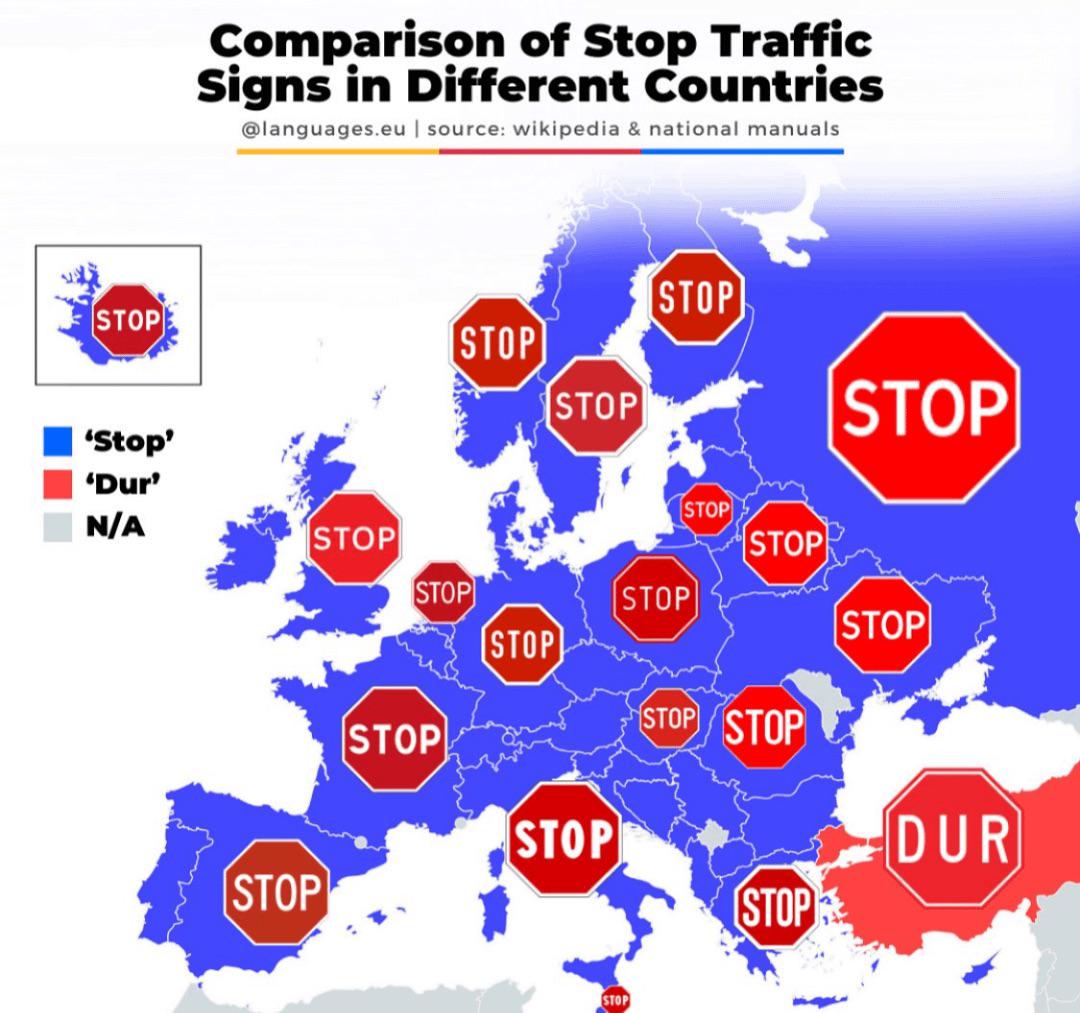
The UK rarely uses stop signs because British road design prefers Give Way junctions and roundabouts, keeping traffic moving unless a full stop is genuinely needed. Official guidance treats new STOP signs as exceptional, mainly for junctions with very poor visibility.
Turkey uses “DUR” because it means “stop” in Turkish. The red octagonal sign is internationally recognisable by shape/colour, and the Vienna road-sign system allows countries to use national-language wording on signs, even though most of Europe standardised on “STOP.”
Which is your favourite one?



Mike M says
The UK’s Belisha beacons may be unique in Europe, but not in the world: eg NZ also uses them, sometimes simplified to a reflective orange disc.
The UK/Irish figures heading to the right while all the others head to the left is presumably because the figures are intended to show someone starting to cross from the driver’s side of the road.