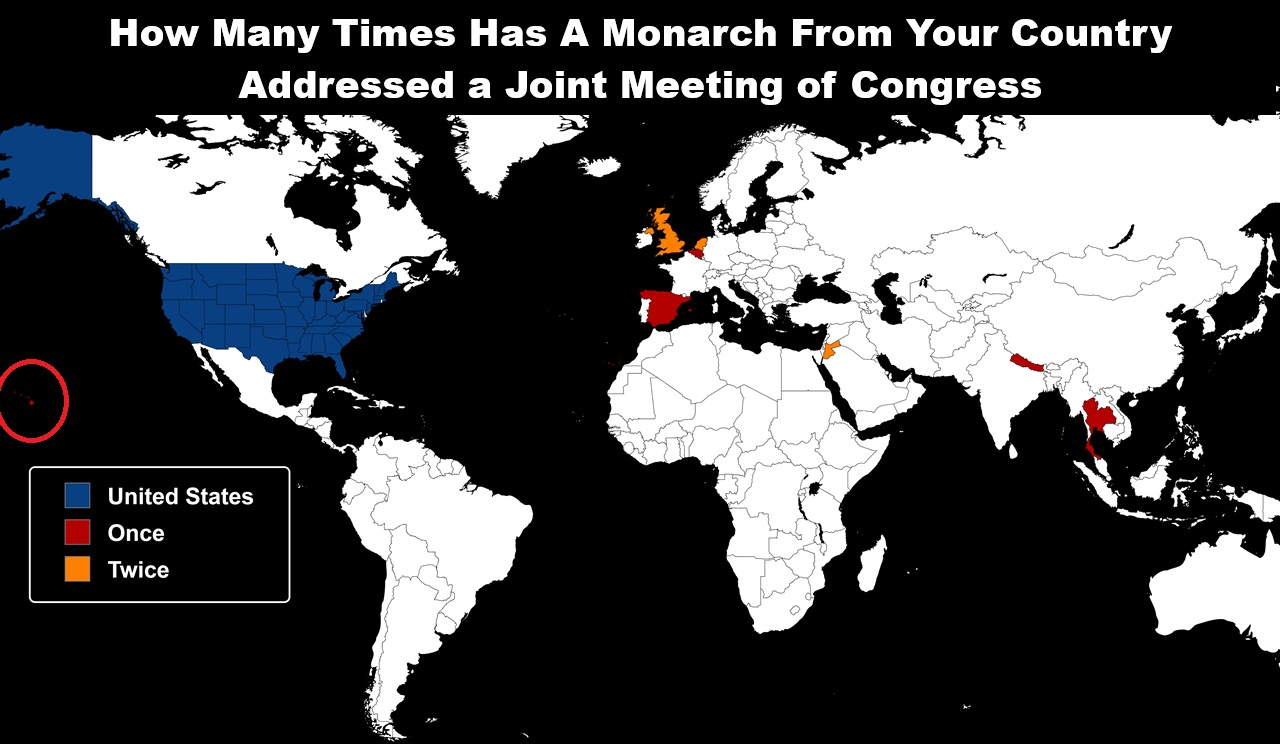
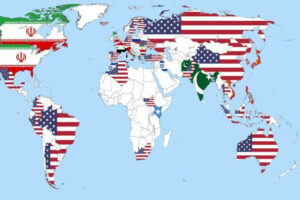
The map above shows how many Monarchs (Kings & Queens) have addressed a joint meeting of the US Congress throughout history, and I’m surprised how low the numbers are. According to Congress.gov: King Charles is the 11th king or queen to address a joint meeting of Congress.
The others in order are:
| Date | Monarch | Country |
|---|---|---|
| December 18, 1874 | King Kalakauaa* | Kingdom of Hawaii |
| April 3, 1952 | Queen Juliana | Kingdom of the Netherlands |
| May 12, 1959 | King Baudouin | Kingdom of Belgium |
| April 28, 1960 | King Mahendra | Kingdom of Nepal |
| June 29, 1960 | King Bhumibol Adulyadej | Kingdom of Thailand |
| June 2, 1976 | King Juan Carlos I | Kingdom of Spain |
| April 21, 1982 | Queen Beatrix | Kingdom of the Netherlands |
| May 16, 1991 | Queen Elizabeth II | United Kingdom of Great Britain and Northern Ireland |
| July 26, 1994 | King Hussein I** | Hashemite Kingdom of Jordan |
| March 7, 2007 | King Abdullah II Bin Al Hussein | Hashemite Kingdom of Jordan |
| April 28, 2026 | King Charles III | United Kingdom of Great Britain and Northern Ireland |
Note from Congress.gov:
* King Kalakaua was unable to deliver his speech “because of a severe cold and hoarseness.” The speech was “read by former Representative Elisha Hunt Allen, then serving as Chancellor and Chief Justice of the Hawaiian Islands” on King Kalakaua’s behalf. See U.S. Congress, “Joint Sessions and Meetings, Address to the Senate or the House, and Inaugurations,”
** The address by King Hussein I was a joint address with Israeli Prime Minister Yitzhak Rabin. See “Joint Meeting of the House and Senate to Hear Addresses by His Majesty King Hussein I of the Hashemite Kingdom of Jordan and His Excellency Yitzhak Rabin, Prime Minister of Israel,” Congressional Record, vol. 140, part 12 (July 26, 1994), pp. 17891-17895.
In total, 3 Queens and 8 Kings have addressed Congress. With The UK, Netherlands and Jordan the only countries to have done so twice. No Monarch has done so more than once.
Why have so few Monarchs ever addressed a joint session of Congress?
Congress reserves joint sessions for exceptional occasions
A joint meeting or joint session is a very high honour, typically used for:
- U.S. presidents (like the State of the Union)
- Major wartime or historic allies
- Foreign leaders whose visits symbolize unusually important moments
It’s intentionally uncommon.
The U.S. is historically wary of monarchy
Because the United States was founded in revolt against a king (American Revolution), American political culture has often had a republican discomfort with hereditary rule.
That doesn’t prevent close relations with monarchies, but it has made congressional honors for monarchs less instinctive than for elected heads of government.
Most monarchs are ceremonial, not political decision-makers
In constitutional monarchies like the United Kingdom, Sweden, or Japan, monarchs usually do not set policy. Congress often prefers hearing from prime ministers or presidents who actually direct foreign policy.
For example:
- Winston Churchill addressed Congress multiple times.
- Benjamin Netanyahu has done so multiple times.
- Prime ministers from allies are much more common than kings or queens.
Monarchs often avoid political forums
Many constitutional monarchs avoid anything that could seem partisan or political. Speaking before a legislature, especially one known for sharp partisan divisions, can raise constitutional sensitivities at home.
For example, the late Queen Elizabeth II made major U.S. speeches, but only once addressed a joint session of Congress, despite her meeting 13 sitting US presidents.
Protocol favours state visits over congressional speeches
Monarchs are usually honoured through:
- State dinners at the White House
- Ceremonial welcomes
- Addresses at banquets or national institutions
- Meetings with the president rather than Congress
That often fits royal diplomacy better.
And a final fact for you.
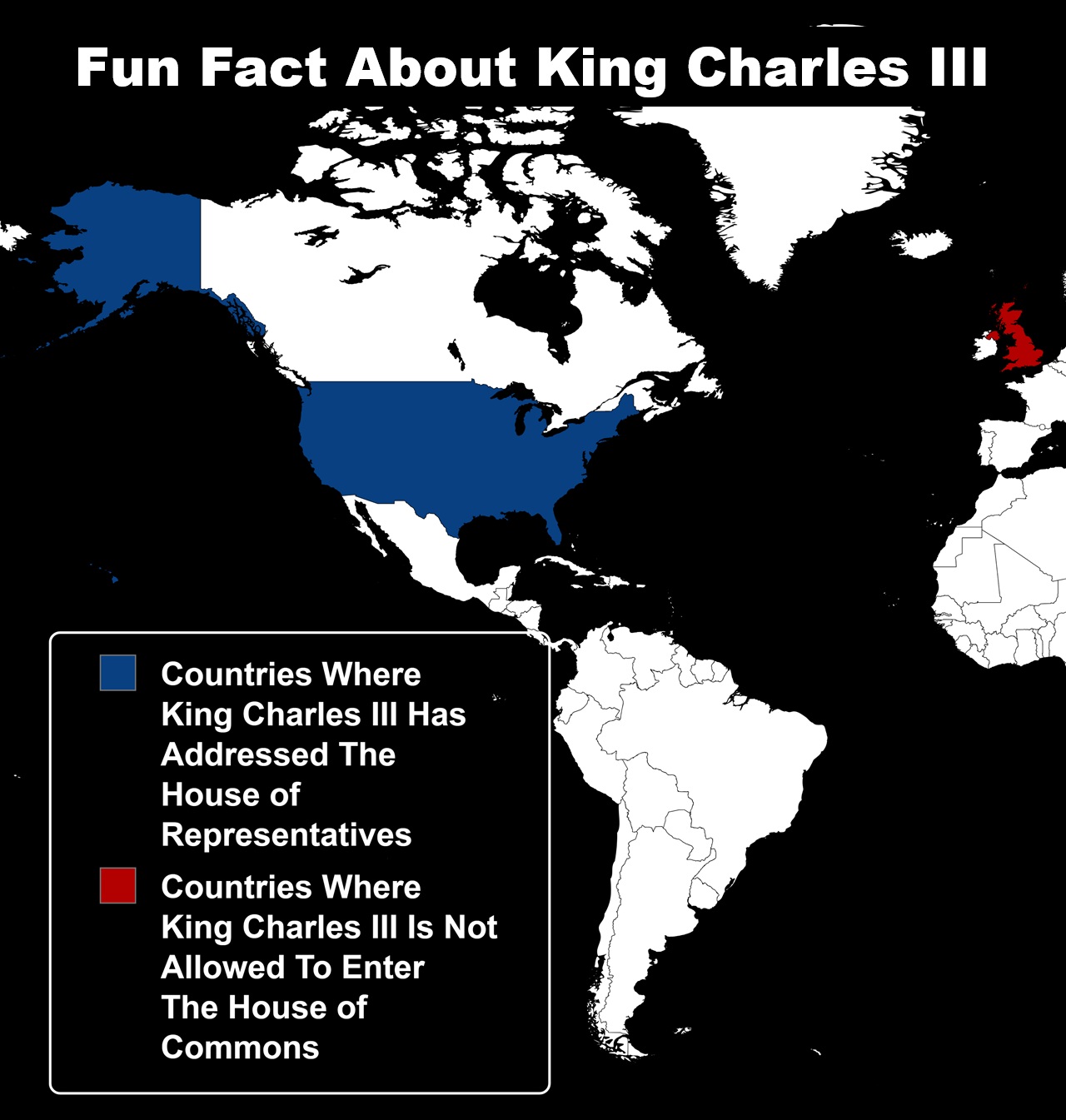
In the UK, The monarch is not allowed into the Commons chamber.
The sovereign (currently King Charles III) does NOT enter the House of Commons chamber.
This is one of the most famous traditions in the Parliament of the United Kingdom.
Why not?
It goes back to a constitutional crisis:
Charles I tried to arrest MPs in 1642
King Charles I entered the Commons with armed guards to arrest five members of Parliament for treason.
When he asked Speaker William Lenthall where they were, Lenthall famously replied he had:
“Neither eyes to see nor tongue to speak in this place but as the House is pleased to direct me…”
This became a foundational symbol that the Commons is independent from the Crown. The conflict helped lead into the English Civil War.
What happens today?
During the State Opening of Parliament:
- The monarch sits in the House of Lords.
- An official called Black Rod is sent to summon the Commons.
- The Commons famously slams the door in Black Rod’s face before admitting them, a ritual symbolizing independence from royal authority.
- MPs then go to the Lords to hear the King’s Speech.
Can the monarch ever enter the Commons chamber?
By convention, no reigning monarch enters the chamber. It is considered off-limits.
Can the monarch enter the Commons building at all?
The monarch can be in the Palace of Westminster for ceremonies, but not in the Commons chamber itself.
So in short: the monarch does not enter the House of Commons because Parliament’s independence from the Crown is a core constitutional principle, rooted in the events of 1642.





Pamela says
King Charles III is the king of g of my country too. Canada. And several others.