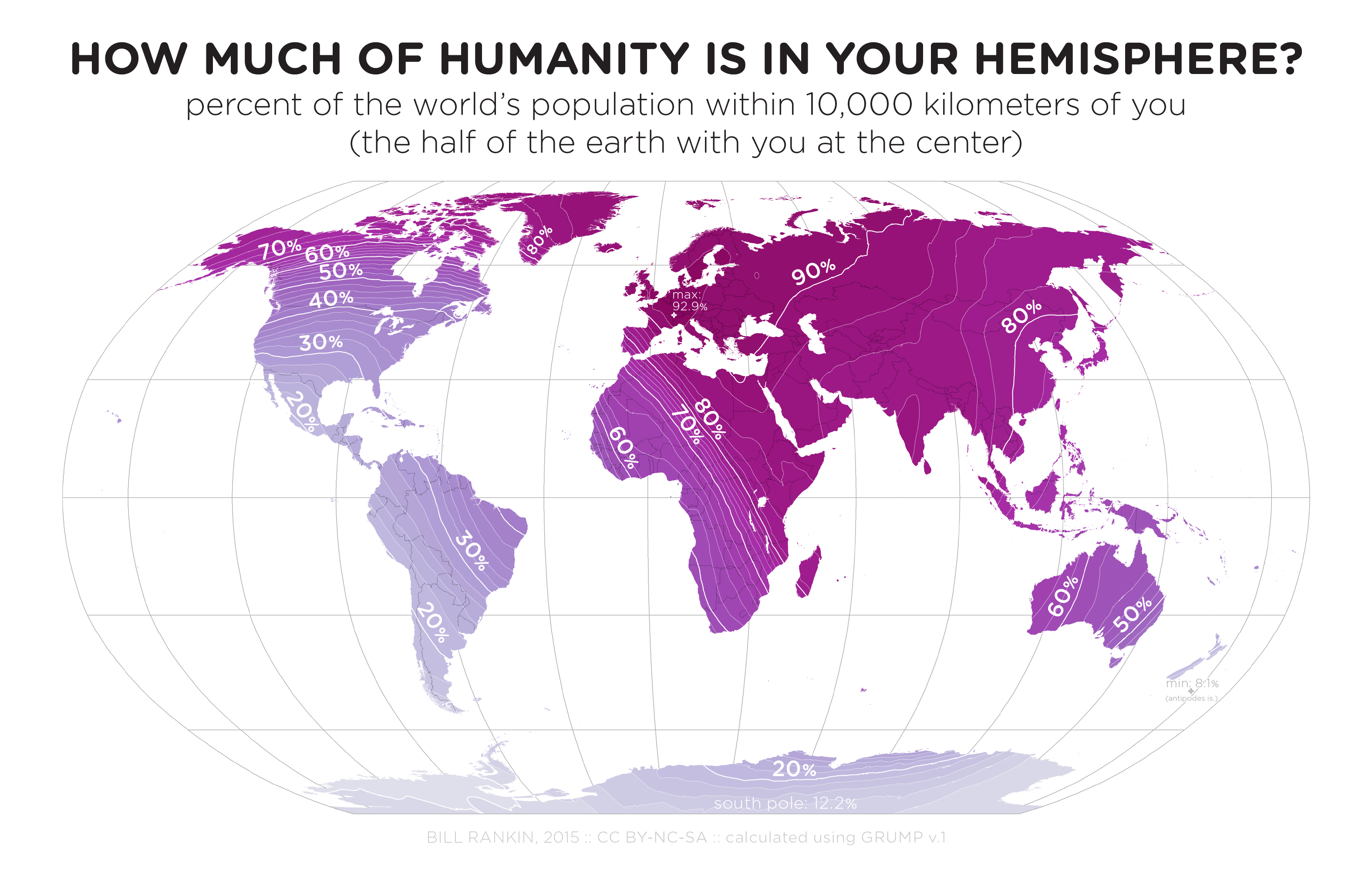
There are a few interesting things to note about the map.
- The point on the earth with the highest number of people living within 10,000km, is located in western Switzerland with up to 92.9% of all humans living on the same side of the world.
- Conversely, some of the islands off the coast of New Zealand have only 7.1% of the world’s population living on their side of the world, which is even lower than the South Pole at 12.2%.
- In the United States, the percentage of world population living in their half of the world drops as you go south and rises as you head north (just look at Alaska). This is because the Pacific Ocean is so big that it puts Asia on the other side of the world.
To see just how extreme this can get see the following:
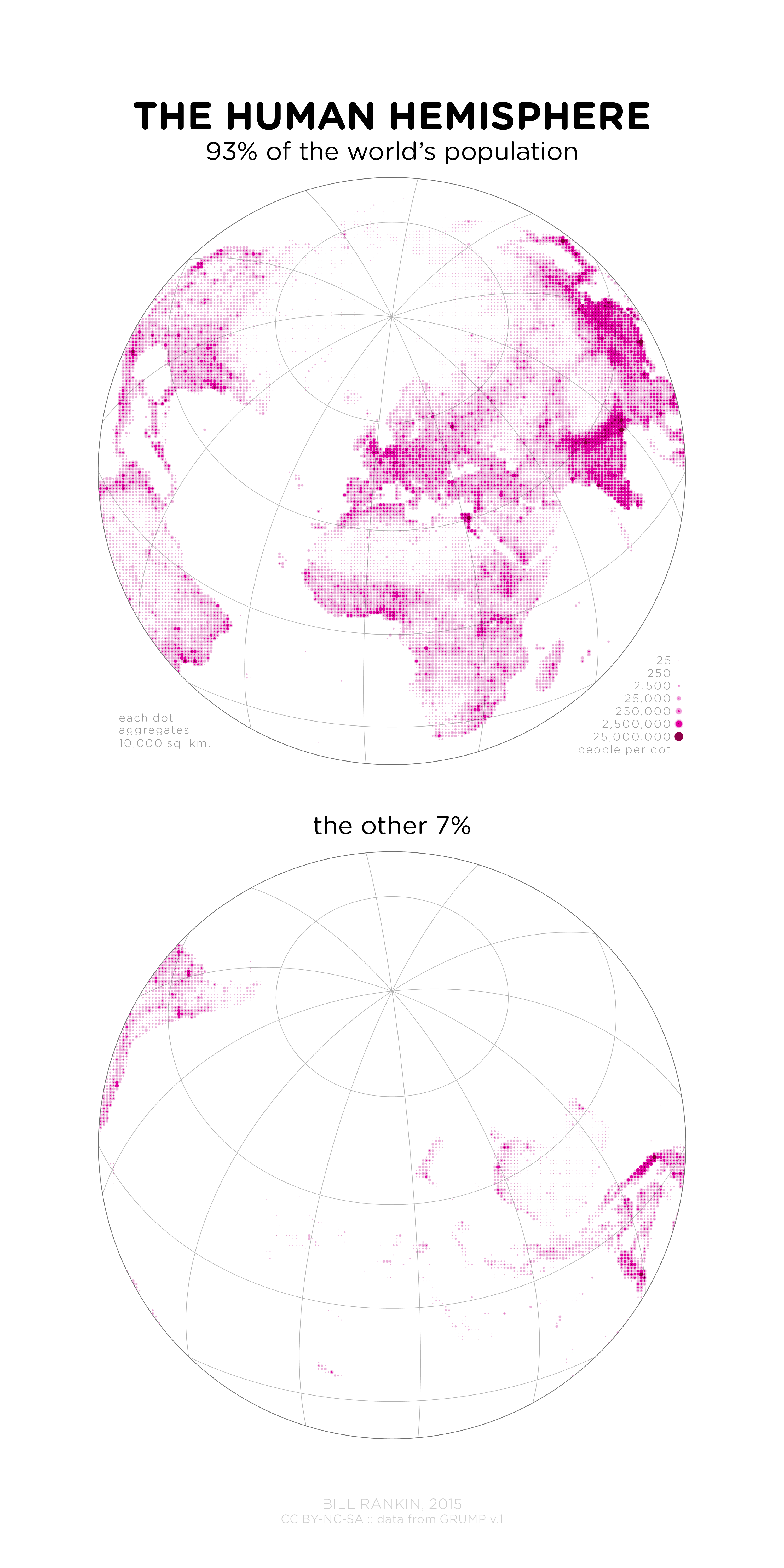
- 88% of humanity lives in the Northern Hemisphere.
- 82% lives in the Eastern Hemisphere.
- The maps above are very similar to the land and water hemispheres of the world.
- The map is not showing center of population, which is unknown globally but thought to be somewhere north of South Asia.
Finally, if you’ve wondered what’s on the other side of the world from you have a look at: Antipodes World Map & Why You Can’t Dig To China From The US.
Where Humans Can Live

To learn more about world population have a look at the following books:
- Sapiens: A Brief History of Humankind
- Rebuilding Earth: Designing Ecoconscious Habitats for Humans
- World Population Dynamics: An Introduction to Demography
- The Age of Migration: International Population Movements in the Modern World
- A Concise History of World Population
Find this post interesting? Then help us by sharing it:





Anthony says
I don’t understand why the center would be in Switzerland and not the center of population (north South Asia). What is the population of the hemisphere drawn from that center?
David Starner says
Why would the center be the center of population? You can move the center of population around by moving people around in the hemisphere, but this doesn’t affect the number of people in that hemisphere. The current hemisphere is almost identical to the hemisphere maximizing the amount of land; moving the center to the east would drop out highly-populated California and Mexico in exchange for unpopulated Pacific Ocean.
Joseph says
If the circle was a lot smaller that might be the case, because Europe is less populated than Asia, but because we’re dealing with a whole hemisphere, the centre doesn’t need to be near the very populated centre (north South Asia), it just needs to be within a hemispheres range of many very populated areas (including north South Asia). A hemisphere with its centre situated in Asia would include the billions of people living in China and India (and other Asian countries) very close to its centre, but this wouldn’t matter, because most of the hemisphere would be in pacific ocean, with practically no people. Switzerland on the other hand, while not right in the centre of the most populated general area (north South Asia), its whole hemisphere still includes Asia as a whole, Europe, and the highly dense areas in North America and Africa. The best spots for the centres of hemispheres (if you want the highest population) would probably be somewhere in between many very populated areas, so it can reach all of them at its fringes; and would not necessarily be in the centre of the most populated area (although Switzerland happens to be)
jewel says
i like it
Betterebee says
The Amazing Maps map of human habitat is certainly truly amazing in its depiction of New Zealand’s location, thousands of kilometres from reality in both latitude and longitude.